
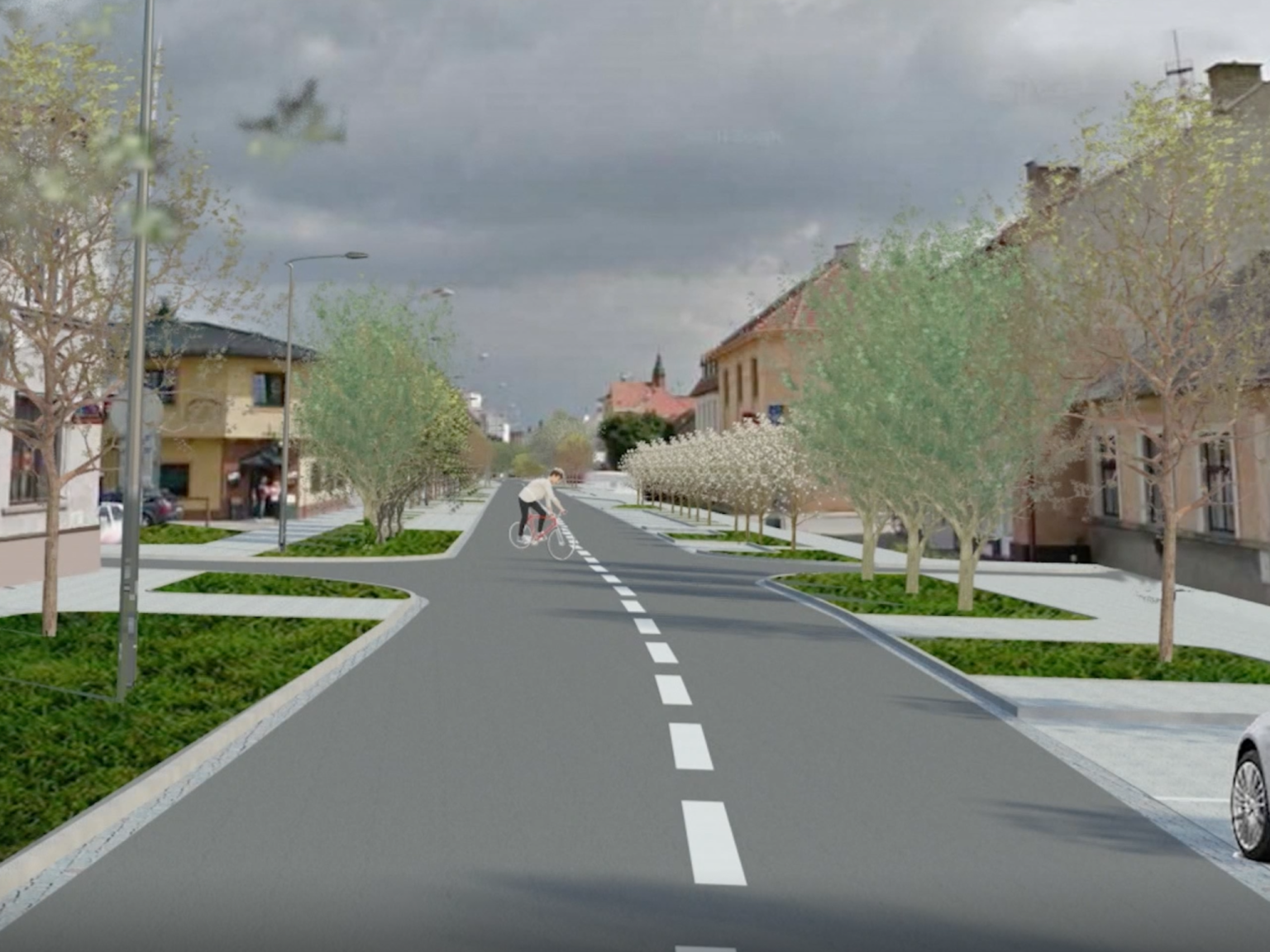
In the first week of July, a controversial news story made its way through the media: city councillors in Prostějov are calling for a ban on cyclists using Plumlovská Street — one of the city’s main thoroughfares for all types of transport.
Concerns over cyclists using Plumlovská Street have been voiced before. Arguments in favor of a ban seem to have gained traction following the street’s complete reconstruction, during which the roadway was narrowed. During peak hours, it becomes difficult — especially for trucks — to safely overtake cyclists riding on the road. This has now created a problem that will be hard to resolve. But at this stage, it’s really the result of past mistakes — specifically, the poorly executed 2019 street reconstruction.
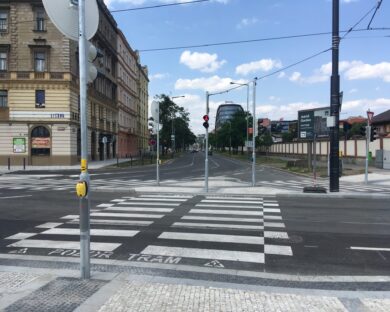
The reconstruction was fairly extensive. According to the documentation for the joint zoning and building permit, it also involved rerouting several utility lines. The designer therefore had a great deal of freedom in determining how to arrange the various functional elements of the street into a coherent whole. Space was found for comfortable sidewalks, green strips with trees, parking spaces, and bus stop bays. The only group left out entirely were the cyclists.
It’s striking how both designers and approving authorities often ignore basic requirements of Czech traffic design standards. For instance, ČSN 73 6110 — Design of Local Roads, which also applies to through sections of roads, states in the chapter on Traffic Design Principles that: “In the design of through road sections, conditions for all types of traffic — pedestrians, cyclists, public, individual automobile, and parking — must be balanced. Balance means redistributing traffic space in the interest of the safety of all traffic types, especially pedestrians and cyclists…”
The standard also specifies that: “…in reconstructions within limited space, favorable conditions must be created for each type of road user in the following order of priority: pedestrians, public transport, cyclists, motor vehicles.”
It seems that when it comes to cyclists‘ interests, some designers and approving authorities have no issue disregarding certain parts of the standards — while highlighting those that obstruct the development of effective cycling infrastructure. Yet many cities, including Prostějov, have an adopted Sustainable Urban Mobility Plan. One of its fundamental goals is to enable people to replace some short, everyday car trips with more sustainable forms of transport — such as walking or cycling. This, however, can only be achieved by creating direct, safe, and comfortable routes. With its flat terrain and short distances, Prostějov is an ideal city for active mobility.
City representatives argue that cyclists don’t have to use Plumlovská — they can instead take the cyclepath on nearby Melantrichova Street. Of course they can — and some already do. But it’s not a direct route, which makes it less comfortable and attractive. This helps explain why many people still choose Plumlovská, where numerous destinations for daily commutes are located. It’s hard to imagine someone arguing that pedestrians or cars shouldn’t be allowed access to all city streets. So why do designers and politicians so often assume that cyclists are some kind of special group who should only be allowed on designated routes?
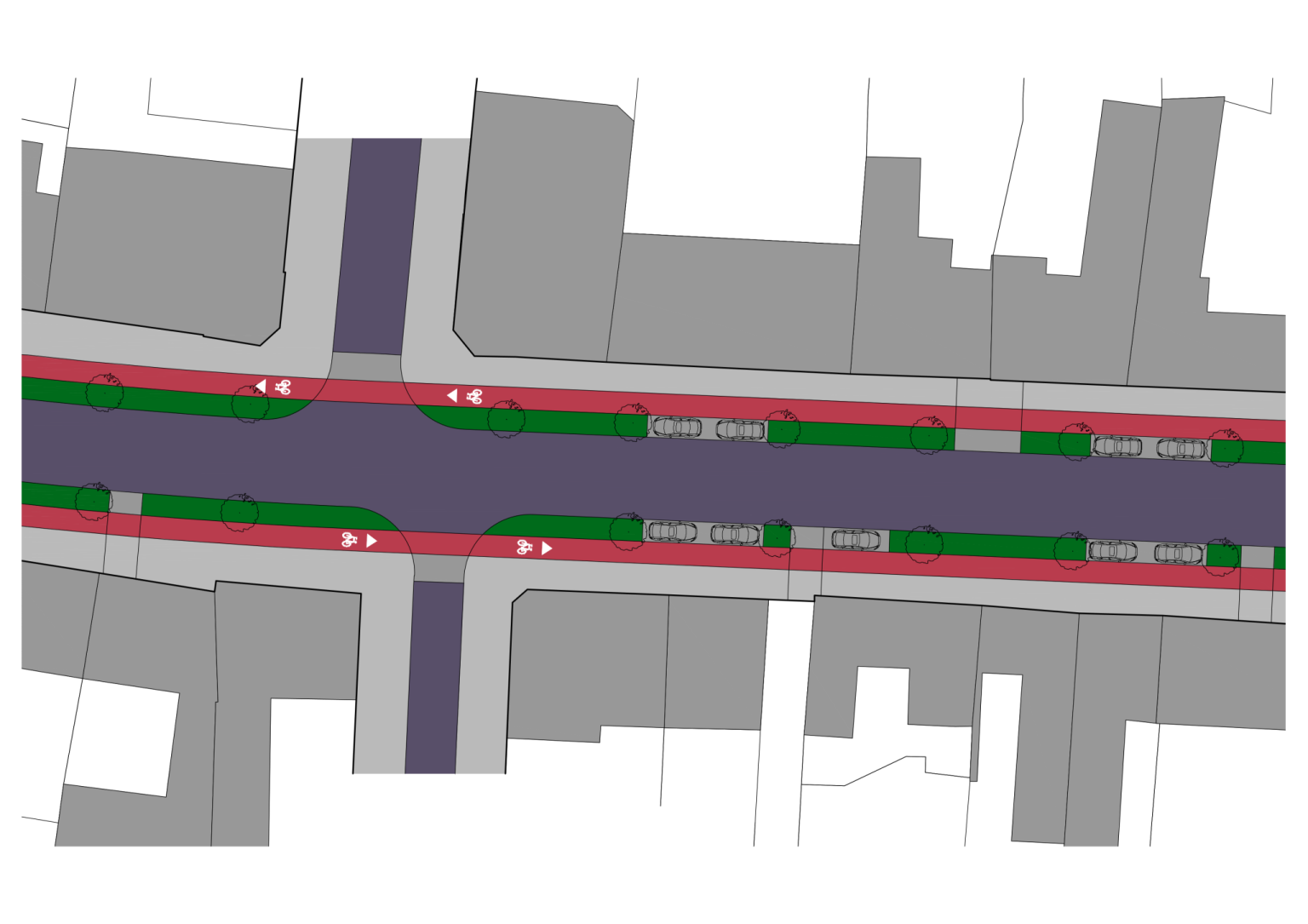
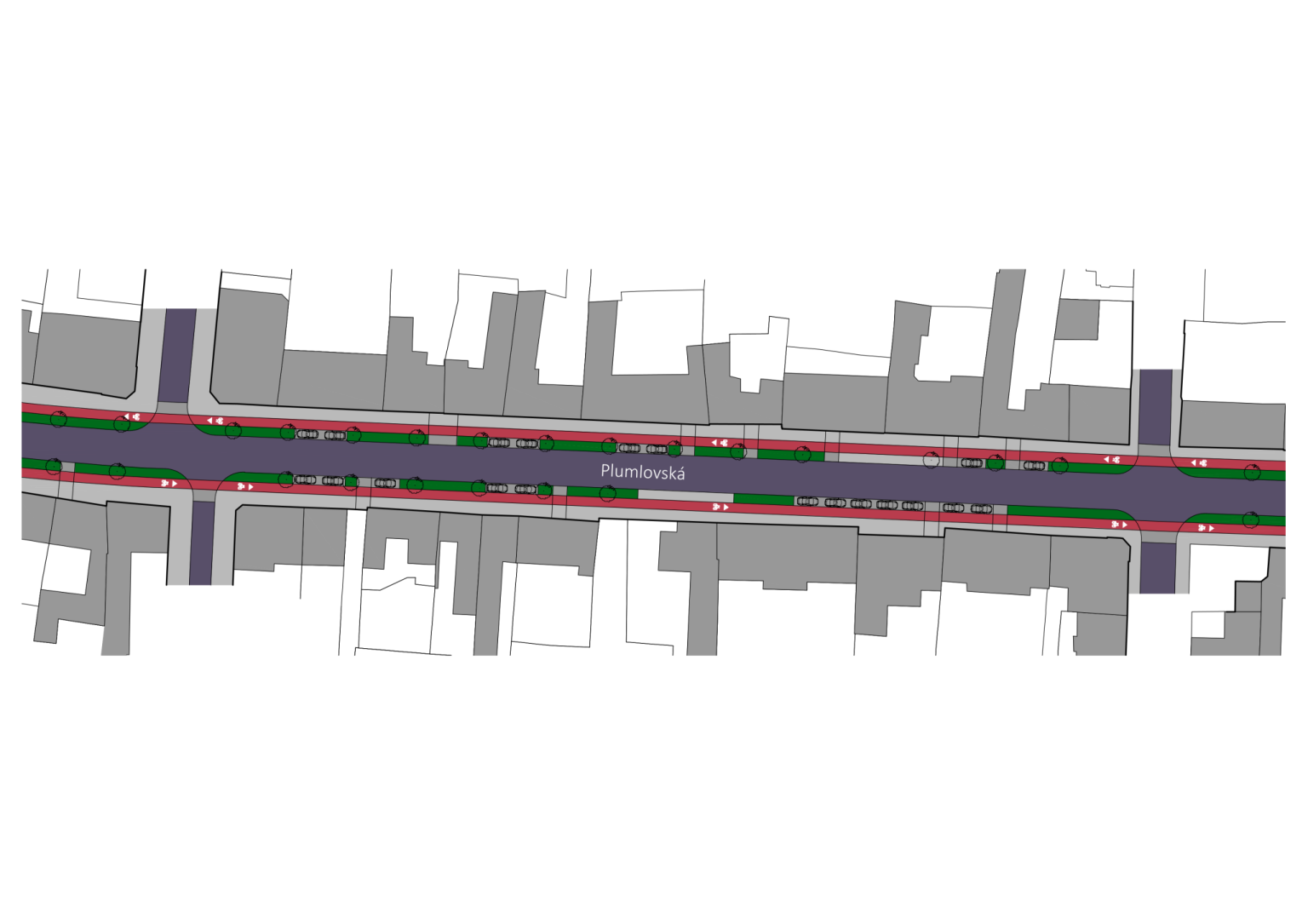
One of many alternative designs is shown on the map, illustrating how it would have been possible, during the reconstruction of Plumlovská, to create direct, comfortable, and safe infrastructure for everyone — including cyclists. This type of solution is already common in Prostějov, so it’s puzzling why it wasn’t used here. A two-meter-wide, one-way bike lane runs outside the parked cars. It can be separated from the sidewalk — which is a comfortable 2.5 meters wide — by a slight height difference. The strips alongside the roadway alternate between parallel parking spaces, trees, and bus stops. The road width remains at the current 7.5 meters, although this is arguably excessive for an urban through-road.
Another option would have been to run a bike lane directly in the carriageway. However, in such a case, it is not appropriate to include parking spaces — riding between moving cars on the left and parked cars on the right reduces comfort for many users and increases the risk of so-called dooring, i.e. colliding with a suddenly opened door of a parked vehicle.
Unfortunately, these design options are no longer feasible — the street would need to be extensively and expensively reconstructed again. Perhaps the only remaining option is to add narrow advisory bike lanes in the carriageway, with cars driving outside these lanes, and trucks and buses using the full width of the road. For such an arrangement, it would likely be necessary to reduce the maximum allowed speed to 30 km/h, which is reasonable for a half-kilometer section. If the speed limit were genuinely lowered and effectively enforced, the advisory lane might even be unnecessary.
The case of Plumlovská Street should serve as a warning and a lesson for other cities in the Czech Republic. Sustainable mobility must be planned in a comprehensive and responsible way. We cannot continue designing streets that reflect ideas from the 1970s.
Many thanks to one of our readers for this contribution! If you have a topic you’d like to see covered or discussed on Městem na kole, don’t hesitate to contact us at: redakce@mestemnakole.cz.
This is an adjusted machine translation using Automat’s CycleLingo Translator (ChatGPT) of this article: https://mestemnakole.cz/2025/07/komentar-zakaz-cyklistu-na-plumlovske-v-prostejove-je-vysledkem-spatne-prace-projektantu-i-mesta/
Líbil se Vám článek? Chcete v Česku lepší podmínky pro cyklodopravu?
Podpořte nás, stačí i 100 korun. 💙🚲
Vyberte prosím částku, poté budete přesmerováni na darujme.cz



komentář