
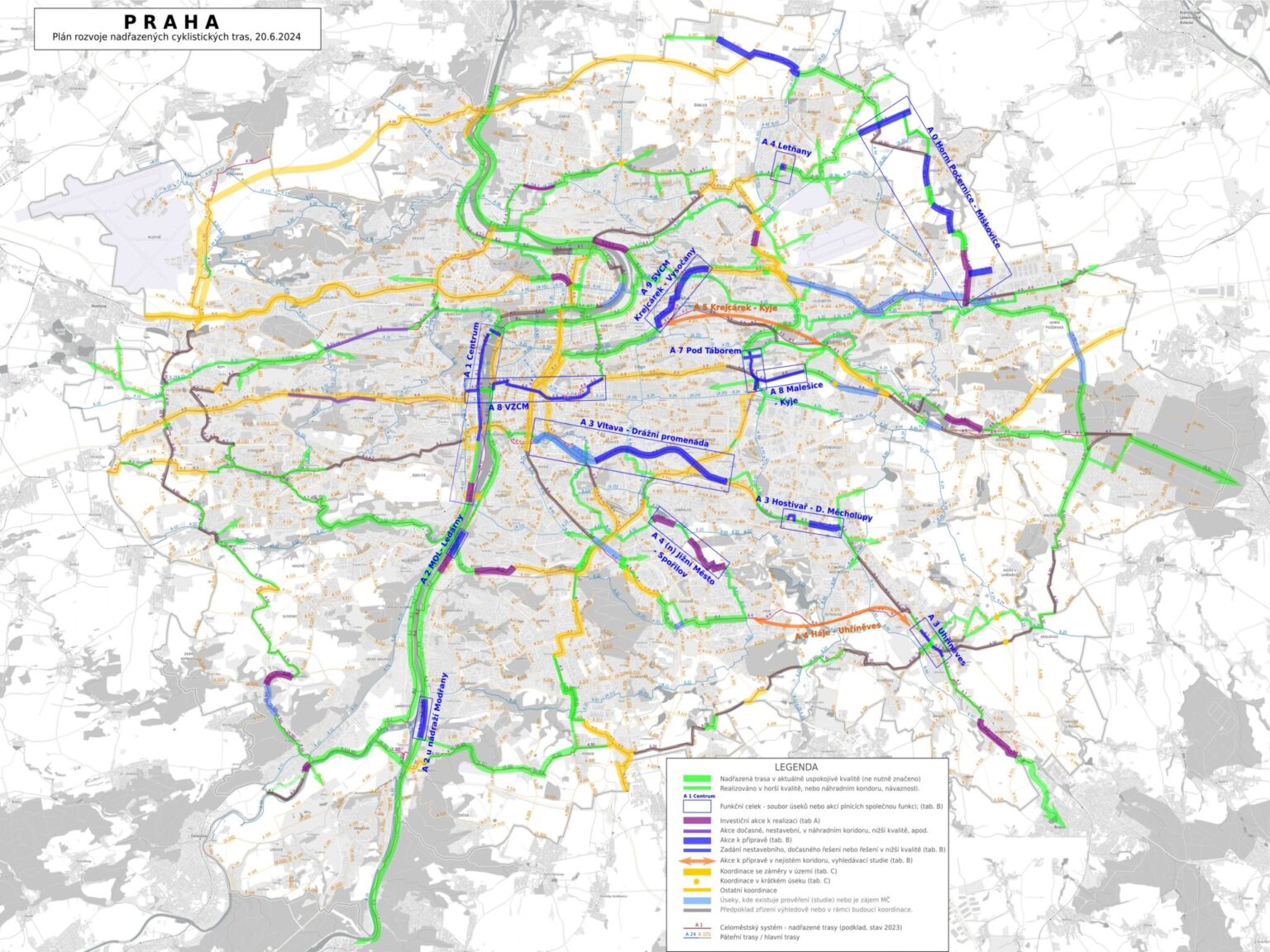
A continuation of the series on cycling infrastructure in Prague. Its development is an uphill battle, accompanied by stories filled with countless twists and turns. In this series, I would like to bring you closer to what I remember from almost twenty years—before I forget it completely.
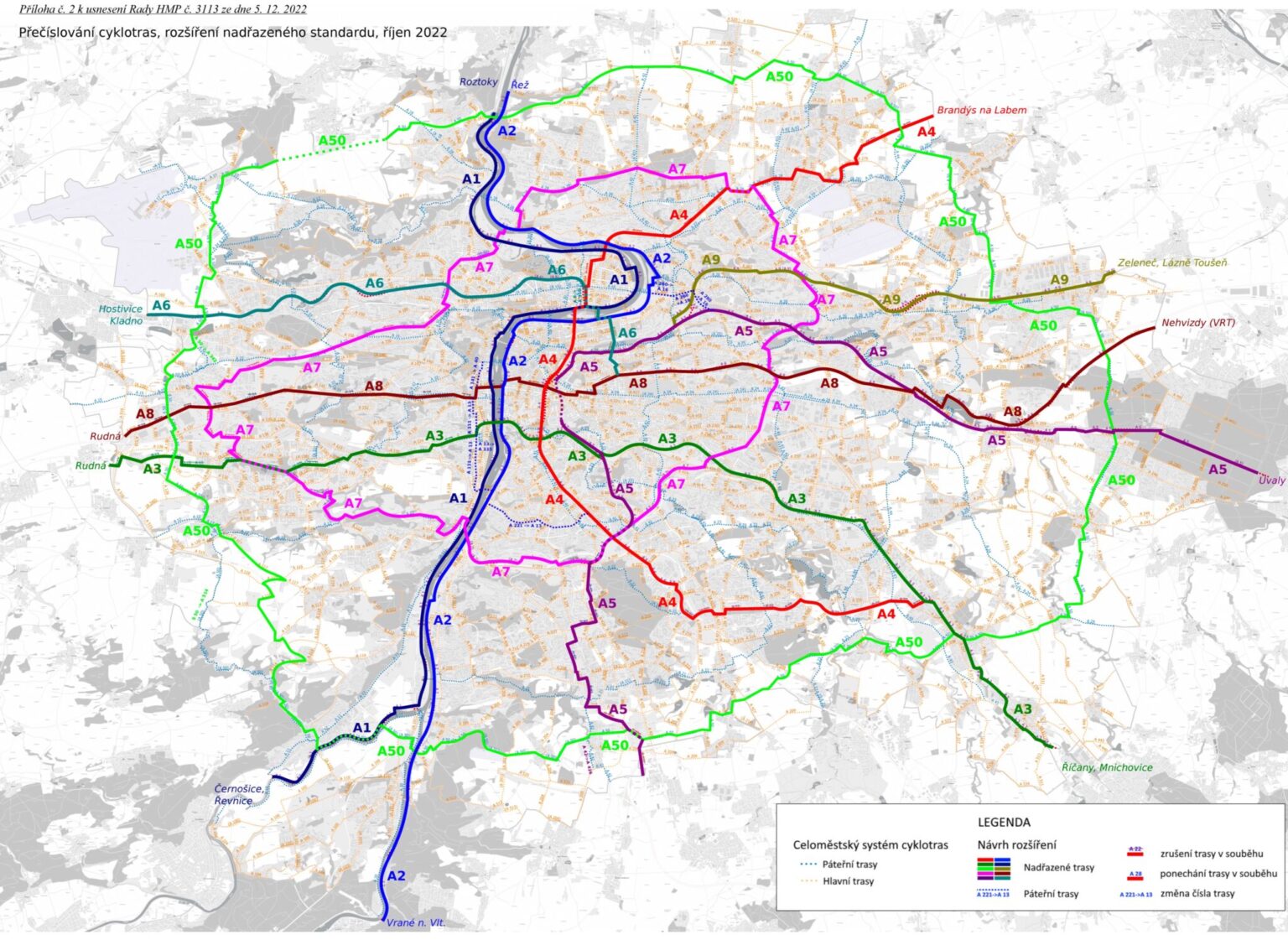
In the previous installment, I focused on the origin of the primary routes (A3 to A9 and A0). This article now focuses on the first steps of their implementation, particularly the developments during the current electoral term.
As mentioned last time, the citywide route system—split into primary, backbone, and main routes—along with the Active Mobility Standards, forms a fairly comprehensive framework. It clearly defines at a municipal level what kind of cycling infrastructure should be built and where.
However, the actual implementation of primary cycle routes lacks the momentum that accelerated the construction of the A2 route after 2006. During the 2018–2022 term, Deputy Mayor for Transportation Adam Scheinherr (Praha Sobě) commissioned a series of feasibility studies for sections of primary routes (such as the Nusle Rail Trail). For other longer-planned projects (the Northeast Cycle Superhighway, A3 Kolovraty), preparation was handled either by TSK (Technical Administration of Roads) or by individual municipal districts with city grant support.
By autumn 2022, plenty of plans were prepared, but nowhere were they concentrated enough for the incoming Deputy Mayor, Zdeněk Hřib (Pirates), to pick projects that could visibly advance a single primary route within a few years. Route A3 was considered, but even then it was clear that neither the Rail Promenade nor the Railway Bridge would be operational by 2026. This ruined the „wow factor“ of launching major works on the connecting section in Nusle and Vyšehrad, and the idea was dropped in the spring of 2023.
Under the new coalition constellation, continuing citywide route investments with design and preparation capacity largely outsourced to municipal districts was out of the question. A funding scheme designed to combine city hall and district resources—which would have provided reliable, long-term financing for walking and cycling infrastructure in line with the Sustainable Mobility Plan without major intervention from the Finance Councillor—was one of the first things stopped by the new Finance Councillor, Zdeněk Kovářík (ODS).
A feasible workaround had to be found to prevent cycling investment from grinding to a halt. The Finance Councillor’s neglectful approach set the first boundary: focusing exclusively on primary routes. Projects on backbone or main routes with promises of future city funding that districts had spent years preparing were tossed into the same pool as other district priorities (like education). Evaluating their merit was left to the whim of the city treasury keeper.
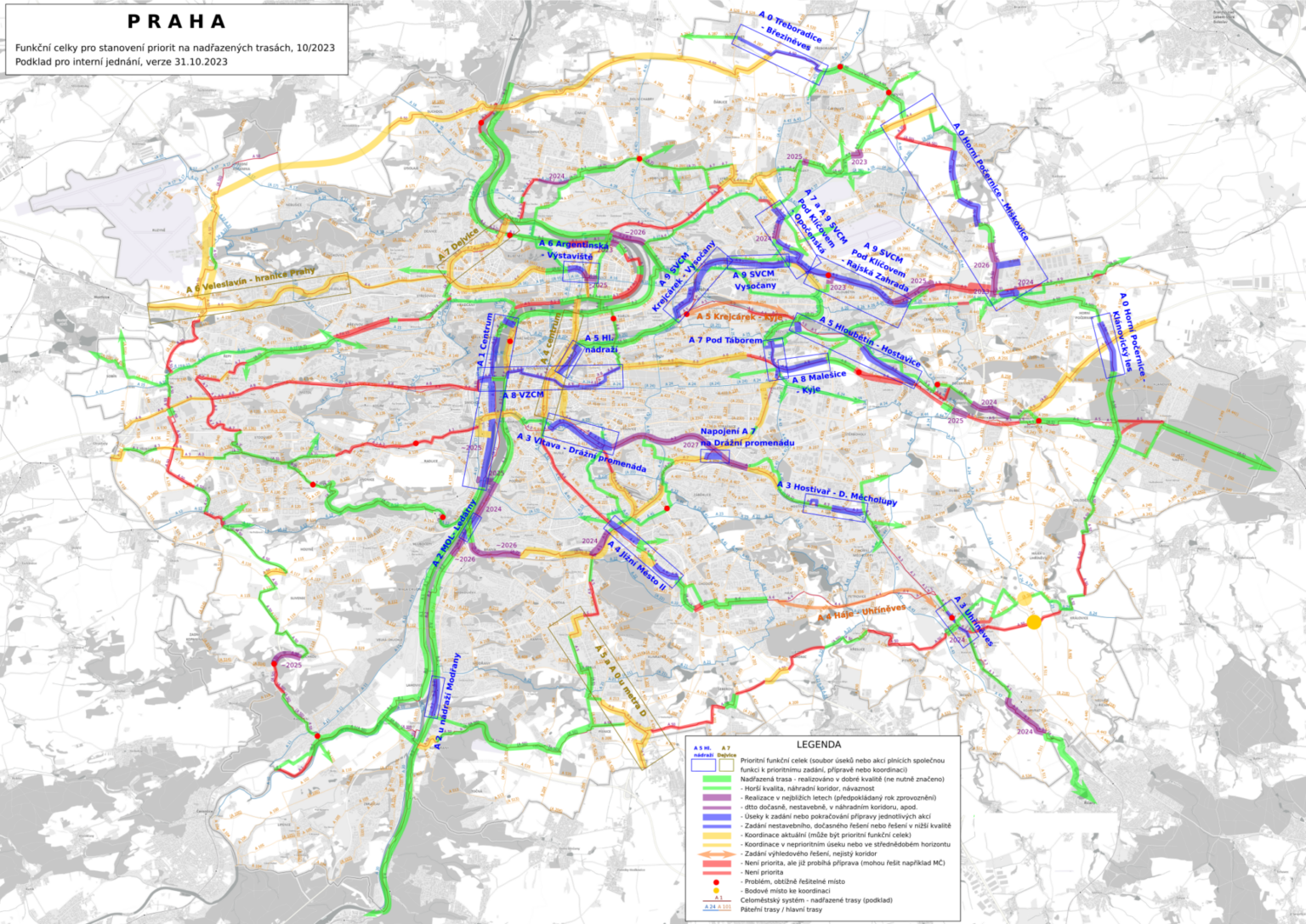
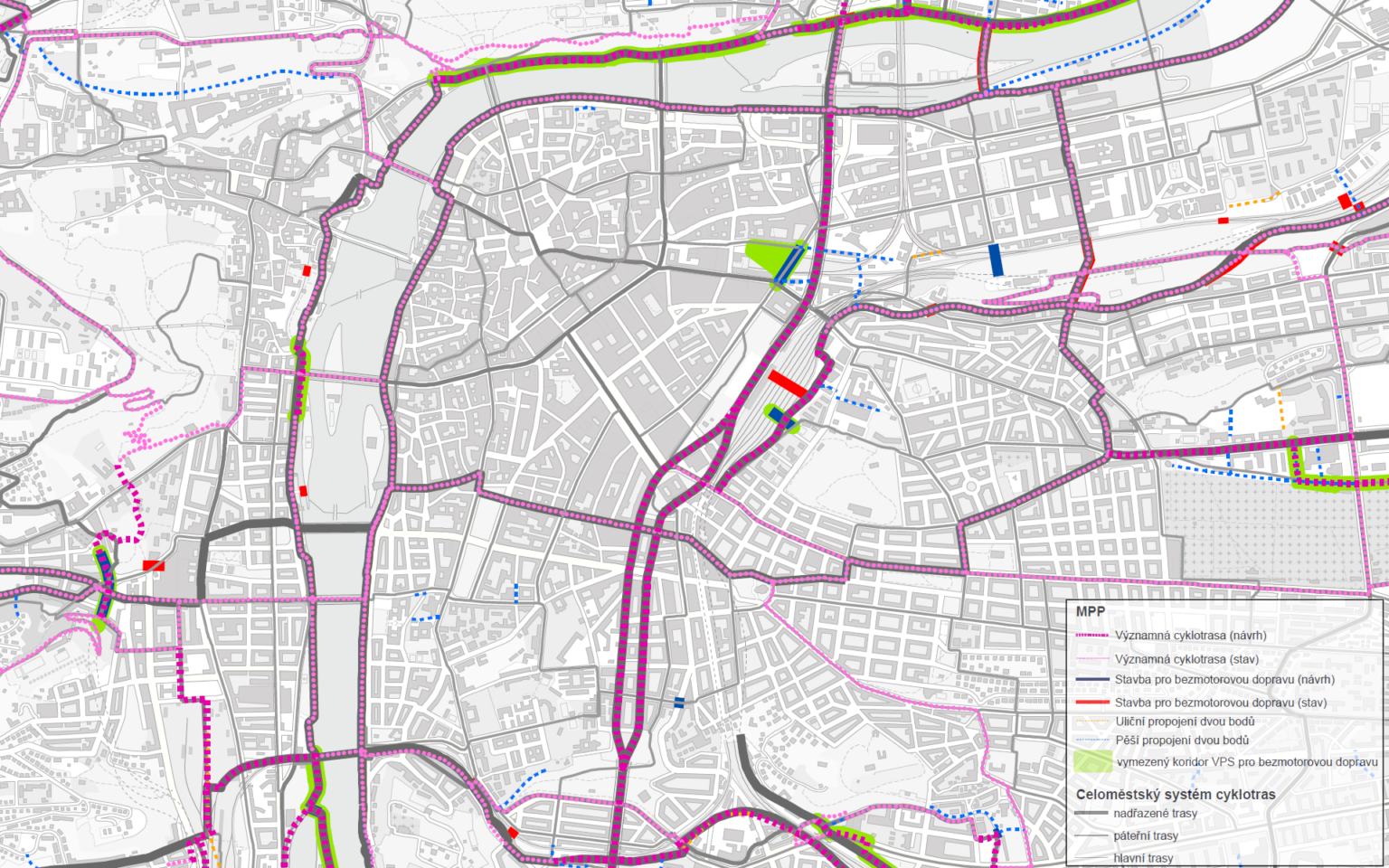
The Cycling Commission was tasked with managing this situation. Its working group evaluated all primary routes and drafted a proposal for so-called „functional units.“ These were intended to bridge gaps or create new sections long enough to boost local interest in cycling (see map below). The concept was submitted to the Prague City Council in October 2023.
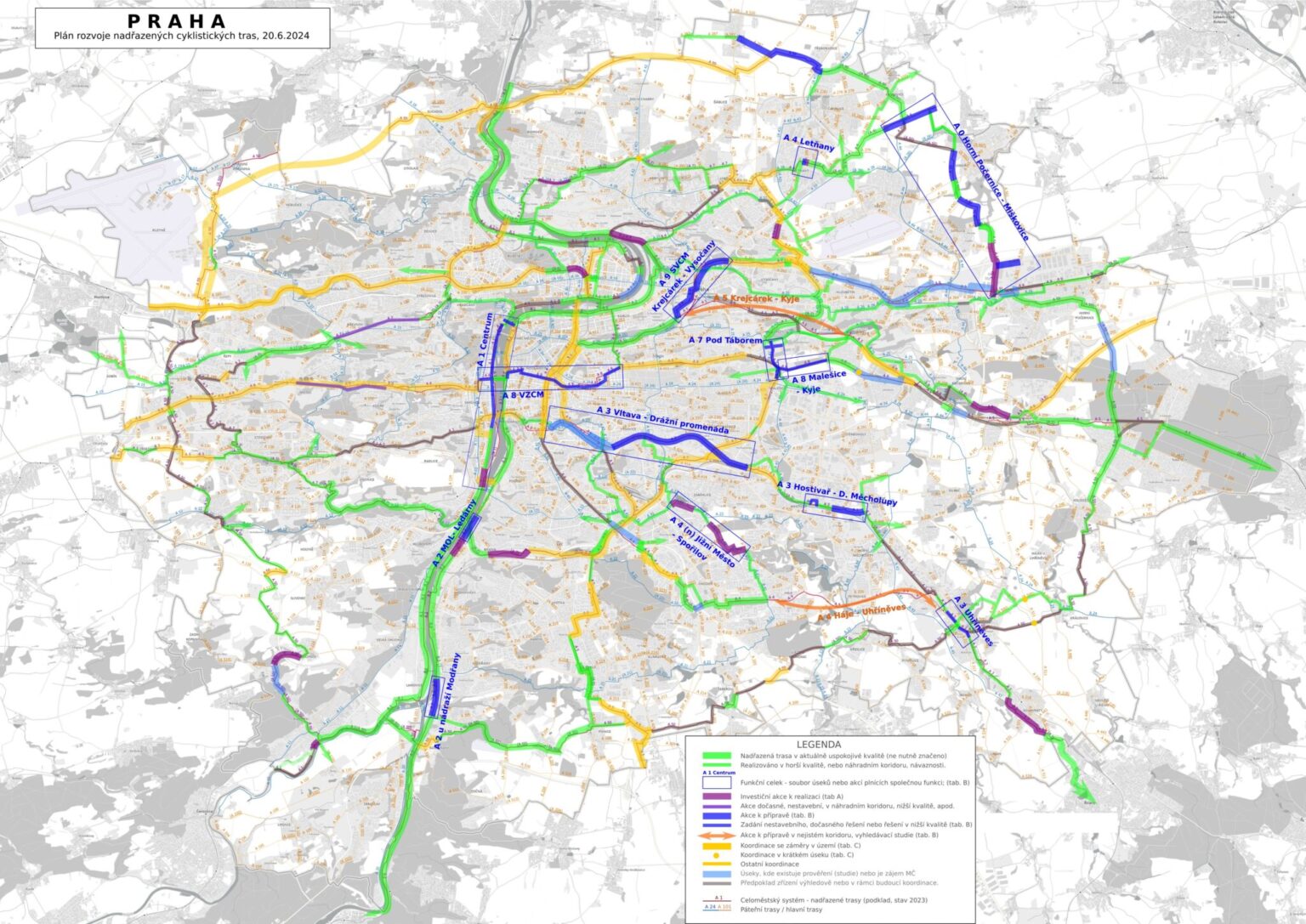
Ignoring the context of the Sustainable Mobility Plan’s Action Plan, the City Council did not approve the development plan through 2030 (derived from the functional units concept) until June 2024. And that only happened after Finance Councillor Zdeněk Kovářík (ODS) pushed a large portion of the investment projects past 2027 (see second map below).
Subsequently, automatic allocation of funds for these selected projects was blocked when ODS made the implementation of the mobility plan conditional on parking reform—a reform ODS has sabotaged ever since. As a result, Kovářík retained the power to allocate funds to individual projects on a piecemeal basis; a power he frequently used to withhold funding or delay financing by a year or more.
Councillor Kovářík also effectively halted the launch of new projects and studies by tightening the financial belt. Although TSK did not completely freeze projects already underway, it lacked the means to push them forward with any real intensity.
Since roughly 2023, the Cycling Commission had been requesting dedicated project managers („mandatáři“) at TSK whose sole job would be to manage preparation and coordinate primary routes. A cycling route preparation coordinator role partially fulfilling this function was finally filled in March 2026, though without significant authority inside or outside TSK.
Meanwhile, studies for rail trails commissioned by Petr Dolínek (ČSSD) and Adam Scheinherr (Praha Sobě) between 2015 and 2020 are mostly gathering dust. Delays on the Vršovice Rail Promenade show that these visions may soon become obsolete due to surrounding urban development.
Thus, the cycling-hostile electoral term of 2022–2026 in Prague managed once again to slow down what had been promising under Petr Dolínek (2014–2018) and Adam Scheinherr (2018–2022)—just as Karel Březina (ČSSD) derailed cycling progress following Pavel Bém’s two terms (ODS). While this may not be immediately obvious from a dip in completed projects—things are, after all, still being built—the real setback lies in delayed preparation. The full impact of this slowdown will become apparent over the next five to ten years.
All the while, Kovářík sits on the largest pile of unused capital reserves in the city’s history. One can only surmise that by stifling sustainable mobility and other investments, he is quietly saving up for the completion of the City Ring Road. Its real obstacle is not the current lack of a building permit, but rather its projected 200-billion-CZK price tag. Completing the City Ring Road will almost certainly deliver a biblical blow to Prague’s budget—seven lean years, much like the Blanka Tunnel did between 2008 and 2015. Saving in advance is necessary, and what developments are better to cut than sustainable mobility and pedestrian safety?
What is left to mention is the relationship between primary cycle routes and the recently approved Metropolitan Plan. The inclusion of cycle routes in the Metropolitan Plan is critical: unlike the citywide system and standards, which city institutions are merely supposed to respect (with no consequences for non-compliance), the spatial plan is legally binding for everyone.
The Metropolitan Plan mostly incorporates the primary routes, though in certain sections it proposes different corridors—some better, others unfortunately less advantageous in terms of alignment and gradient. Still, the core framework of the cycle route transport system is present in the land-use plan. It could have been better, but considering earlier drafts, it could also have been much worse.
Primary cycle routes were created with a vision: to become high-quality corridors widely recognized by the public. Except for the historic A2 route, this vision has not yet been realized. The routes remain lines on a map rather than distinct physical entities on the ground. Upgrading them into a recognizable „transport product“—akin to a metro or tram line—is an essential prerequisite for high-quality execution and public understanding, including among non-cyclists.
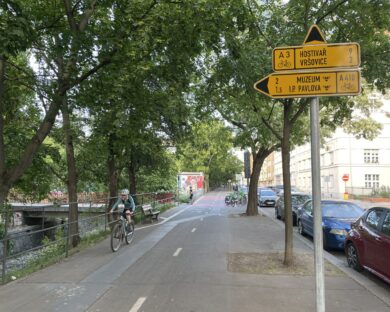
Yellow signs on a shared path do not constitute a product that primary routes can—or should—be. Quality standards go beyond path width or separation from pedestrians. They require distinct surface coloring, custom way-finding, junction maps, distance markers, and dedicated cycling amenities.
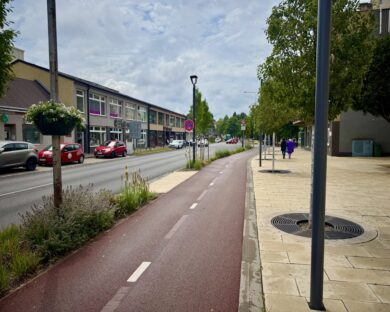
Making primary cycle routes prominent features of the city may draw criticism from those who oppose cycling in Prague. Yet this is precisely how to unlock the full potential of these core routes. Upgrades to the A2 route featuring red asphalt point the way forward, but for everything else, the city is still at square one.
Primary cycle routes arose out of the necessity to bridge known shortcomings in the citywide system. They were conceived between the approval of Prague’s Sustainable Mobility Plan and the Active Mobility Strategy, at a time when cycle route planning in draft spatial plans ignored cycling needs and felt like a step back to the 1990s. Primary routes were also developed outside IPR’s (Institute of Planning and Development) traditional transport planning department.
The network layout of primary routes is not perfect. Many sections need further study or integration with routes in the Metropolitan Plan. Their preparation needs re-prioritizing. Nevertheless, primary routes remain a valuable foundation for a network of functional cycle routes that Prague simply must have to ensure decent riding conditions—hills or no hills, politics or no politics.
In upcoming articles, we will set aside visionary thinking and plunge back into the marshes of preparing these potential lifesavers for Prague’s stagnant cycling infrastructure, starting step by step with route A3.
Líbil se Vám článek? Chcete v Česku lepší podmínky pro cyklodopravu?
Podpořte nás, stačí i 100 korun. 💙🚲
Vyberte prosím částku, poté budete přesmerováni na darujme.cz



komentář