

After a brief hiatus, I am resuming the series on cycling infrastructure in Prague. Its development has been painstaking, marked by stories full of endless twists and turns. In this series, I would like to share what I remember from almost twenty years of involvement—before I forget it completely.
Attention turned to the inner Holešovice bend only in recent years. From the perspective of long-distance routes, this section carries little significance: traveling from the city center to Sedlec via Dukelských hrdinů Street is three kilometers shorter (and six kilometers shorter via Bubeneč). Furthermore, solid cycling infrastructure now exists along the „chord“ of this bend on Argentinská Street.
Gradually, however, work has progressed on cycle paths here as well, with new sections built heading upstream along the Vltava after 2020. The path along Holešovické nábřeží dates back to 2023, followed by the path in Park U Vody in 2024. A segment of path on Sanderova Street has been around for some time, and new real estate developments in the former Holešovice port also account for cycling infrastructure. A footbridge crossing the Vltava’s dead-end river arm toward Na Maninách Street is planned as well.
It is not all smooth sailing, however. A lack of cooperation from certain developers—combined with the city’s inability to reach agreements with them—means cycle route A1 will have to run partially along Jankovcova Street, a relatively busy thoroughfare where a protected path is unlikely to materialize anytime soon. Similarly, you will not find a continuous path in the park south of Libeň Bridge yet, though the existing paths (where rideable) have reportedly been legalized for cycling.
While Holešovické nábřeží has boasted a high-quality path since 2023 and Stromovka itself was always passable along the river, the gap leading to Za elektrárnou Street has remained wide open since at least 2013—when crossing the new Troja Bridge from Stromovka to the opposite bank first became a practical option.
In 2015, a few friends and I cleared the mud off the footpath to make it somewhat easier to ride on. Meanwhile, the Technical Administration of Roadways (TSK) was preparing a formal cycle path project. That effort stalled, first for years due to an access road required for the wastewater treatment plant reconstruction, and after 2020 due to conflicting visions over the route’s alignment.
The superior option directly along the waterfront was opposed by Lenka Burgerová (Praha Sobě), the Prague 7 district councilor for urban development. She preferred a two-meter-wide crushed-stone path along the water reserved for strollers, wanting to divert cyclists along the elevated railway tracks instead—a detour involving a ten-meter redundant elevation change. This proposal was non-viable for two reasons: cyclists would have used the lower path anyway, and the Railway Administration had no intention of allowing cyclists onto the upper route (whereas the Vltava River Basin authority down by the water was far more cooperative). Thus, while design work and construction progressed along Holešovické nábřeží and in Park U Vody, the section leading to Stromovka ground to a complete halt.
This deadlock was finally broken by the Vltava River Basin authority itself. In 2024, they overhauled their waterfront embankment, restoring it as a towpath surfaced with exposed, impassable gravel—effectively scuttling the district council’s localized vision. Prague City Hall then stepped in, initiating intensive negotiations with the river authority’s management alongside Pavel Polák, a veteran advocate for Prague cycling, who successfully brokered a crucial agreement. According to updates from spring 2026, TSK is currently designing a cycle path overlay above the towpath, mirroring the design used across many kilometers of route A2 on the opposite bank.
On Za elektrárnou Street, plans to separate motorized and non-motorized traffic are currently limited to non-structural measures via road signs and traffic control devices, though progress remains very slow. Conditions threaten to worsen near the bridge to Císařský Island: the bridge is scheduled to be raised, making a bypass impossible. Even if you want to stay along the river, you will have to ride ten meters up and down in a shared traffic space alongside cars and heavy trucks.
Between Za Císařským mlýnem and Papírenská streets, cyclists prior to 2011 had to climb over the hill above the redeveloped Císařský Mlýn complex or ride through its grounds—where owners are required by occupancy permits to allow pedestrian passage, but routinely block the public from doing so. A singletrack along the water was constructed as a low-cost solution (costing under one million CZK) and has served riders for over a decade—provided you are comfortable riding right alongside the river, and the path is not covered in ice sloping toward the water.
In the wastewater treatment plant area, a new footbridge over the Vltava toward the Prague Zoo is currently in planning, designated to carry the future radial route A7. More on that another time.
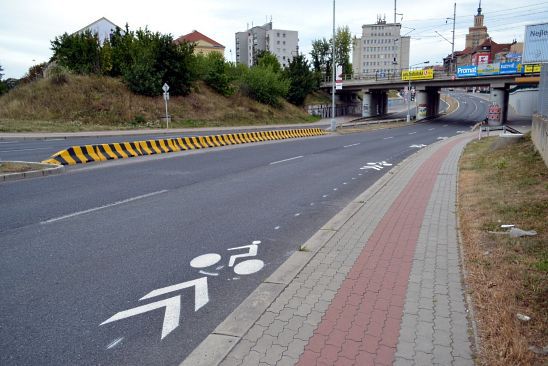
The four-lane expansion of Podbabská and Roztocká streets—complete with bidirectional sidewalks featuring color-differentiated paving to suggest cycling suitability—was finished in 2001. The eastern sidewalk was designated as a shared pedestrian and cycle path, notorious among riders for its abrupt dips at several driveway entrances. For a long time, legal cycle access ended abruptly near the Roztocká bus stop; resolving this gap took years of effort. The extremely narrow western sidewalk heading into the center may have been intended for legal cycling (as hinted by a strip of pink paving), but this was never formally designated, or was short-lived at best.
Despite these gaps, a dedicated cycle path through the park extending all the way to the Sedlec ferry had already been completed as early as 2006.
It was not until 2011 that the missing gap was connected by a structurally complex section cut into the slope beneath Roztocká Street. The city chose an expensive yet half-hearted solution. At the time, its high construction costs—alongside the Rokytka path—were used as a pretext to halt the promising momentum of Prague’s cycling infrastructure development. Amid the lingering effects of the 2009 financial crisis, with municipal funds being swallowed by the bottomless pit of the Blanka Tunnel project, the city needed a justification to cut funding for cycle paths: a price tag of 18 million CZK for a quarter-kilometer path served that purpose perfectly.
Cycle route A1, completed in 2006, terminates in the north at the Sedlec ferry. Beyond the Prague city limits, the route continues along a local road toward Roztoky, featuring a one-kilometer stretch suited only for the faint of heart. High investment costs have crushed any immediate prospect of extending the cycle path here. A study proposing an elevated viaduct running alongside the existing road carried a price tag of 400 million CZK at prices from a decade ago.
More cost-effective options—such as a steel-grate walkway similar to the Vít Branda Footbridge in Kadaň or the structure suspended beneath the Prague Ring Road in Komořany—were never evaluated. Instead, stakeholders waited to see how the piers of the future Prague Ring Road bridge would affect the valley. However, current designs leave the existing road unchanged. When Prague and the Central Bohemian Region will step up to humanize this unpleasant section remains entirely up in the air. A footbridge replacing the ferry at Klecánky may well arrive first—though for anyone commuting from Roztoky to the center, that detour adds three kilometers to the ride.
Future installments in this series will focus on more recently designated cycle routes, starting with Route A3. This will require a brief interlude covering the evolution of Prague’s cycle route numbering system since around 2000, tracing how it led to today’s vision for primary radial routes—and the largely futile efforts to brand them effectively.
This is an adjusted machine translation using Gemini of this article: https://mestemnakole.cz/2026/08/vzpominani-na-prazske-cyklotrasy-9-levobrezni-cyklotrasa-a-1-od-holesovic-dal/
Líbil se Vám článek? Chcete v Česku lepší podmínky pro cyklodopravu?
Podpořte nás, stačí i 100 korun. 💙🚲
Vyberte prosím částku, poté budete přesmerováni na darujme.cz



komentář