
I have been interested in the development of cycling infrastructure in Prague since roughly 2007. Its evolution is arduous, accompanied by stories full of countless twists and turns. In this series, I would like to share what I remember from those nearly twenty years—before I forget it entirely. I welcome any corrections to potential errors or inaccuracies in the comments.
Where is the most controversial street in Prague today from a cycling perspective? Is it some arterial road where a cyclist would be afraid to ride? Not at all. The section of street whose cycling solution has seen perhaps the longest-running dispute has five houses, is 56 meters long, and offers a total of twenty parking spaces. That is how I wrote about Šeříková Street back in 2013.
The effort to allow two-way cycling in this small street—through which more cyclists rode illegally against the traffic for years than cars rode along it—dragged on for a long fourteen years. It wasn’t until September 20, 2019, that the contraflow cycle lane was finally established.
I have already told the full story of how this became successful. You’ll find everything in it: broken promises, the „cycling terrorist“ rhetoric of Mayor Lomecký, the drafting of nine project variants that Councilor Veselý didn’t like anyway, and the demand to maintain a 50 km/h speed limit in a 56-meter-long street ending in a triangle intersection.
What you won’t find there are the rumors that reached me: that the contraflow lane was allegedly blocked most by an influential resident with ties to the town hall who simply didn’t want cyclists there at any cost. However, when Prague 5 legalized two-way cycling for the opposite block of Šeříková in 2018—where the roadway was half a meter narrower—the resistance from Prague 1 became laughable. Even so, the contraflow lane was only realized after the anti-cycling leadership of the time left office following elections and the local coalition briefly turned into a more tolerant one.
Today, no one is surprised by the contraflow cycling in Šeříková. Not a single accident involving a cyclist has been recorded in the lane itself or at the adjacent intersections since its establishment. Furthermore, contraflow cycle lanes are now commonly established in Prague on roadways even narrower than the straight four meters found in Šeříková.
Kampa Park has always been a closely watched cycling transit point, chosen by many cyclists who would use the right-bank A2 route if it were not for the poor conditions on Smetanovo nábřeží. The busy sidewalks in the park were quite prone to conflicts with cycling. Starting around 2011, a revitalization project for Kampa was prepared, which included widening the main path by about six meters to include a cycle path.
This proposal met with strong resistance from locals, for whom widening the path meant both an undesirable encroachment on green space and a fear of cyclists „running wild“ if they had a clearly designated space. Locals requested smaller interventions in the greenery and requested that a separate cycle path not be established, while still maintaining the possibility of riding a bike.
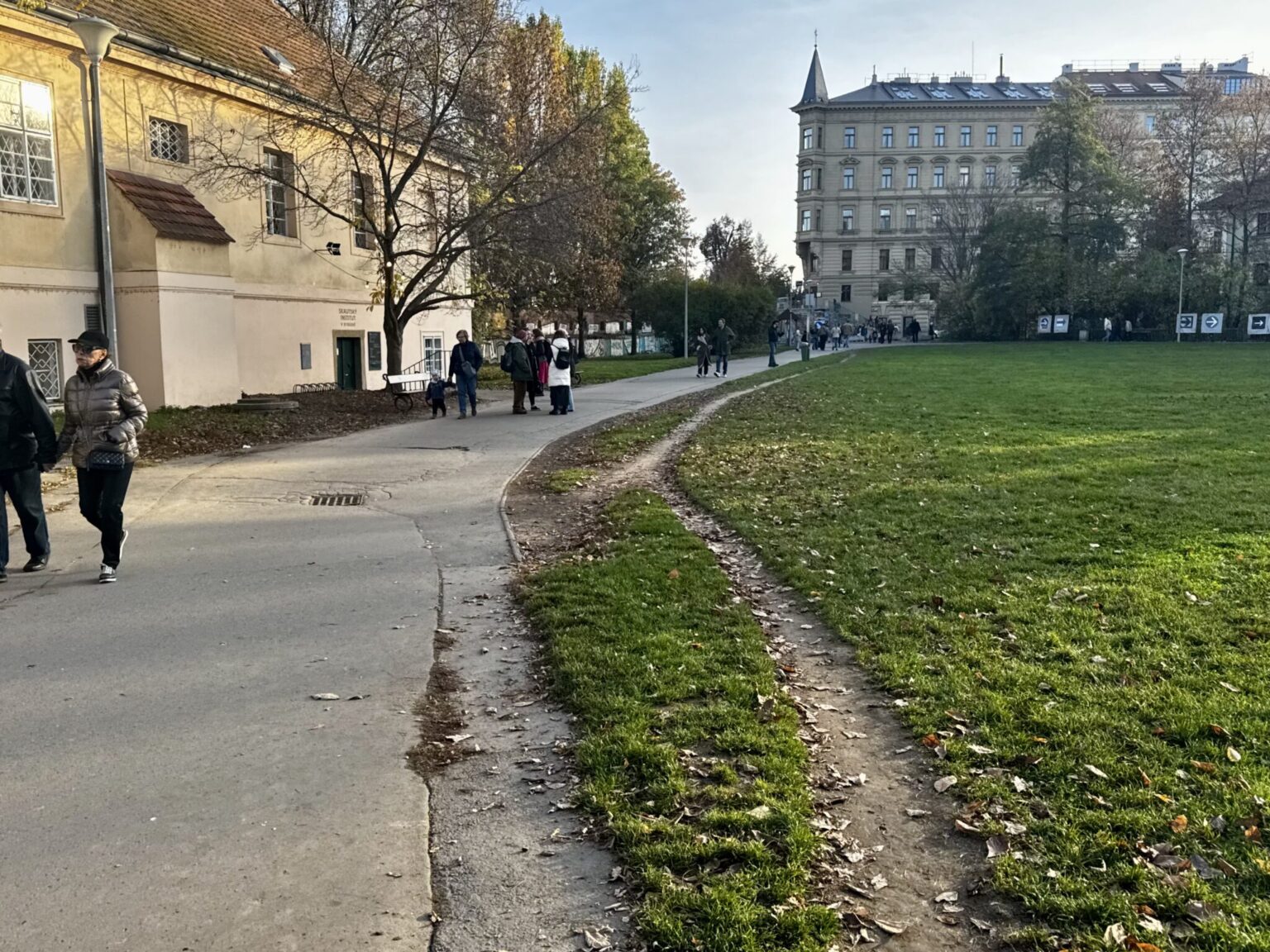
This was followed by an over-the-top move by Councilor for Transport Veselý, who (based on alleged complaints) had cycling through Kampa banned entirely. The AutoMat association subsequently supported a March 2014 proposal by KC Kampa and asked the town hall to maintain shared but calmed cycling traffic. An appeal to preserve the transit route was signed by 150 people on the Cyklisté sobě website. The ban was rescinded after a few weeks, albeit somewhat conditionally. Thus, a 10 km/h speed limit was established, which remains in effect today. The coexistence of cyclists and pedestrians has improved over time as the standard is now for cyclists to use the dirt track worn in along the sidewalk in the southern part of the park.
After the 2022 elections, the district returned to the postponed park revitalization project. The traffic solution was consulted with IPR and AutoMat experts, and in 2024, the town hall decided that cycling traffic would not be separated from pedestrians. This year, the district is tendering a contractor.
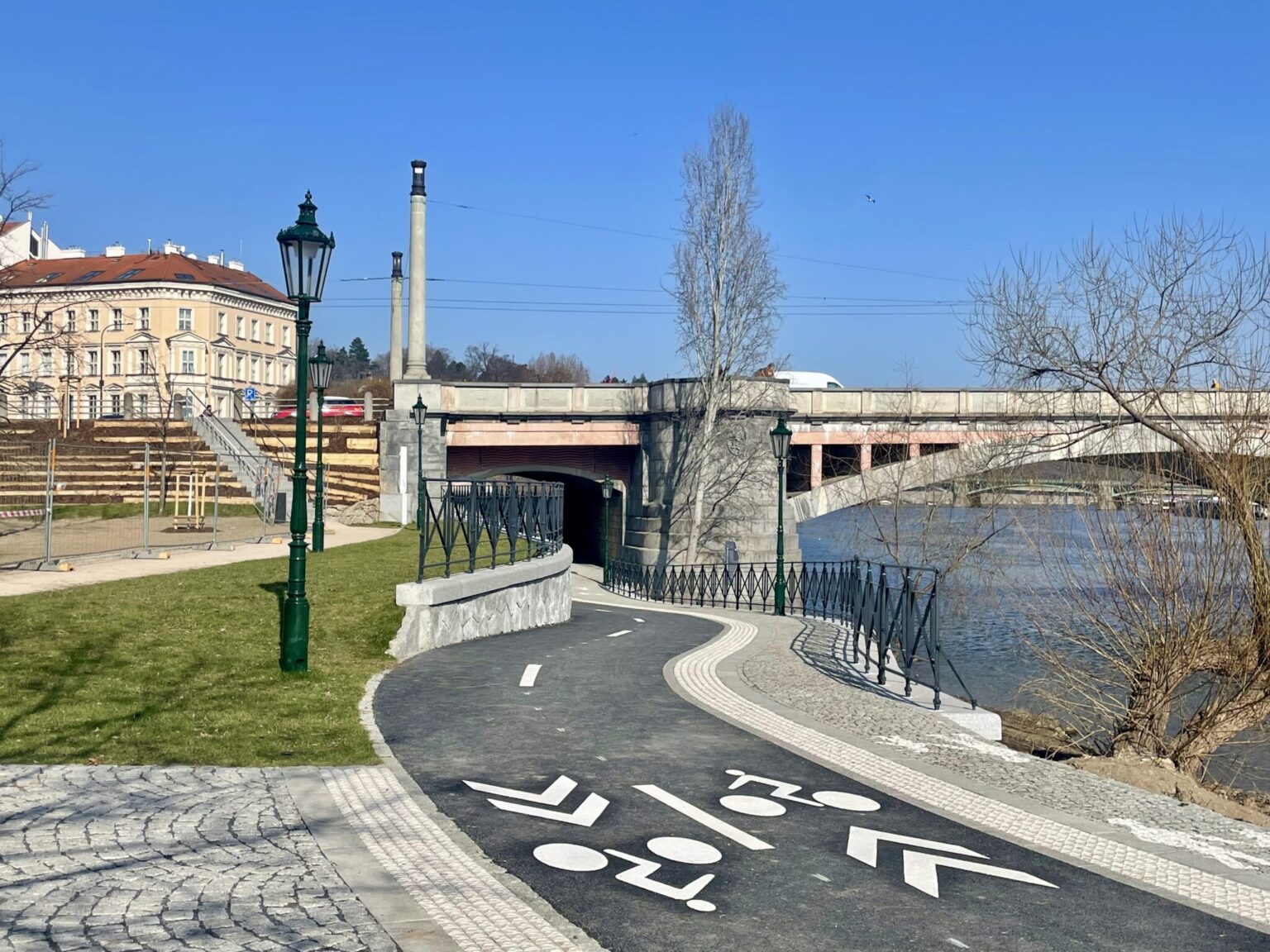
The separate path under Mánes Bridge feels like a fairy tale from a completely different city. It was opened in two stages in 2022 (the city-managed section) and 2023 (the section in the park prepared by the district).
The small tunnel under the Mánes Bridge, though inaccessible to the public, has existed since the bridge was built. The idea to establish this underpass is attributed to Pavel Polák, the long-time Prague cycling coordinator; in any case, he deserves great credit for preparing the plan, which was already underway in 2008.
Around 2010, the documentation for the planning permit was rejected by the district, and further negotiations were halted by the reduction of cycling funds in 2012. In 2018, Adam Scheinherr brought the project back to the table, and coordination was successfully arranged with the revitalization of Cihelná Park, carried out by the district.
The underpass eliminates the difficult crossing of the Klárov and Letenská intersection toward U Lužického semináře street, which is prohibited from the Mánes Bridge and where one must walk the bike across the pedestrian/cycle crossing. Even in the opposite direction, riding onto the Mánes Bridge has become more comfortable. This is important because the corridor of the A1 route continues along the Vltava in a rather uncomfortable manner.
Returning a bit to the south, a similar underpass is also being considered under the Legion Bridge (most Legií). This would allow route A1 to avoid Šeříková, the crossing with Vítězná, and half of Kampa Park, which would be very beneficial for both pedestrians and cyclists. The plan is being vetted by IPR, but feasibility is very uncertain.
While the contraflow cycle lane on Kosárkovo nábřeží is a pleasant part of the A1 route in the center, coming from the south we end up on Nábřeží Edvarda Beneše, which is very, very far from pleasant. The A1 Route basically ends here with a steep climb to Letná near the Hanavský Pavilion; incidentally, this is where long-distance route 2 historically led.
The connecting viaduct of Nábřeží Edvarda Beneše was designed as a four-lane road with a shared tram track and a minimal sidewalk. The Čechův and Štefánikův bridges are bypassed by underpasses when heading from the center, which serve as parking for tourist buses. A continuous cycle path would only fit if this parking is simultaneously removed.
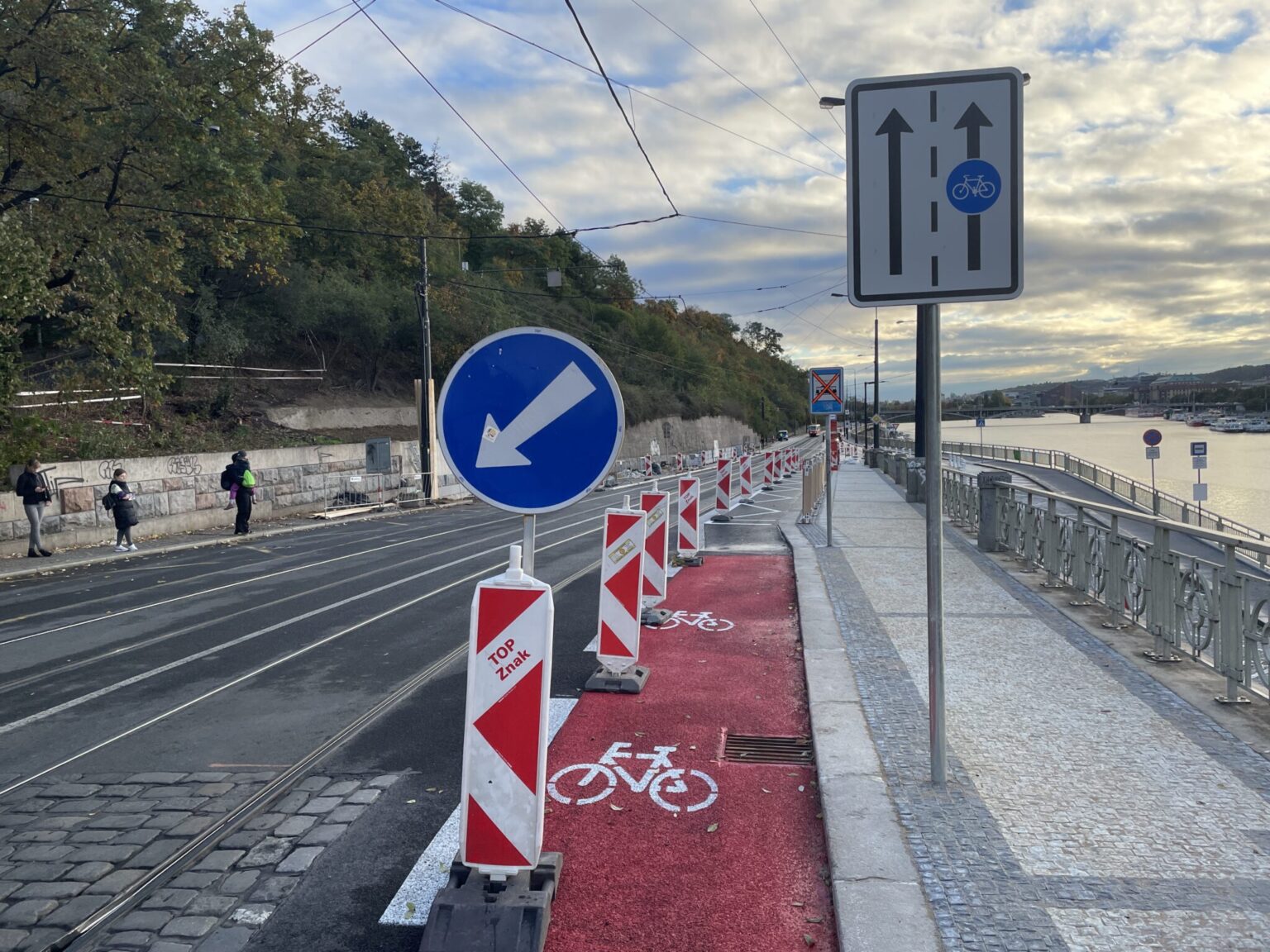
The reconstruction of the tram line on the embankment did not lead to the creation of a path off the roadway, but it did at least offer a cycle lane heading away from the center. This could perhaps be used in the future for a two-way path at sidewalk level. The second-ever „Vienna-style“ tram/bike stop in Prague, at Čechův most, was also created here. If only such stops would replace bus stop peninsulas where those are dangerous.
This is an adjusted machine translation using Gemini of this article: https://mestemnakole.cz/2026/03/vzpominani-na-prazske-cyklotrasy-7-levobrezni-cyklotrasa-a-1-v-centru/
Líbil se Vám článek? Chcete v Česku lepší podmínky pro cyklodopravu?
Podpořte nás, stačí i 100 korun. 💙🚲
Vyberte prosím částku, poté budete přesmerováni na darujme.cz





komentář