

Allowing cycling in constrained conditions often depends on the intensity of pedestrian or motor vehicle traffic. This article outlines the width limits for cycle paths and two-way cycle lanes and provides an introduction to the methods of „official“ traffic counting. We will also touch on the possibility of automating counting using cameras and artificial intelligence.
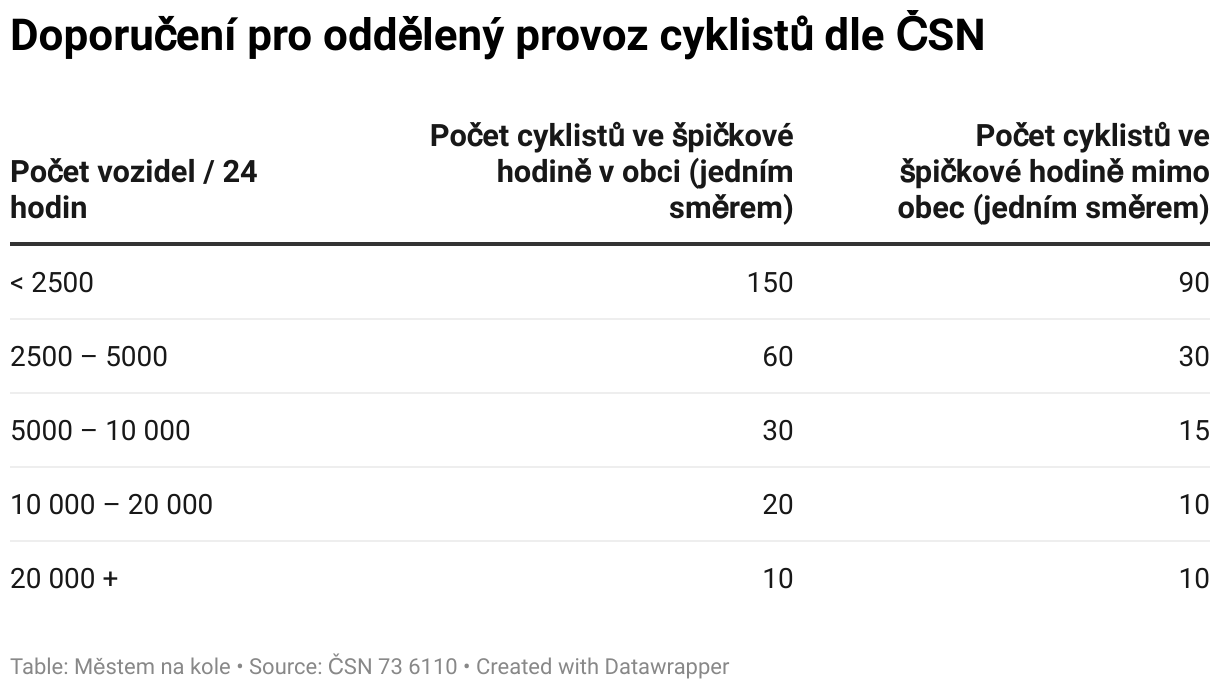
Section 10.4.2.2 of ČSN 73 6110 provides recommendations for the separate operation of cyclists, meaning the construction of a path outside the main traffic area, based on motor vehicle traffic intensity and the projected number of passing cyclists.
.
[Edited] The requirement is relatively moderate; for example, on a road within a municipality with over 10,000 vehicles per day, a daily intensity of around 600 cyclists justifies the creation of a path. The intensity of motor vehicle traffic on existing roads can often be obtained from traffic data, while projected figures can be derived from traffic-engineering inputs for urban plans. Estimating the projected number of cyclists on current roads can be uncertain, but may sometimes be inferred from a cycling master plan, depending on the route’s significance and intensities on similar established routes.
Counting is, of course, a reliable minimum; no one would argue that introducing cycling measures would reduce the number of cyclists. Cyclists are counted using a method to determine peak-hour intensity, which is described later. Experiences with implementing cycling measures show that a continuous stretch of quality infrastructure can increase the number of cyclists, even several times over. Thus, ČSN reliably demonstrates the necessity of cycling measures even in cases where cyclist counts do not meet the threshold, provided it is at least roughly half. [End of edit]
ČSN 73 6110 provides detailed guidance on the possibilities for creating a shared pedestrian and cyclist path with a width of less than the standard 3.0 meters in section 10.4.3.6. Section 10.4.3.4 outlines the conditions for a one-lane, two-way cycle path. TP 179 places less stringent requirements on maximum intensities for shared paths.
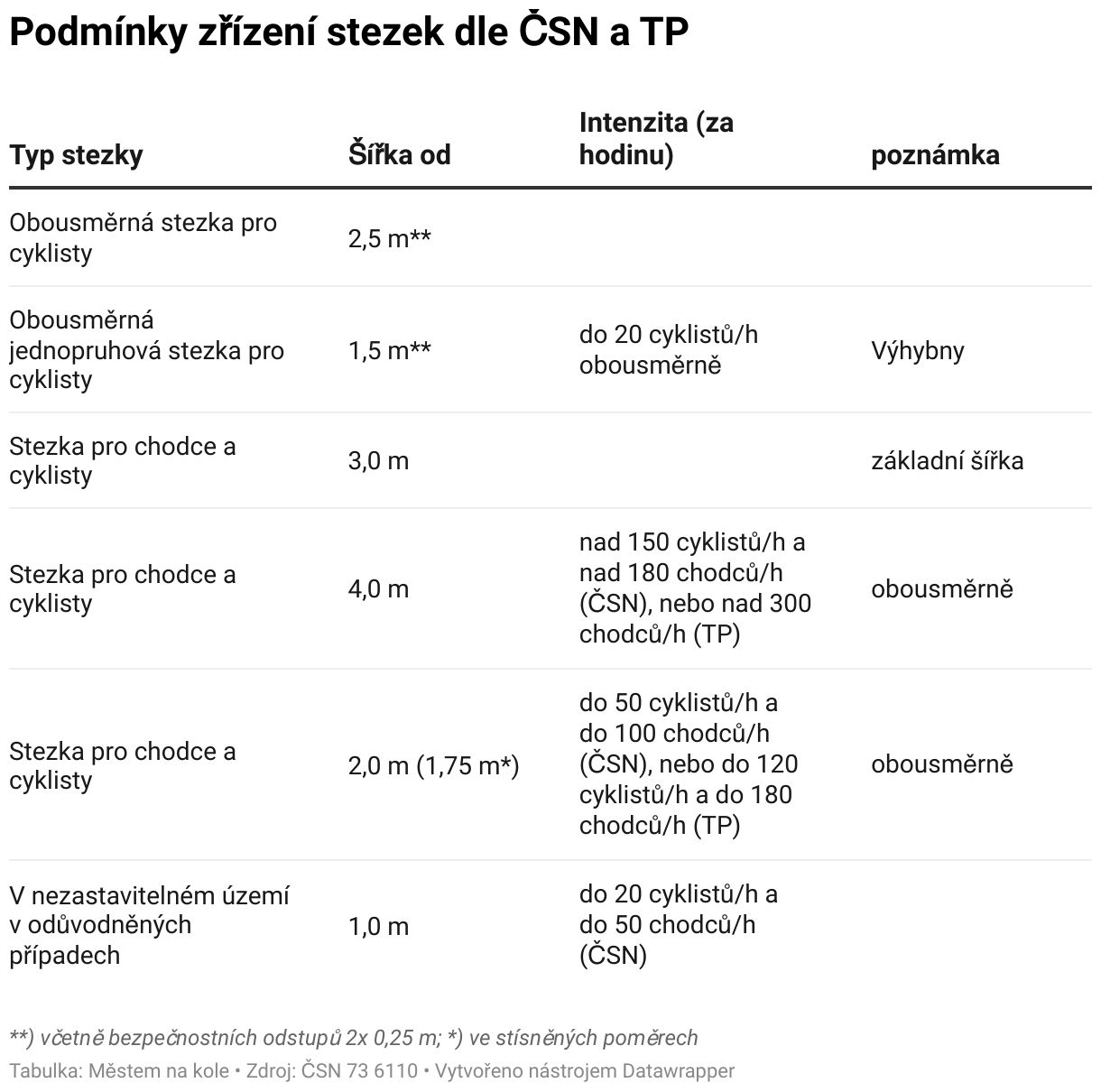
For pedestrian and cyclist paths where cycling is permitted, the rules for pedestrian paths are used as a basis. ČSN does not define requirements for this traffic mode due to its time of origin. TP 179 does not set any minimum intensities for sidewalks where cycling is allowed.
The requirements in ČSN 73 6110 were established without regard to the intensity of motor vehicle traffic and do not account for their introduction on streets with low traffic in a one-lane, two-way traffic regime. To determine the feasibility of introducing a two-way cycle lane in narrow streets, TP 179 should be referenced. TP 179 provides indicative intensities for a speed of 30 km/h, stating that each location needs to be assessed individually. The sufficient carriageway width is specified as:
The number of cyclists is not decisive, so all traffic can be counted regardless of cyclists; there is no need to wait for a suitable season.
For existing roads with speeds up to 30 km/h, a width of about 3.50 m can be considered sufficient for a two-way cycle lane without regard to traffic when safety clearances are nullified (section 6.4.4.2).
TP 189, updated in 2018, establishes the procedure for determining traffic intensities.
Daily motor vehicle traffic intensity is rarely counted. According to section 3.3.1 of TP 189, counting is conducted:
– on regular working days,
– in the months of April, May, June, September, and October,
– for 2 x 4 hours between 7:00 – 11:00 and 13:00 – 17:00,
– with hourly distinctions.
Daily intensities are calculated from the counted values using conversion tables. For secondary and tertiary roads, it is necessary to know the type of traffic for daily intensity calculations. If this is unknown, additional counting should be done on Sunday between 16:00 – 20:00.
For hourly motor vehicle traffic intensity, the focus is usually on peak-hour intensity. The peak-hour survey (section 3.3.2) is conducted:
– on regular working days,
– in the months of April, May, June, September, and October,
– for 2 x 2 hours between 7:00 – 9:00 and 15:00 – 17:00,
– with distinctions every 15 minutes.
When counting on roads outside municipalities or on sections of primary roads, the 50th-highest hourly intensity (defined as the 50th highest hourly traffic volume) is determined. Counting is conducted similarly to peak-hour surveys, but only on Fridays. A conversion coefficient of 1.13 applies when adjusting between peak-hour and 50th-hour intensity (i.e., the 50th-hour intensity is 1.13 times higher).
The peak-hour motor vehicle intensity is determined from measured 15-minute segments as the highest sum of four consecutive 15-minute intervals.
All surveys should ideally be conducted on different days for morning and afternoon sessions, and the afternoon peak can be shifted to a later time depending on local conditions. The expected survey accuracy is about 10%.
If conducting the survey in the designated month is not possible, adjustments to the average month can be made using a conversion table (appendix 3.6). For local roads (M), coefficients range from 93% (January) to 104% (October). For non-recreational secondary roads, coefficients range from 91% to 107%. Intensity adjustments are made by dividing by the coefficient for the given month (lower in winter, generally higher in summer).
Cyclist and Pedestrian Traffic Counting is Conducted in Favorable Weather Conditions. The survey is performed:
Given the generally lower intensity of pedestrian and cyclist traffic, it is appropriate to conduct extended counting (eight hours in this case). Results from surveys conducted in unsuitable weather conditions can be professionally adjusted using a verification traffic survey conducted on a day with weather favorable for pedestrian or cycling traffic. TP 189 does not specify the parameters for such verification surveys, but it can be assumed that it involves several hours of counting on a more suitable day.
Daily pedestrian and cyclist traffic intensity estimates are typically not used when assessing cycling measures. The conversion to daily intensities according to TP uses a table of hourly relative values differing for areas with commuter cycling, recreational-sport cycling, and mixed cycling (see chapter 5 and appendix 4 of TP 189). In Prague, we could more accurately use the hourly distribution of intensities determined by nearby automatic counters, although this data is not published in the TSK yearbooks.
The peak hour is determined directly from the survey as the highest recorded value. According to the conversion table in Appendix 4 (fig.), it is recommended to count cyclists and pedestrians during the afternoon peak between 2:00 p.m. and 6:00 p.m. to identify peak-hour intensity.
Traffic fluctuations in large cities may differ from TP recommendations, but in practice, this is unlikely. This was confirmed in Prague, where daily and annual fluctuations in motor vehicle traffic intensity are described in the yearbooks of the Technical Road Administration. Average values for the entire city indicate that peak traffic levels in Prague occur between 7:00–8:00 a.m. and 3:00–5:00 p.m. (each accounting for 6.8% of daily traffic intensity). This aligns with the TP requirements, which recommend counting from 7:00–9:00 a.m. and 3:00–5:00 p.m.
The months with the highest peak traffic intensities, according to TP, are April, May, June, September, and October. The Prague traffic yearbook lists April through June as the strongest months (in 2022), or March through June (2019); 2020 and 2021 were affected by COVID restrictions, and their annual variations are atypical. Even for annual intensity, it can be concluded that following TP is sufficient, as counting accuracy remains around 10%, with corrections in the range of ± a few percent.
Cycling traffic in Prague reaches near-peak intensities from April to October, depending on the weather—sometimes earlier or later in certain years. The summer holidays are 10–20% lower in intensity, but weather dependency is always key. Therefore, it is recommended to count cyclists anytime between April and the end of October, as soon as favorable weather conditions arise—which at the beginning and end of the season means exceptionally warm weather.
Describing the methodology for counting is beyond the scope of this article. TP 189 provides template forms that can be used directly or suitably modified. Typically, results are segmented every 15 minutes, which some subsequent processing requires, and it also helps with clarity.
Besides manual counting and the use of automatic counters, pre-trained open-source computer vision models are a new alternative for counting. These models allow automatic counting from images captured by an ordinary camera using commonly available hardware, even in home settings. These models have an error margin of around ± 1.5%, making them entirely sufficient for counting according to TP 189.
Currently, in Prague, the yolov8 model is being tested for the verification of potential two-way cycle lanes in one location. More detailed information and source codes are available on GitHub. Another option is using OpenAlpr, which offers this functionality for free, though not publicly advertised.
For initial consideration of a measure, an indicative count that provides rough results is often sufficient to determine whether legalization or a two-way cycle lane in a given location makes sense. For such an assessment, it is appropriate to use the figures from TP 179, which have lower requirements.
Counting according to the methodology in TP 189 is more labor-intensive but suitable in some cases. Results obtained in compliance with TP 189 can support decision-makers, justifying the implementation of cycling measures. However, be prepared for some to only need to meet the TP 179 requirements, while others may demand stricter ČSN compliance.
It is worth noting that neither document is binding, and TP and ČSN are essentially on the same level. In the field of cycling infrastructure, it makes sense to refer to the figures in TP 179. These TP are newer and more focused on the functionality of cycling measures than ČSN. However, if a location meets the ČSN conditions, the cycling measure will be functional with a significant margin.
ČSN 73 6110 is also expected to be updated soon, so it can be assumed that over time, it will offer a more unified perspective with TP 179.
Part of the article on automated counting was created in collaboration with an external volunteer, whom we can put you in touch with if you are interested in automated counting in specific locations.
This is an adjusted machine translation using Automat’s CycleLingo Translator (ChatGPT) of this article: https://mestemnakole.cz/2024/10/scitame-dopravu-pro-cykloopatreni/
Líbil se Vám článek? Chcete v Česku lepší podmínky pro cyklodopravu?
Podpořte nás, stačí i 100 korun. 💙🚲
Vyberte prosím částku, poté budete přesmerováni na darujme.cz



komentář