

While everyone may perceive the scope, form, and appropriateness of individual measures differently, it is indisputable that urban cycling has experienced—and continues to experience—unprecedented growth in recent years. Cycling infrastructure is no longer just the domain of park pathways or sporadic lanes marked on wide thoroughfares.
Today, one encounters various cycling measures much more frequently, whether they are contraflow bike lanes (two-way cycling in one-way streets), advisory and dedicated lanes, or the authorization for cyclists to use sidewalks via shared paths for pedestrians and cyclists and the so-called „legalization“ of sidewalk riding.
Along with the rapid development of these measures, it is becoming clear that legislation and technical regulations are lagging behind the actual needs and conditions on the streets. Measures implemented within the roadway—primarily the aforementioned contraflow lanes, dedicated and non-dedicated cycle lanes, advanced stop lines, and others— function reasonably well within the framework of the law and technical regulations (specifically the technical conditions TP 179, which focus mainly on roadway measures). However, a much more significant problem arises with measures that lead cyclists off the roads used by cars.
In this article, the term „cycle path“ is used to cover various regimes for simplicity, such as dedicated cycle paths, shared pedestrian and cycle paths, divided paths, pedestrian zones with permitted bicycle entry, and similar arrangements.
What situations are currently not covered by legislation or the aforementioned TP 179? For example, there is the question of whether cycle paths (and thus the rules governing them) must always be marked by signs from intersection to intersection, or if they can be marked zonally—and what actually constitutes an „intersection“ in the context of a cycle path. In this regard, practice and theory diverge sharply, leading to „creative“ solutions by designers and stakeholders in every individual case.
There are no established rules for marking typical situations. Consequently, a similar location in different cities might be marked with different signs intended to enforce the same rules. Alternatively, it might be marked with the identical signs, but with a different understanding of their meaning.
Furthermore, the role of cycle crossings is not legally anchored. In some places, it is automatically assumed that after crossing a cycle crossing, the cycle path continues seamlessly without requiring further signage. Elsewhere, it is standard practice to assume the crossing terminates the path. One can even encounter cycle crossings that lead directly onto a sidewalk, where a person on a bike unknowingly enters an area where they are „not supposed to be.“
There is also no general answer to whether a cycle path automatically continues around a corner into a perpendicular street at an intersection, or whether it ends there unless otherwise stated. There is no clear definition of how to actually start and end cycle paths. This specific topic is the focus of the rest of this article.
According to the Road Traffic Act, cycle paths are always marked with the appropriate signs (C7 to C10), and the rules allowing cyclists to ride apply from the sign marking the beginning of such a path to the sign marking its end. This is a fundamental difference compared to a sidewalk, which requires no signage and isn’t even strictly defined by the law, although the law sets rules for its use. A particularly essential rule is defined in Section 53, Paragraph 2:
„Road users other than pedestrians shall not use the sidewalk or pedestrian path unless otherwise provided in this Act (…).“
From the above, it can be inferred that if something looks like a sidewalk, it most likely is a sidewalk, unless vertical signage establishes a different regime. And on a sidewalk, no one is allowed to move other than on foot.
Since the placement of signs often means cycle paths do not begin directly at the edge of the roadway but, for example, behind a perpendicular sidewalk, a problem arises: can a cyclist legally ride from the road onto the cycle path? Or must they dismount and push their bike like a pedestrian across the section that is, for all intents and purposes, a sidewalk?
In technical practice, there is a term called a „sidewalk crossing“ (chodníkový přejezd)—a place where a vehicle crosses perpendicularly over a sidewalk. Examples include driveway entrances to properties, entrances to residential zones, or indeed, the outlets of cycle paths. Technical regulations explicitly require that in certain situations, sidewalk crossings be used preferentially over other ways of intersecting pedestrians and other vehicles. However, the Road Traffic Act does not recognize anything like a „sidewalk crossing.“ The fact that the physical state of our streets and the wording of the law do not align has been documented before.
Why is this such a problem specifically for cycling, and why does the law deserve an update? After all, one could argue that it „sort of works,“ we have common sense, and we don’t need laws or regulations for everything…
Firstly, these are not isolated cases; this is a situation encountered at the beginning and end of almost every cycle path, except for those that connect to the road in places where there is no sidewalk.
Secondly, it is a systemic problem. It would be correct to have legislation set up so that in situations that are typically very similar and appear repeatedly in many places, the rules of conduct for all participants are simply defined and correspond to how cyclists and pedestrians naturally behave there in reality.
Secondly, although the physical design of the infrastructure is often intentionally built to guide cyclists through a smooth transition, it actually encourages illegal behavior. We are creating public spaces where it isn’t clear at all how to behave correctly; the combination of physical construction and inadequate traffic signage leads cyclists to unconsciously break the rules. Such rules then lose their meaning.
Furthermore, cyclists are systematically conditioned to view breaking regulations as the norm—and essentially a necessity—just to get anywhere. This leads to a loss of trust in traffic signs and forces cyclists to improvise and ride in areas where they technically shouldn’t.
Thirdly, if we are serious about supporting cycling, it is unacceptable for the law to force a cyclist to dismount and remount at every street corner. This is certainly not what real support for cycling should look like. If society decides to invest funds into building cycling infrastructure, that infrastructure should allow for continuous, legal riding without mandatory dismounting—just as a car can travel on new roads without the driver having to get out or push the vehicle with the engine off.
Fourthly, even with the best intentions, designers today are often unable to design a cycle path that can be legally traversed without dismounting once. A designer should not be forced to propose a project that, from its inception, nudges users toward illegal behavior.
This leaves the designer with two bad options: ignore the issue entirely, or try to „save“ it with a flood of redundant vertical signage, for which no standard template exists. In the current state, it is actually impossible to fulfill the provisions of TP 65, which states:
„Traffic signage must be completely understandable, concise, unambiguous, complete, and intuitive for road users. It must be implemented according to uniform principles (…) Identical traffic situations (…) must be marked in the same way.“
The problem is that no uniform principles for marking these identical situations exist for cycle paths. A „formally perfect“ marking setup that ensures a legal, smooth passage would require so many signs in such odd positions that they would cease to be understandable or intuitive.
Fifthly, if someone actually tries to solve this within the current framework, it ends in a „signage forest“—an explosion of unnecessary signs that might fix the legal technicality but litters public space and degrades the perceived importance of traffic signs. While a „correct“ formal solution exists, it isn’t the right path from an urbanistic (visual), safety (clarity), or economic (maintenance) perspective.
Sixthly, road administrative authorities and the Police of the Czech Republic sometimes view allowing cyclists to transition from a sidewalk into the roadway as a risk they don’t want to be responsible for. They often take the easiest route: formally refusing to authorize the passage to „ensure safety.“ They simply look the other way regarding the fact that, in reality, no one actually dismounts.
If the end of a cycle path legally and automatically included the right to cross a sidewalk to reach the adjacent road, the burden of individual responsibility for every single design choice would be lifted from these authorities and replaced by a general rule.
Seventhly, because in these situations, nobody dismounts anyway—and it doesn’t cause any problems. The law is simply outdated and does not reflect reality.
Below are selected examples of locations where only a few meters of „legalized“ sidewalk passage are missing to connect to a cycle path, but the road administrative authority or the Czech Police hold a different opinion:
1. The outlet of the cycle path under Mánes Bridge in Prague onto Kosárkovo nábřeží. Physically, this is a well-designed sidewalk crossing for cyclists that allows for a smooth transition from the embankment roadway to the cycle path. However, technically, a cyclist is not allowed to ride through here. Although the district’s transport department would support legalizing the passage, the police do not want any changes leading to its legalization.

2. The entrance to the shared path in Prague-Radotín from Na Betonce Street. A stretch of about 15 meters of sidewalk stands in the way of a smooth transition from the roadway to the path. The local transport department simply stated that, in this location, it is necessary to push the bicycle.

3. A smooth crossing without dismounting is also not possible in Hradec Králové across Pospíšilova Street from Hostivítova Street into Kubišta Gardens, despite there being a marked cycle crossing. According to the road administrative authority, „the shared path for pedestrians and cyclists is terminated here for safety reasons. Cyclists crossing the sidewalk on Pospíšilova Boulevard could endanger pedestrians. Furthermore, it is appropriate to ensure the protection of the cyclists themselves, so that they look carefully before entering the road and do not enter a busy thoroughfare at high speed. The legal obligation to dismount from the bike and walk across the sidewalk is intended to contribute to this step.“
4. Surprisingly, the Czech Police hold the opposite opinion regarding the cycle crossing over Vrbova Street near the Jižní spojka in Prague. Crossing the sidewalk at the intersection with the cycle path is reportedly possible without dismounting, provided safety on both the sidewalk and the road is maintained
Elsewhere, one can find places where the relevant authorities have clearly reflected on this problem and resolved the situation by carefully delineating the space intended for cyclists with traffic signs. While this makes the passage legal, it is often at the expense of clarity—the sheer volume of signs or their poor orientation obscures the clear information of where the cyclist is actually supposed to go.
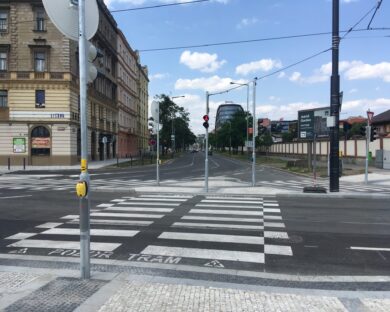
A prime example is the outlet of the cycle path along the Rokytka onto Zenklova Street in Prague. Here, one can ride through smoothly because the short section of sidewalk that cyclists cross is designated as a shared path. However, the traffic signage is installed in such a way that the cyclist cannot see the signs at all, as they are oriented parallel to the cycle path. They are perfectly visible to pedestrians walking along Zenklova Street, who step onto the cycle path for a brief moment and then immediately leave it; however, a cyclist arriving via the cycle crossing can hardly see them and thus cannot even be sure if there is a cycle path on the other side at all. In the photo, the signs are visible on the right on the post above the yellow cycle route number and on the left on the tram overhead line pole. If you cannot find them in the photo, you are in a similar position to a cyclist at that location trying to figure out where to go next.
A second example is the cycle crossing across Sokolovská Street in Prague, where legalizing the crossing of a roughly five-meter stretch of sidewalk required installing double-sided signs from three directions. Besides the higher costs for installation and subsequent maintenance, this is a relatively unsightly and unnecessarily complex solution—though unfortunately, it is currently perhaps the only one possible.
The situation regarding where and under what conditions one can legally ride a bike across a sidewalk is complex, difficult to predict, often fails to correspond to the physical state of the infrastructure, and depends heavily on the subjective opinions of the relevant officials.

Even the Ministry of Transport, in its response to an inquiry, did not clarify the situation. It merely stated that individual solutions are fully within the competence of the respective municipal authorities with extended powers and that one must turn to them. While this is true, traffic rules should be understandable and consistent everywhere.
The only „saving grace“ in this dismal situation is the fact that, in such places, neither cyclists nor police officers are generally aware of the obligation to dismount. In reality, riding through these spots is tolerated, and everything works in a „partisan“ sort of way.
The described situation needs a systemic solution. The reasons have already been mentioned above, but I will add one more that I consider important: if we cannot establish legislative and technical rules that allow us to design clear and legal solutions for simple traffic situations that everyone can understand, we can hardly tackle anything more complex.
One option, for example, is to amend the law with a section that would explicitly allow cyclists to ride on the sidewalk if it is necessary to transition from the roadway to an immediately adjacent cycle path, provided the area is structurally adapted for it. Alternatively, the decree on traffic signaling could be modified to adjust the validity of cycle path signs in certain situations—making them valid from the edge of the adjacent roadway rather than from the physical location of the sign itself, thereby covering the „sidewalk crossing“ area.
Another possibility would be to formally introduce the term „sidewalk crossing“ (chodníkový přejezd) into the law, which would resolve multiple issues at once. After all, the very section that defines the conditions for traffic on sidewalks ends with the „magic formula“: „unless otherwise provided for in this Act.“ It is perhaps time to make use of that and finally define what that „otherwise“ looks like. In this way, legislation would finally catch up with reality.
Líbil se Vám článek? Chcete v Česku lepší podmínky pro cyklodopravu?
Podpořte nás, stačí i 100 korun. 💙🚲
Vyberte prosím částku, poté budete přesmerováni na darujme.cz





komentář