
I have been interested in the development of cycling infrastructure in Prague since roughly 2007. Its evolution is arduous, accompanied by stories full of countless twists and turns. In this series, I would like to share what I remember from those nearly twenty years—before I forget it entirely.
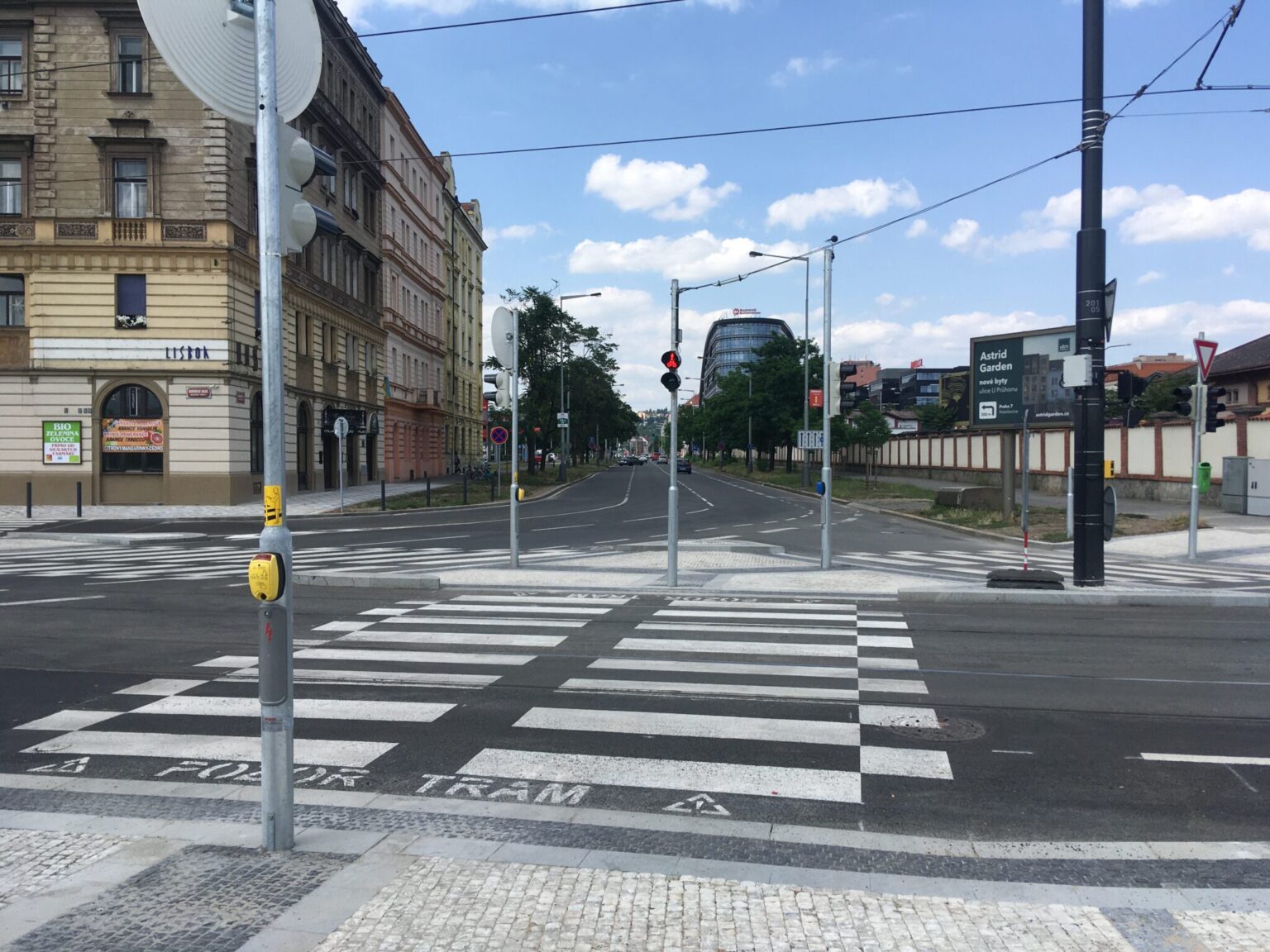
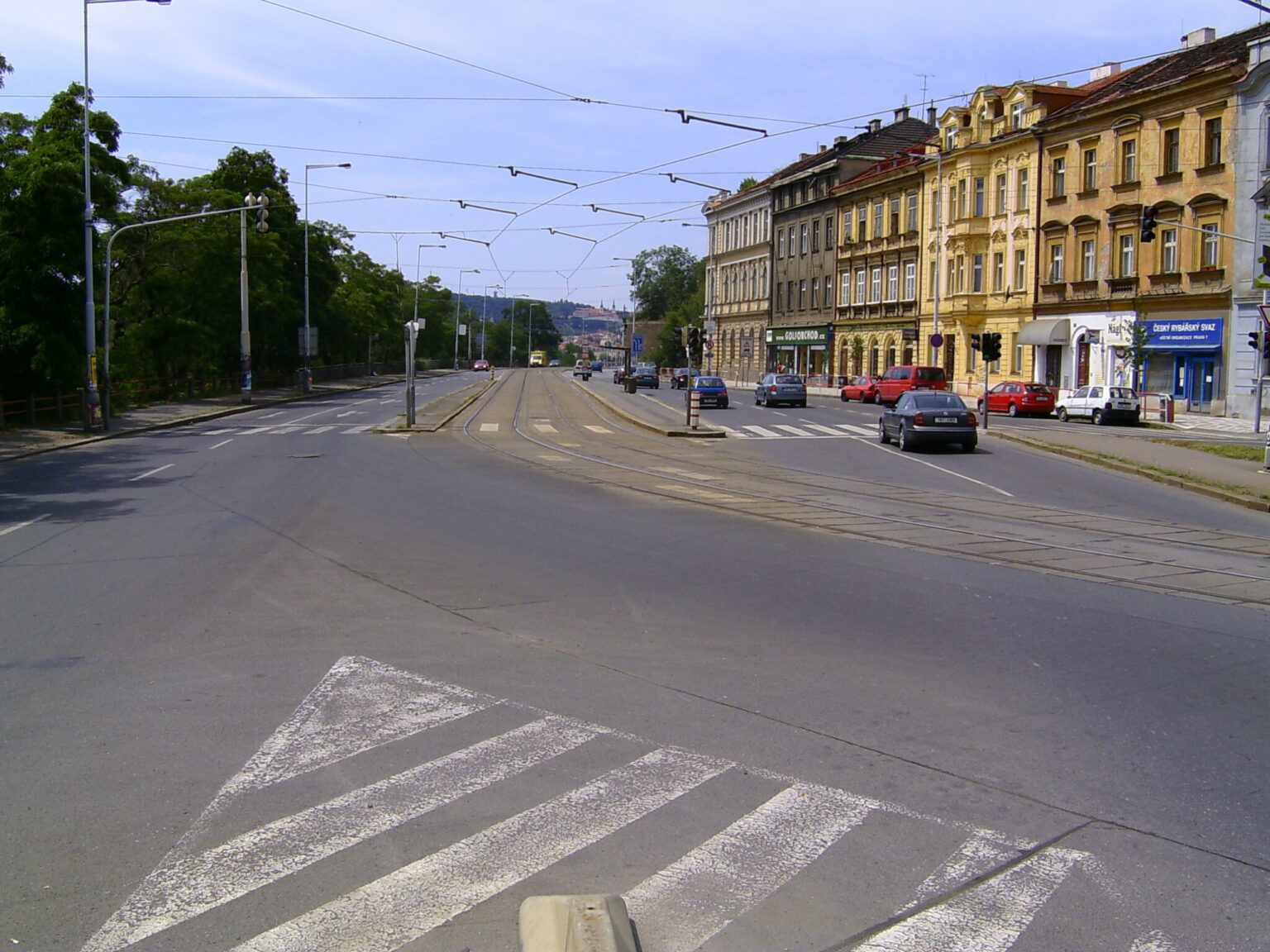
From Malá Strana and the city center to Stromovka Park, lower Letná, and Northern Prague along the Vltava, it was always most practical to take Nábřeží Kapitána Jaroše and turn left into Dukelských hrdinů Street. However, making a left turn on a bike from the left lane, which was a continuous through-lane, was always extremely problematic for cyclists. Crossing the embankment via a pedestrian crossing with a high traffic island was also absolutely terrible for cycling.
In January 2006, a tragic accident occurred here: Jan „Pup“ Bouchal, the then-leader of the Oživení association and the Auto*mat project (at a time when AutoMat was not yet an independent association), was struck and killed by a car. Pup himself had previously warned about the danger of this intersection. His death became a symbol of the inhumane conditions for cyclists and pedestrians in Prague. Since 2007, the regular January memorial bike ride has always followed the path of Pup’s fatal journey, starting from the house in Thunovská Street where Oživení was then based.
In the following years, efforts to modify the intersection went into full gear. By 2010, driving straight from the left lane was abolished. A construction project that made the left turn safer and established two cycle crossings was implemented in 2012—at a time when almost no money was allocated for cycling, but then-Mayor Bohuslav Svoboda supported the project.
In 2013, the „Bike to Heaven“ monument to victims of cycling accidents, created by Kryštof Kintera, was erected at the intersection. It had won second place in a competition announced by Pup’s friends. The winning design by David Černý—a metal silhouette of a run-over cyclist placed directly in the roadway—was unacceptable to state authorities. The monument was funded almost entirely by private donations; many suppliers and Kryštof Kintera himself waived their fees. A public collection organized by the AutoMat association raised 270,000 CZK.
Incidentally, public support was so strong that the collection had to be stopped and all funds transferred from the transparent account long before the actual realization of the monument. An underestimation of communication at the time gave „cycling-haters“ an opportunity for baseless accusations of embezzlement, showing those involved in AutoMat that goodwill alone isn’t enough to prevent mud from being slung at you. This tactic, after all, continues to pay off for that type of person today.
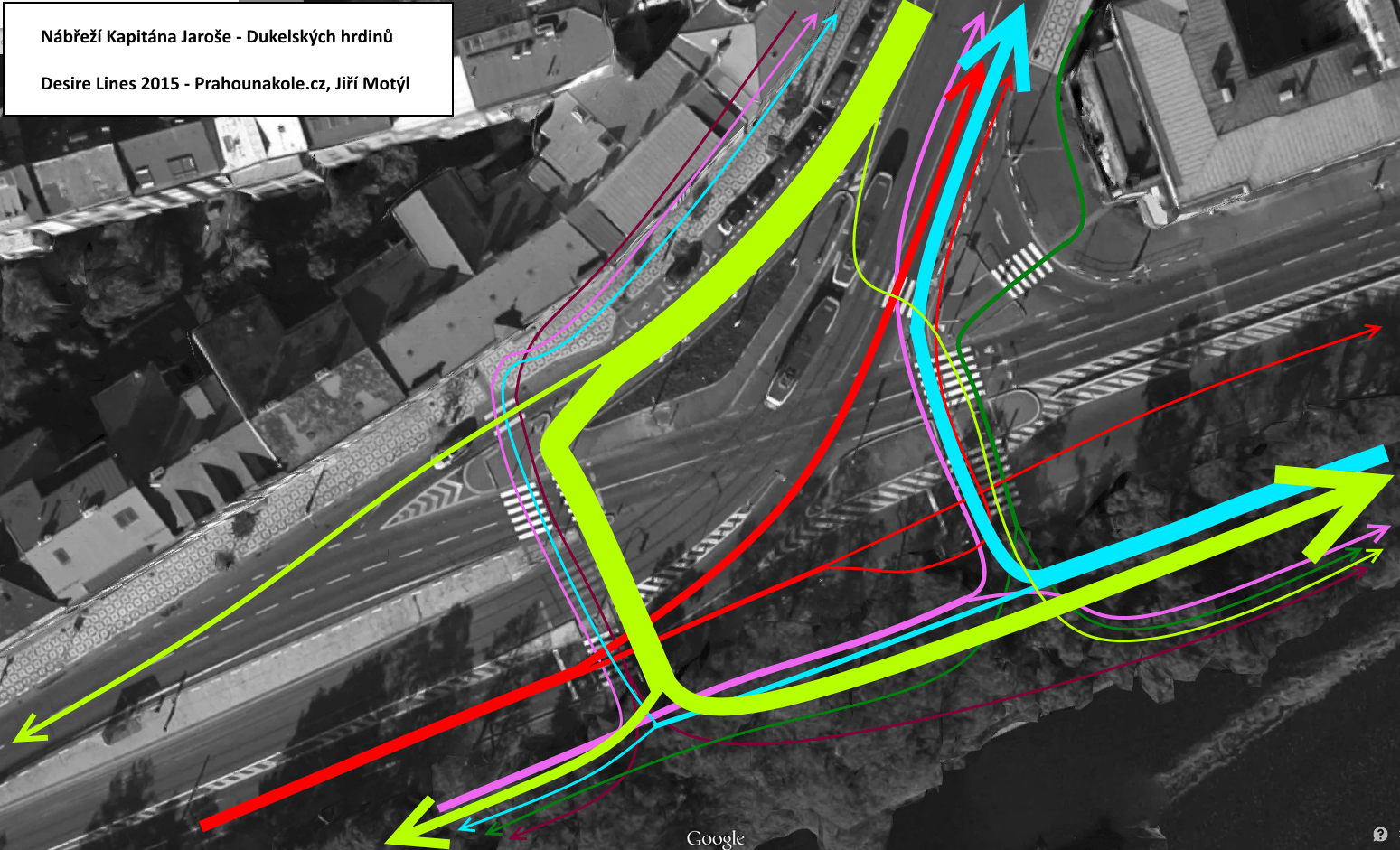
After the intersection’s reconstruction, the number of cyclists passing through nearly doubled. A detailed study of cyclist behavior in the reconstructed intersection, based on observing so-called „desire lines,“ was conducted in 2015 by then-editor-in-chief of Městem na kole, Jiří Motýl. While it became possible to reach Hlávkův Bridge away from cars along the embankment, continuous legalization up to and across Štefánik Bridge—which is significantly shorter for getting to the center—is still missing.
The multi-level intersection at the Vltavská metro station was always a hellish ulcer for cycling, plunging the city highway (magistrála) into a spot where, a hundred years prior, twenty-four buildings of old Bubny once stood. The location clearly demonstrated why you cannot have multi-level intersections in a city: you either have a city, or you have multi-level intersections. In 2011, I used the intersection as the setting for a fantasy short story, reflecting the sad events at the nearby Dukelských hrdinů intersection.
The misery of the intersection itself wasn’t such a problem for the direction of route A1; cyclists used an underpass, likely legalized in 2006 (it appeared in the 2008 atlas). The problem lay with other directions: getting from the bridgehead of Hlávkův Bridge to the Vltavská metro—just 150 meters away—meant riding about half a kilometer along intersection ramps to find a barrier-free path.
The year 2018 brought a major overhaul of non-motorized conditions around the intersection. It was done boldly in the summer before local elections; crossings were added over the western arms of the intersection, and the corner by the Elektrické podniky building was connected to Hlávkův Bridge. Cycle crossings complemented the pedestrian accessibility. Tomáš Cach’s project also intervened in the roadway, adding cycle lanes in practically all directions.
These lanes, of course, became a target of criticism. Naturally, you can’t conjure a „Dutch solution“ in this motorized hell until the intersection is fully rebuilt. However, during subsequent repairs to the Vltava underpass, the cycle lanes served for months as the only way to legally get from Holešovice to Letná.
The reconstruction of the intersection was imagined as part of the „humanization“ of the highway. Architect Tomáš Cach’s idea to place a large public building at the site of the current tram stops became part of the Bubny-Zátory territorial study. The preparation of this study, covering a vast area largely sold cheaply by Czech Railways to private investors, was closely watched. There was an opportunity for a sustainable —environmentally and socially— design of inner Prague’s largest heat island but that did not happen. The Vltavská intersection itself was left to be resolved together with the new building.
The city, represented mainly through the efforts of Deputy Mayor for Territorial Development Petr Hlaváček, decided to build the representative Vltavská Philharmonic building here. However, the traffic solution’s brief was ideologically grounded in the idea that the highway’s capacity must not be reduced.
A street-level intersection with an underpass from the center, like at the Čechův and Štefánikův bridges? Forget it! Just as many cars must be squeezed through as today—actually even more, because 2030 traffic intensities are binding for technocrats, whereas fulfilling the climate strategy or assuming a traffic reduction after the Ring Road opens is dismissed as activism.
The way architects in the international competition dealt with the brief means everyone will lose. Three tunnels and a loop that only reluctantly dives below the surface of the Philharmonic’s forecourt have bulged the building’s underground toward the Vltava so much that the original idea of elegant „stay-and-play“ ramps connecting the building to the river has been reduced to four-meter-wide „perches“ where cyclists will be crammed into pedestrians. And cycling apart from pedestrians won’t be possible because bikes will be banned from the tunnels. This convoluted design between Hlávkův Bridge and Argentinská Street will cause the individual directions of the highway to cross each other twice, creating a bottleneck for cars at an enormous cost.
The final form of the Philharmonic’s forecourt is still being fine-tuned, but not much of significance can be saved. The only hope that we won’t end up with „Husák’s Silence 2.0″—only with worse parameters for everyone—is the sacrilegious thought of scrapping the entire Philharmonic traffic solution due to lack of funds and starting over with a blank sheet of paper. Given how much time and money has already been invested, we probably shouldn’t expect such a move.
The 2023 reconstruction of Bubenské nábřeží followed the „Hol-Ka“ footbridge and was supposed to bring new quality to a long-neglected street—including the continuation of the A1 route. The result is a dual solution: a legalized sidewalk and cycle lanes. Although those involved in the preparation were more or less satisfied, Bubenské nábřeží paradoxly became one of the first reasons for stronger criticism regarding the negative impact of the Prague Public Transport Company (DPP) projects on cycling.
Around 2020, when the project was being prepared, there was a sincere effort by some people at DPP to design a cycling solution in an at least somewhat satisfactory way. Dual solutions were considered acceptable at the time by both DPP and city hall, and the project was generally viewed as good by stakeholders.
Post-realization criticism focused on the poor conceptual brief: why a dual solution and not a separate path, when the street is so wide and was being completely rebuilt? We eventually found out: a protected path could not be designed because the Transport Company chose the specific track placement they did. Cycling then… turned out the way it turned out.
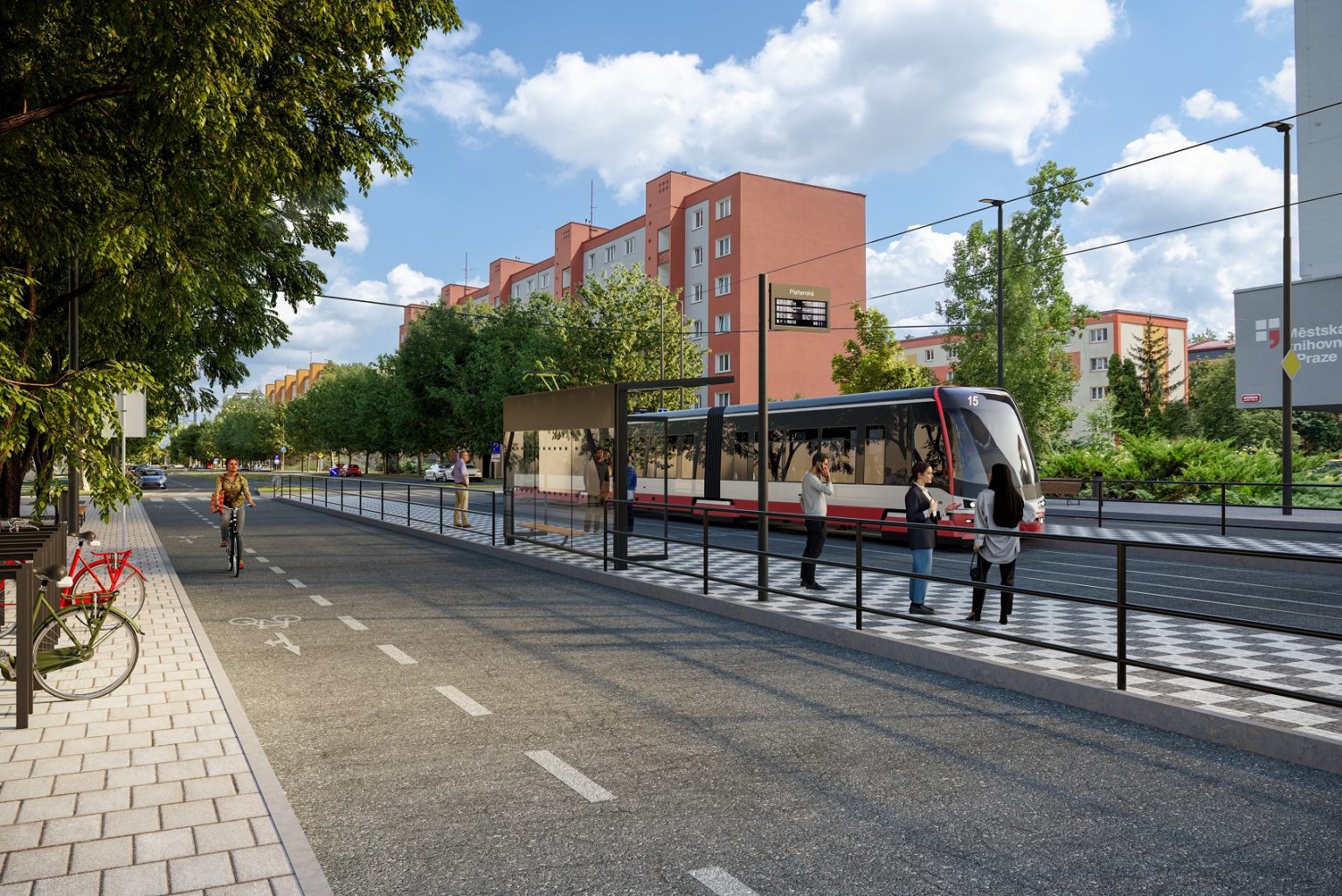
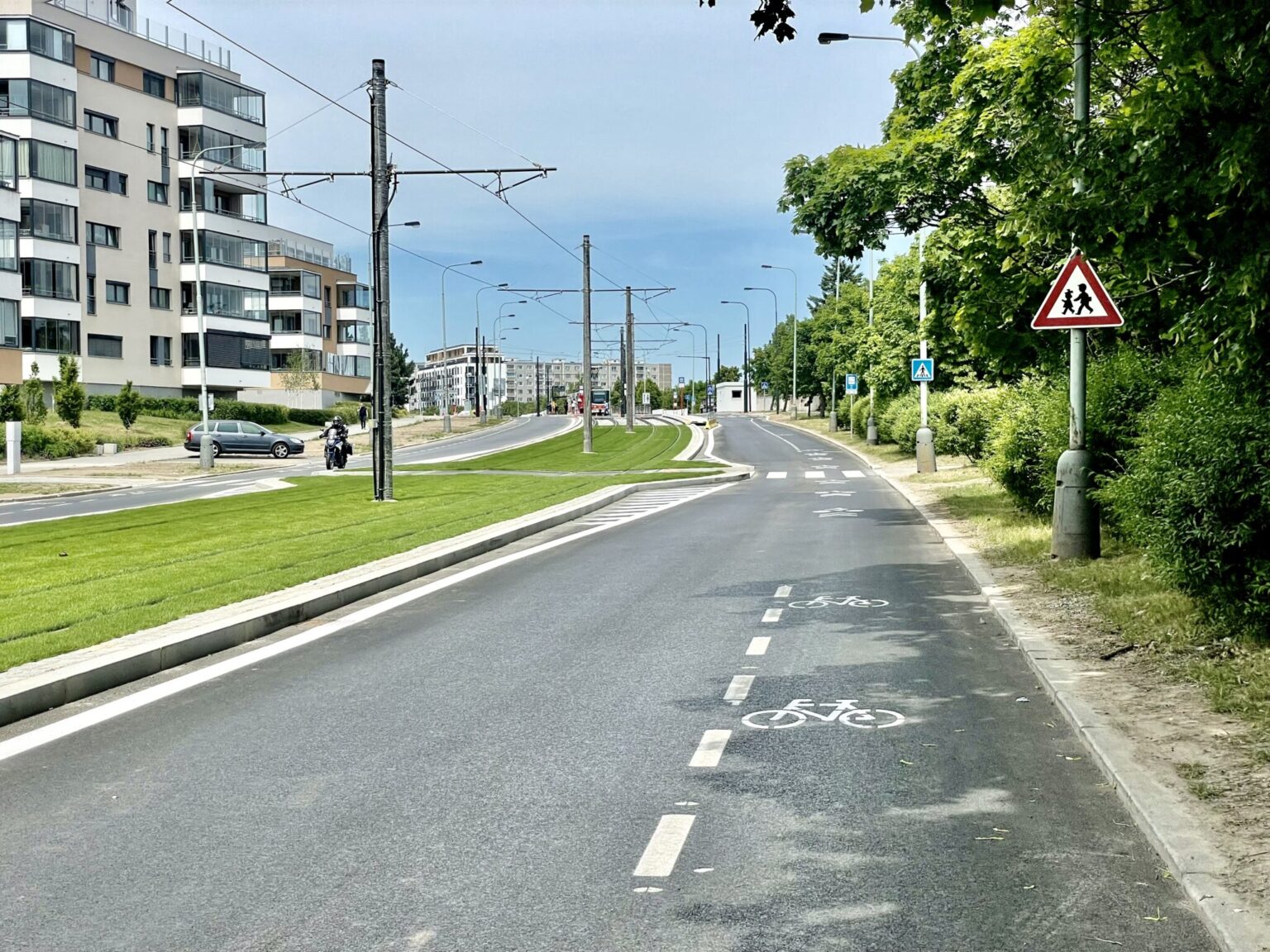
Unfortunately, this wasn’t the only such project. With the boom of tram line reconstructions and new builds after 2020—such as Nádražní, the new tram to Libuš, and especially the tram line to Dědina—the poor quality of cycling measures became apparent. They weren’t perceived positively by the cycling public expecting safety, nor by experts demanding at least a solid dual standard.
The dual solution was usually discontinuous both in the roadway and on the sidewalks, but that wasn’t the biggest problem. The real issue was the reconstruction of intersections, which often didn’t allow for cycling even in the corridors of the city-wide system, let alone for local connections. Rebuilt crossings and sidewalks will prevent cycling for decades to come. This stood in sharp contrast to the reconstructions of traffic signals by TSK, which successfully helped cyclists in many locations.
And we haven’t even seen the completion of ongoing tram projects in Počernická, Ječná, or Ústecká. Of those, the first two are „just“ missed opportunities, but the last one goes even further, proposing a solution so dangerous for cyclists that the cycling commission requested a safety audit of the project in Spring 2025.
After the Dědina tram line opened, it was too much for me, and I commented harshly on the dismal situation. I always considered tram lines to be the surface backbone of transport sustainability and an opportunity to bring light to neglected streets through comprehensive reconstruction that improves conditions for all sustainable modes. Public transport, as a leader of sustainable mobility with the greatest impact on street profiles and the largest budget, should, in my opinion, be responsible for improving conditions for sustainable mobility as a whole. The Dědina project was a slap in the face that shattered this idealized vision.
The reality is different. The development of the tram network in Prague is actually entirely subject to the wishes of car-oriented politicians. Cars must not have a single hair on their heads „mussed,“ for example, by reducing the number of parking spaces. That is why Počernická ended up the way it did, and why the „D“ line won’t have a tram from Na Pankráci all the way to Budějovická.
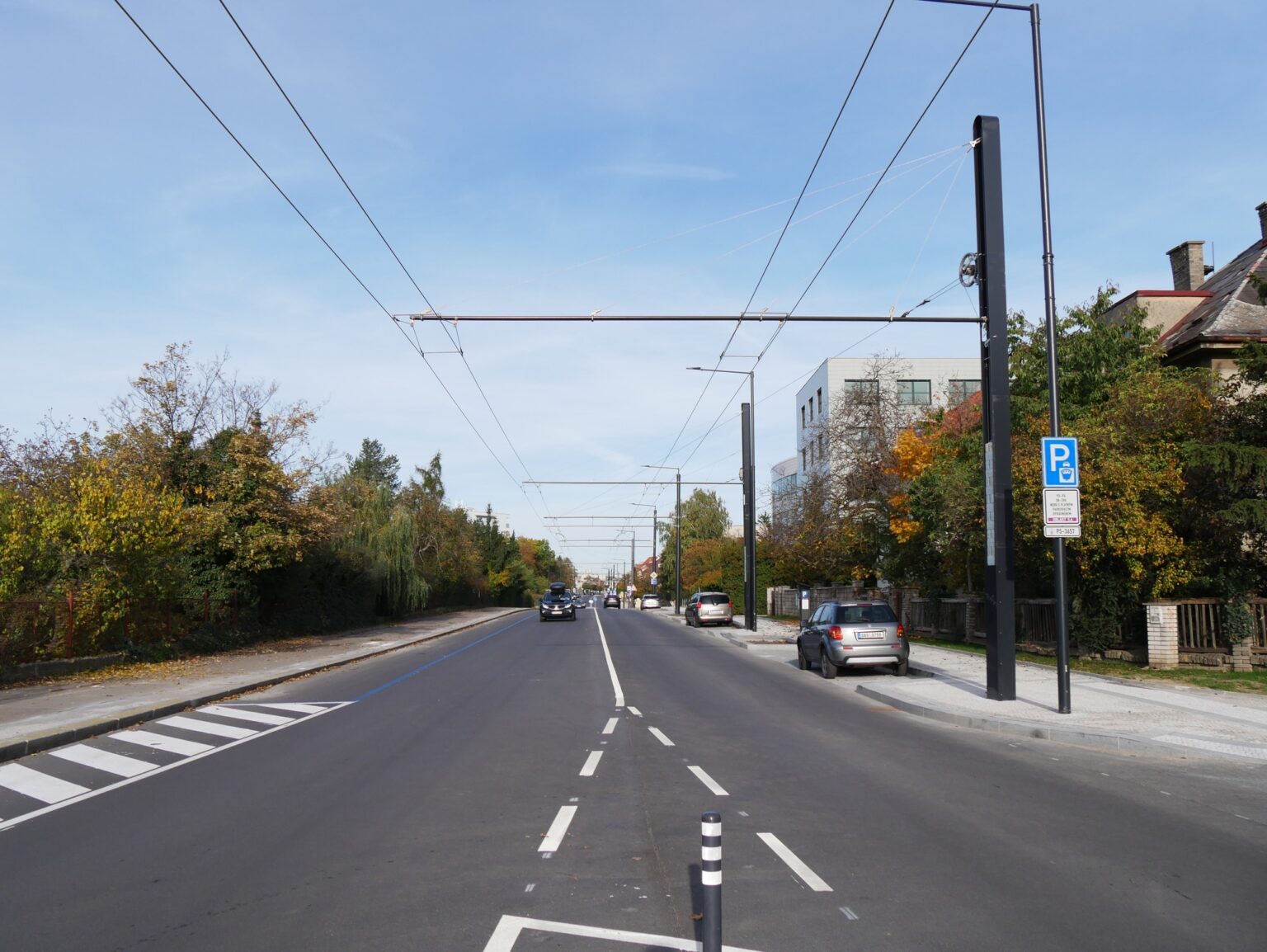
The technical leadership of the Transport Company’s surface section, represented by Jan Šurovský, had to adapt to this motorized dominance and acts according to the pragmatic principle of „looking after one’s own.“ In practice, if the DPP wants to build a tram line, they will happily ignore cyclists. This generally applies to other plans too, such as trolleybus lines (see Peroutkova).
All of this would be somewhat understandable, but sometimes the Transport Company goes against cyclists entirely unnecessarily. DPP made it impossible to establish cycle lanes after the tram reconstruction in Badeniho Street and refuses them on Mánes Bridge. They claim it’s so cars don’t stand on the tracks in traffic jams, even though there’s barely room for cars to the right of the tracks and traffic jams almost never occur in those spots.
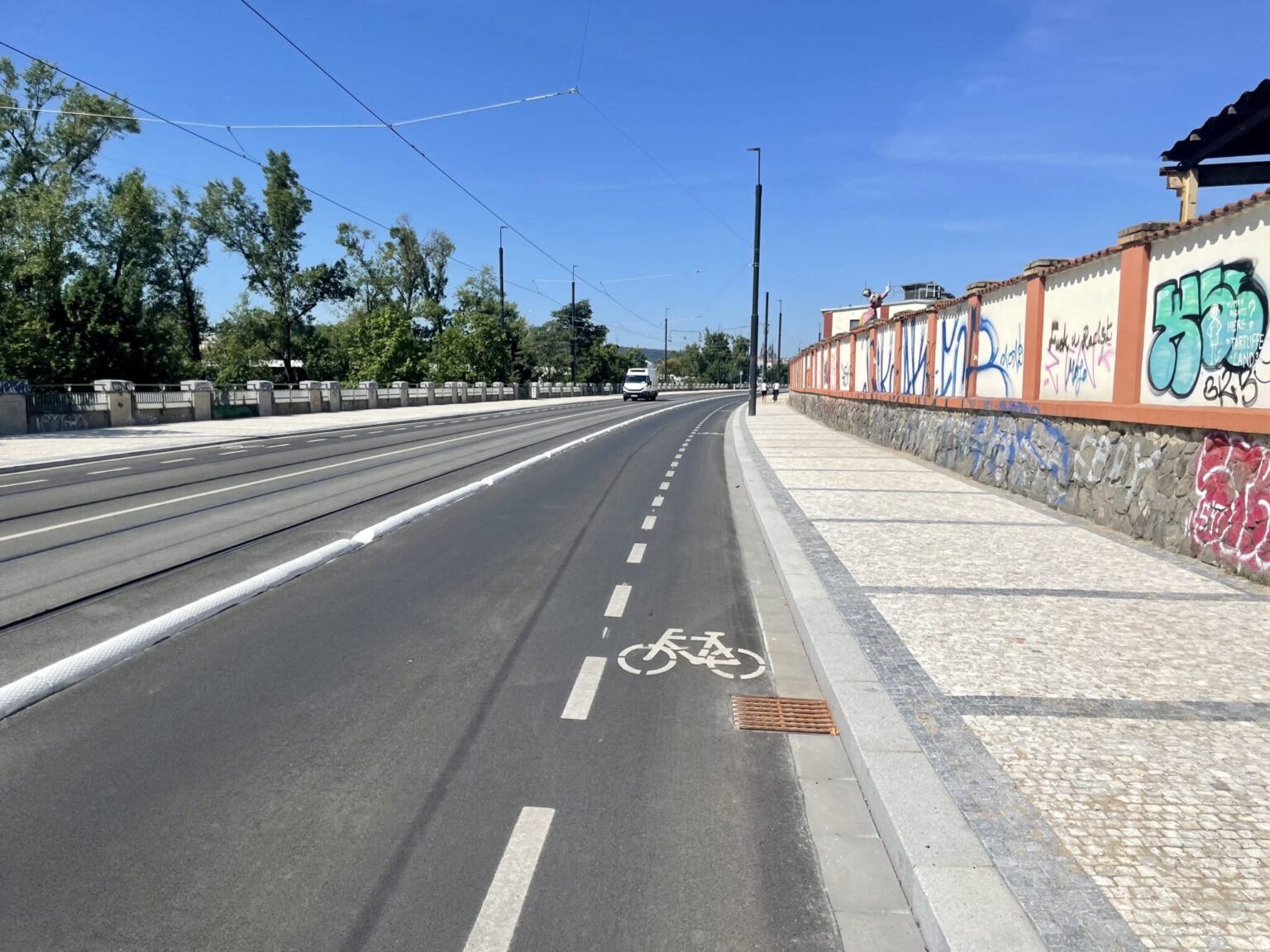
However, I consider the most reprehensible thing to be the insistence on longitudinal separators in nonsensical places where there have never been and will never be traffic jams—like Bubenské nábřeží east of the HolKa bridge or on Nábřeží Kapitána Jaroše heading from the center. The separator forces drivers to overtake cyclists with a dangerously small side clearance, which isn’t just a nuisance; it’s directly life-threatening. There was a time when one could talk to Jan Šurovský about these things, but he has hardened recently, perhaps as he had to yield even more to motorists‘ interests even within public transport.
Advocates for cycling are in a very weak position to influence project designs. While cycling lightens the load on both spatially demanding cars and public transport—making it sensible to support even from a public transport perspective—that only works at a much higher modal share than Prague’s current dismal infrastructure allows. Public transport is the backbone of sustainable mobility, so it’s not exactly ideal to threaten the implementation of their plans—even if they throw their „little brother“ (the cyclists) overboard without mercy.
The motorized „divide and rule“ works perfectly in Prague, not only when it drives cyclists off the road and into pedestrians with half-baked protected solutions. It also pits cycling and public transport against each other. The motorized hegemons are surely satisfied. The dismal cycling solutions—the result of the fact that the motorized hegemony won’t allow anything truly high-quality—successfully convince the public that cycling measures are undesirable.
Only the implementation of high-quality cycling measures, which draw people sensitive to riding in traffic onto bikes, can change this paradigm. But currently, that is being systematically—and very successfully—prevented.
This is an adjusted machine translation using Gemini of this article: https://mestemnakole.cz/2026/03/vzpominani-na-prazske-cyklotrasy-8-levobrezni-cyklotrasa-a-1-v-holesovicich/
Líbil se Vám článek? Chcete v Česku lepší podmínky pro cyklodopravu?
Podpořte nás, stačí i 100 korun. 💙🚲
Vyberte prosím částku, poté budete přesmerováni na darujme.cz






komentář