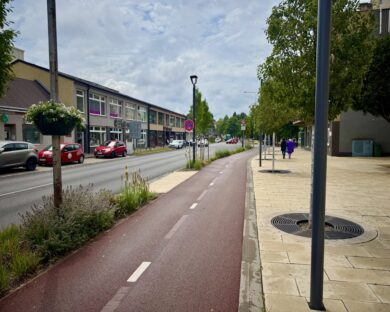
On the morning of Friday, May 31, 2024, a fatal accident occurred on Ústecká Street in Prague. A 60-year-old man cycling on Ústecká was fatally injured by a truck, likely turning right across a designated bike lane. Given that this accident occurred on a type of cycling infrastructure fairly common in Prague, Vratislav Filler would like to offer a brief commentary.
This is an accident („Only through the mirror“) similar to those that used to occur several times a year in London, often just due to visibility issues. From the post-accident photos and an examination of the intersection, it can be inferred that the driver might not have seen the cyclist clearly when starting off at the green light, especially if the driver did not look carefully.
Due to this, modern trucks often have their right-side window extended as low as possible to improve visibility from the cab. Additionally, the stop line for cars is typically set back several meters from the crosswalk, which is not the case at this intersection.
I would like to emphasize some recommendations that have been repeatedly mentioned on these pages:
The following lines are not an analysis of this specific accident; that will be conducted by the Czech Police as part of their investigation. However, from public records, we already know that the police identified the truck driver as the at-fault party. I will attempt to outline various factors that could play a role in similar accidents.
Such incidents are usually the result of a combination of various minor causes or oversights, where factors leading to the accident converge, and simultaneously, all factors that could have prevented the accident or mitigated its consequences are absent. The following circumstances could play a role:
These factors combine, and if any of them do not fully manifest, the accident either does not occur, or its consequences are not as severe. The concept of „who’s fault is the occurrence of the accident“ is, therefore, essentially an administrative simplification.
I would like to note that it is not reasonable to overly criticize cyclists for not fully recognizing the danger of a situation or failing to perform an escape maneuver. The accident is shaped by a number of other factors mentioned above. Awareness of blind spots is undoubtedly necessary for cycling in our conditions, but when assessing this particular event, it may not play a role and might not be ascertainable.
On the other hand, it is also not advisable to blindly generalize toward infrastructure. „Bike lanes are dangerous, let’s remove them“ would be an oversimplification if we cannot replace them with a solution that is equally safe and practical. Even relocating cyclists out of traffic has its risks: the conflict on shared use infrastructure with pedestrians is significant, and if a poorly executed transition crossing is built (unless done better), some cyclists will avoid it even at the cost of staying on the roadway—which, without infrastructure, would be even more dangerous.
In this particular location, in my opinion, the stop line is poorly placed. This can be easily corrected if we can tolerate a small reduction in the intersection’s throughput—which we probably should. This principle applies to a large portion of intersections in Prague.
For example, in Denmark, it is standard to have the stop line for cars five meters away from the crosswalk in similar situations. This not only makes it more pleasant for pedestrians but also ensures that drivers turning right can clearly see any waiting cyclists ahead of them.
Just as every cyclist must at least be aware that blind spots exist, every driver of a large vehicle should be trained to exercise extra caution when turning right. This accident could serve as a cautionary example for mandatory driver training.
Appealing to road users is a necessary part of the effort to improve road safety, but it cannot be the only step. To prevent further similar accidents, we need to focus on other factors that can help prevent such incidents.
I have repeatedly called for improvements to the technical conditions of intersections so that functional solutions can be developed. As we can see, it is also necessary to adjust technical standards to prevent blatantly dangerous designs. In the past, British cycling campaigns have focused on revising regulations to improve visibility from trucks and to add side guards that prevent cyclists from falling under the rear wheels of trucks.
Everyone involved in the field and specializing in aspects related to accidents—whether it’s infrastructure, vehicles, law, education, or the psychology of road users—can use this accident as an opportunity to reflect on what changes might be needed.
This is an adjusted machine translation using Automat’s CycleLingo Translator (ChatGPT) of this article: https://mestemnakole.cz/2024/08/komentar-ke-smrtelne-nehode-na-ustecke/
Líbil se Vám článek? Chcete v Česku lepší podmínky pro cyklodopravu?
Podpořte nás, stačí i 100 korun. 💙🚲
Vyberte prosím částku, poté budete přesmerováni na darujme.cz