Petr Šimáček is the co-creator of the YouTube channel Městská cyklistika [Urban Cycling – ed.]. As a radio host and someone who „just rides his bike to work,“ he’s frustrated that urban cycling still doesn’t have a place in the Czech mainstream media. That’s why he started making educational videos about infrastructure and riding techniques, and recording thematical interviews. Martin Šnobr conducted this interview for Městem na kole.
How did you start cycling in Prague?
I do the morning and mid-morning shows on Radio Beat, which means I head out at 4:30 in the morning. We used to get a taxi allowance at work, but when that benefit was cut, I started looking for another way to get there. I had already been riding a bike around Prague occasionally, so I tried cycling to work—and then I just stuck with it. Looking back, I’m glad it happened. The bike was a logical choice because that early in the morning there’s no direct bus, I’d have to transfer, and I’d get to work 20 minutes later. Plus, I don’t have anywhere to park a car at work.
What route do you usually take?
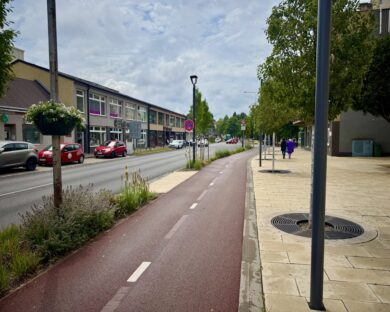
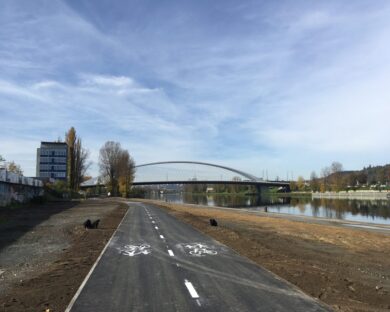
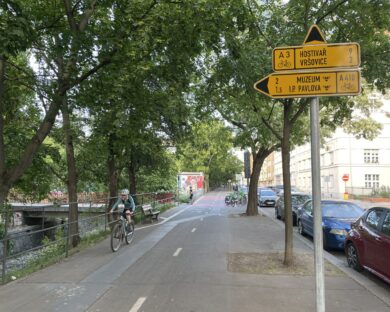
I live on the right bank of the Vltava River in Modřany and I work in Strašnice, so my main route is bike path A2. It’s pretty much my daily routine—I ride that path there and back, twice a day, unless I’m working from home.
Is the situation for cycling in Prague improving?
Since the time of Mayor Bém, not much has changed on my route. I understand that getting anything done in Prague is difficult, but the pace of change is painfully slow. It is getting better—but not fast enough. And even though I appreciate every step forward, I hesitate to say it out loud—people might think it’s good enough. It’s not.
How much do you ride in a year?
I use the Na kole Prahou (Through Prague by Bike) app, so I have a good overview—I ride about 6 to 7 thousand kilometers a year within Prague, and a few hundred more outside the city. I primarily see the bike as a means of transport, not a hobby. I don’t go on weekend rides; I simply commute by bike because it’s more efficient than driving or using public transport.
I’ve done a few leisure cycling rides, though. They were really quite memorable—like a ride across Prague’s bridges. Or the one across the north, west, south and east poles of Prague, though I didn’t have a camera back then, so we’ll have to do it again. One trip I have fond memories of was when we tested my orange single-speed bike from Decathlon. We managed to ride almost 250 km from Dresden to Prague in a single day. The route is flat, of course. But it showed that even a bike worth 5,000 crowns (about 200 Euro’s) can be a proper mode of transport and can easily be used in the city as an alternative to an expensive sports bike.
What advantages does cycling in the city bring you?
It mainly saves time. My commute is 16 kilometers, and even during the afternoon rush, I get home faster than by car. On top of that, cycling gives me enough physical activity—I don’t have to go running or hit the gym to ride a stationary bike. Moving around the city by bike gives me my daily dose of exercise.
The second advantage is health-related. I’ll skip the discussion about air quality and exhaust fumes. Even in Prague, there are routes where you can cycle completely away from car traffic. For example, you can get from Černý Most to Modřany with only one short interruption near Karlovy Lázně, and mostly away from heavy traffic. For me, riding a bike is also a way to clear my head and toughen up. I leave for work early in the morning—even in winter.
How do mainstream media cover urban cycling?
Hardly at all. It depends on individual journalists—if they’re interested, they might write something occasionally. But generally, urban cycling is not a topic. In some media, there’s even pressure to avoid talking about sustainable transport. Every newsroom has its target audience, and if that audience doesn’t care about cycling, the content reflects that. For example, our radio station targets middle-aged men, and you can’t just “push” bikes on them. Still, I have a lot of listeners who are interested in cycling and bike transport.
Is it getting better?
I hope so, but I don’t see much progress. In key positions, there are often people who won’t change their perspective. And in mainstream media, urban cycling still isn’t a topic.
Why did you start the Urban Cycling YouTube channel?
There’s Městem na kole, a great website with detailed information and news. AutoMat does important work in terms of infrastructure. Various local organizations tackle regional issues. But what I felt was missing was video. And since video content is becoming more and more important, I decided to give it a try with a few friends. I’m not a professional videographer, but we wanted to fill that gap. For me, videos were a new thing. My previous experience with filming and editing was just making home videos of the family.
Have you had any success in promoting urban cycling yet?
It’s hard to say—it’s only been a year since we launched the channel, so it’s still early for a big impact. But it makes me happy when someone writes to us saying that they started biking to work thanks to our videos. Even if there aren’t many of them, just a few individuals already makes it worthwhile. A lot of people also tell us that our videos made them think more seriously about urban cycling—and that’s really our main goal.
Because as we know, it’s mostly about a shift in mindset. People ride trails on the weekend, jump off huge ramps, and then during the week get in a car because they’re afraid to ride through the city to work. Part of it is that they don’t know the infrastructure—when you’re in a car, you don’t see it, so you don’t realize that cycling doesn’t have to mean riding on main roads.
Besides filming videos, you’re also pushing for infrastructure changes. Have you had any success?
I’ve been in talks with mayors, transport departments, and other institutions. I focus on the A2 bike path, particularly the section from Barrandovský Bridge to Modřany. Up to 10,000 people cycle that stretch daily, the same number walk it, and about 5,000 rollerblade through it.
For example, near Ledárny, the path suddenly turns into a road, but there’s no warning at all. People often keep riding as if they’re still on a bike path and are surprised when a car comes through. I’d like to make that street a cycling zone—only about 50 cars use it daily, so there’s no reason they should be prioritized over thousands of cyclists. The problem is that the Czech Police don’t know how to designate a main cycling road on a purpose-built local road.
Have you managed to implement any concrete changes?
So far, just small things—like getting a broken crossing button on Vídeňská repaired after months of follow-ups (though it’s already not working again). In Strašnice, I managed to get video detection systems to finally respond to cyclists. The most visible change was probably replacing the “Get off your bike” sign with one that says “Be considerate to each other” near the Modřany weir. I haven’t managed to push through any construction changes yet, but I’m working on it.
How do you choose topics for your videos?
We have three main areas: infrastructure, interviews, and riding technique. We try to rotate between them, though it doesn’t always work out. For example, there’s not always enough time to cover technique, even though I’ve got things like how to approach a cycle box from the right side past parked cars on my list. That’s going to be a hot topic. Even many recreational cyclists don’t understand it—and it makes sense, since most people only drive in the city.
Which video got the most attention?
The one that made the biggest splash was a guerrilla-built ramp for a curb in Braník—it got 170,000 views. The video even reached people who are against urban cycling and various motorist groups, so the comments were pretty negative. Unfortunately, that’s how the YouTube algorithm works—if people are arguing, the video gets pushed to even more viewers.
On the other hand, I was surprised by the low reach of our interview with the Minister of Transport. I expected more interest, but I guess people weren’t expecting any groundbreaking insights. The funny part was that I got a flat tire near the National Theatre on my way to the interview, so I didn’t arrive at the ministry by bike—I had to take a tram.
What are your goals for the future?
We want to normalize urban cycling in the public’s eyes. People don’t just ride bikes for recreation—many also commute by bike daily, just like motorists or public transport users. Our goal is for people to stop seeing urban cycling as something crazy and start seeing it as a normal mode of transport.
Thank you for the interview!
This is an adjusted machine translation using Automat’s CycleLingo Translator (ChatGPT) of this article: https://mestemnakole.cz/2025/03/petr-simacek-z-kanalu-mestska-cyklistika-neni-to-blaznovstvi-ale-normalni-zpusob-dopravy/
Líbil se Vám článek? Chcete v Česku lepší podmínky pro cyklodopravu?
Podpořte nás, stačí i 100 korun. 💙🚲
Vyberte prosím částku, poté budete přesmerováni na darujme.cz