The Central Bohemian Region, in cooperation with Prague Integrated Transport (PID), has unveiled plans for a new tram line that will, for the first time, extend beyond the borders of Prague. The 5.2-kilometer route will connect Prague’s Vozovna Kobylisy with Zdiby and the new Sedlec terminal. While the project promises improvements in public transport, the proposed cycling infrastructure has raised concerns.
The tram line will follow the old Ústí road II/608, cross the D8 motorway via a new bridge, and terminate at the Sedlec terminal, which will also feature a large park-and-ride lot with 834 spaces. Lines 10 and 17 will serve the route with frequent intervals and direct connections to central Prague. The line is intended to improve access to Prague’s northern edge and neighboring towns, especially during off-peak hours. Residents of Odolena Voda, Klecany, and Veltrusy are expected to benefit most from the plan.
The project presentation promises „improved cycling infrastructure.“ However, a closer look reveals that cycling was addressed only superficially – the plan includes bike pictogram corridors within the main street space, without any physical separation from motor traffic. On a busy road like this, such a solution falls short of modern safety standards and is unsuitable for children, seniors, and novice cyclists. Notably, Ústecká Street in Dolní Chabry — the part of the route within Prague — is 30 meters wide.
Public reactions under a video about the new tram line have expressed criticism, particularly of the cycling arrangements: „Boasting about improvements for cyclists is a real joke.“ Others point out: „All other developed European cities are doing more for cyclists than Prague.“ Some ask: „Why are you painting symbols on the road again when there’s enough room for a separate bike path? Is one dead cyclist not enough?“
Criticism on social media is easy, so we asked the responsible authorities for details. What, then, was the origin of this proposal?
Aneta Řehková, spokesperson for the Prague Public Transit Company (DPP), told MNK that despite the street’s generous width, the final solution is a compromise: „A more generous solution for cyclists within the built-up section of Ústecká Street isn’t feasible if we want to preserve greenery, sightlines, and parking.“ She explained that the street’s final design was the result of negotiations among the project designers, the local district, Prague’s Technical Road Administration (TSK), and the Prague Institute of Planning and Development (IPR).
The DPP spokesperson further clarified: „In the section from Kobylisy to Dolní Chabry, cyclists are routed within the main traffic space using bike lanes and pictogram corridors, with parallel alternative routes marked on neighboring streets.“
However, it should be noted that these side routes will never be as convenient, direct, or level as riding along the main street.
Outside Prague the tram line follows Ústecká Street out of the built-up area and runs between fields toward Zdiby. In this section, the project includes a shared path for pedestrians and cyclists alongside the road. When asked whether he considers this solution beneficial, Central Bohemian cycling coordinator Petr Klimeš responded: “The project improves cycling infrastructure compared to the current state.” He added that he had consulted on the project on behalf of the Central Bohemian Region and generally agrees with it—except for “the design of the Průběžná–Pražská intersection in Zdiby and the cycling infrastructure within the Sedlec terminal.”
He also noted that broader connectivity to the regional cycling network is covered by the Regional Cycling Development Concept for 2024–2030, which proposes route NR21 running from Zdiby through Líbeznice, Zlonín, and Kojetice to Neratovice. However, this route is not part of the tram project itself, though it will intersect it.
Petr Borecký (STAN), the Central Bohemian Region’s transport councilor, expressed frustration over the cycling infrastructure along the tram line within the region. On social media, he stated that he had advocated for a bike path separated from both cars and pedestrians, but according to him, the police rejected the proposal.
The future tram line is set to end in the village of Sedlec, where a transfer hub for buses will be built, along with a parking garage.
However, the project raises broader urban planning questions: instead of becoming the seed of a modern urban district, the new terminal will primarily be a large parking lot. There is no proposal for mixed-use development that would offer housing, services, or community facilities—in short, a new walkable neighborhood sustainably connected to central Prague.
Thus, the project repeats the mistake of the Černý Most terminal, a site Prague has unsuccessfully tried to fix for years. Instead of drawing inspiration from Europe’s “transit-friendly” developments, this project looks more like something from the U.S., whilst even there the model of single-use transit terminals with large parking lots is being phased out.
One other sore spot may be the only planned B+R (Bike + Ride) parking facility, located at the Sedlec terminal: “A 60 m² area for bicycle parking is proposed there; I’m not aware of any other B+R plans,” added Central Bohemian cycling coordinator Klimeš.
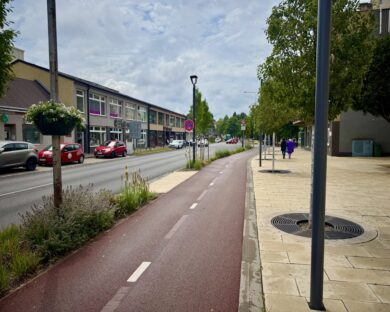
The tram line, expected to be completed around 2030, could have been an opportunity to connect Dolní Chabry, Zdiby, and Sedlec not only by public transport but also with safe cycling infrastructure. Although the regional cycling coordinator calls the plan an improvement over the current situation, the bar is set very low. The section passing through Dolní Chabry won’t even connect to the dedicated bike lanes on Ústecká Street built in 2020. Cyclists will be diverted onto side streets that are less convenient and less safe or into pictogram lanes offering minimal protection.
This is especially troubling given that a cyclist was killed on Ústecká Street last year after being hit by a turning truck. It’s disturbing that even such a tragedy did not prompt the city or the project designers to reconsider their safety standards. In a wide street like this—located in a residential area with strong potential for daily cycling—this represents a particularly painful failure. Prague is once again squandering an opportunity—and this time, it may have tragic consequences.
This is an adjusted machine translation using ChatGPT of this article: https://mestemnakole.cz/2025/06/promarnena-sance-nova-tramvajova-trat-z-prahy-povede-cyklisty-po-piktogramech/?cn-reloaded=1
Líbil se Vám článek? Chcete v Česku lepší podmínky pro cyklodopravu?
Podpořte nás, stačí i 100 korun. 💙🚲
Vyberte prosím částku, poté budete přesmerováni na darujme.cz