
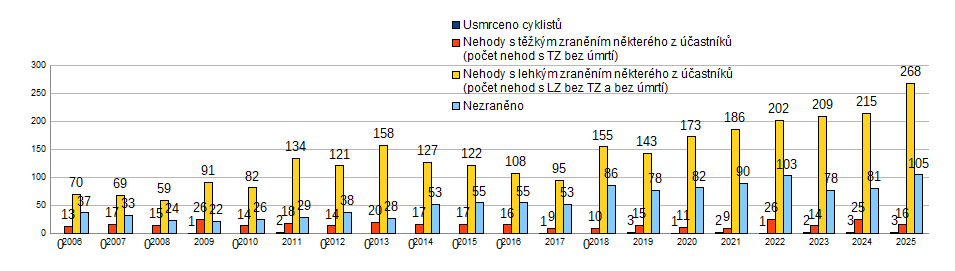
As we do every year, AutoMat brings you an analysis of traffic accidents in Prague involving bicycles and scooters. The total number of these accidents has been rising since 2023, reaching a peak last year. Unfortunately, the number of accidents resulting in injury is also increasing. All signs suggest that while the number of cyclists is growing, the development of safe infrastructure is failing to keep pace.
The analysis is based on the publicly available database nehody.cdv.cz, provided by the Transport Research Centre (CDV) using data recorded by the Czech Police. We thank both institutions for access to this information.
At the outset, we would like to point out that it has still not been possible to correct some emerging inaccuracies in the database, especially regarding the classification of electric scooters as motor vehicles, even though by law they fall into the category of bicycles—i.e., non-motorized vehicles. If you would like to browse the data yourself, please be mindful of this. In our methodology, we try to correct these errors at the baseline.
While the number of accidents involving serious injuries returned „to normal“ last year, the charts show that 2025 surpassed many previous years in almost every other metric.
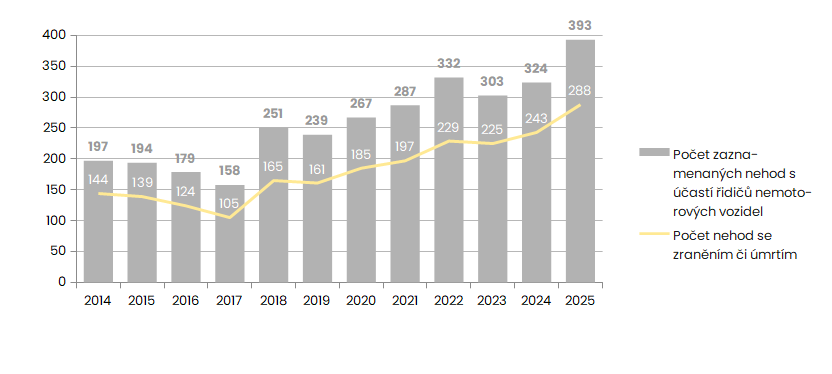
The total number of accidents involving drivers of non-motorized vehicles reached a historic high. From the chart below, it is evident that the number of accidents involving injury (with the exception of 2023) has been growing continuously since 2017.
As we predicted last year, it seems that the development of infrastructure for active mobility is failing to safely cover the increasing demand. Combined with increasing motor traffic intensities, this is literally a deadly combination.
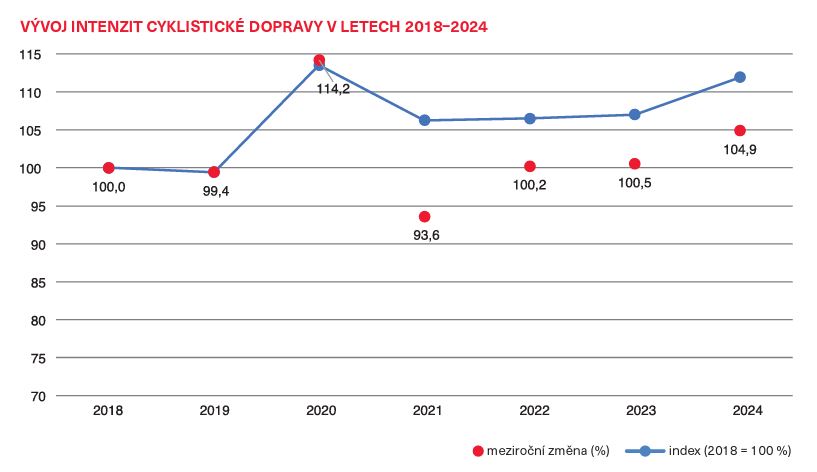
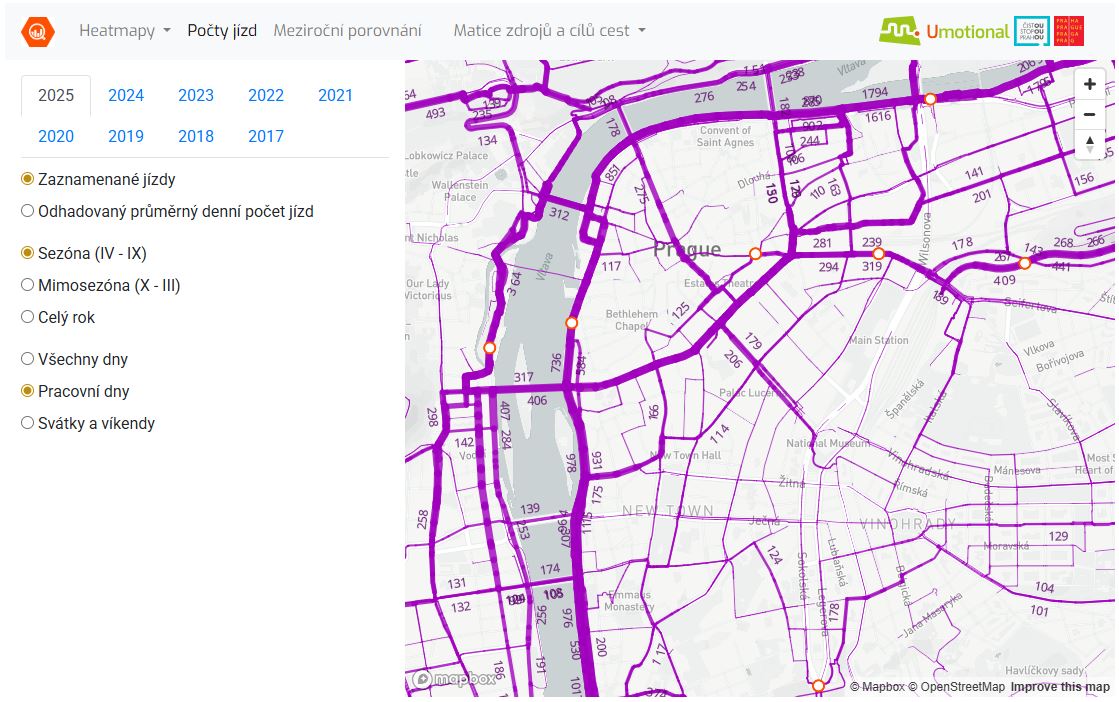
We are still waiting for the new TSK yearbook for 2025, but we are attaching at least the graph of the development of cycling intensities up to 2024, from which the growth trend in bicycle use is noticeable — a trend confirmed by our own analysis.
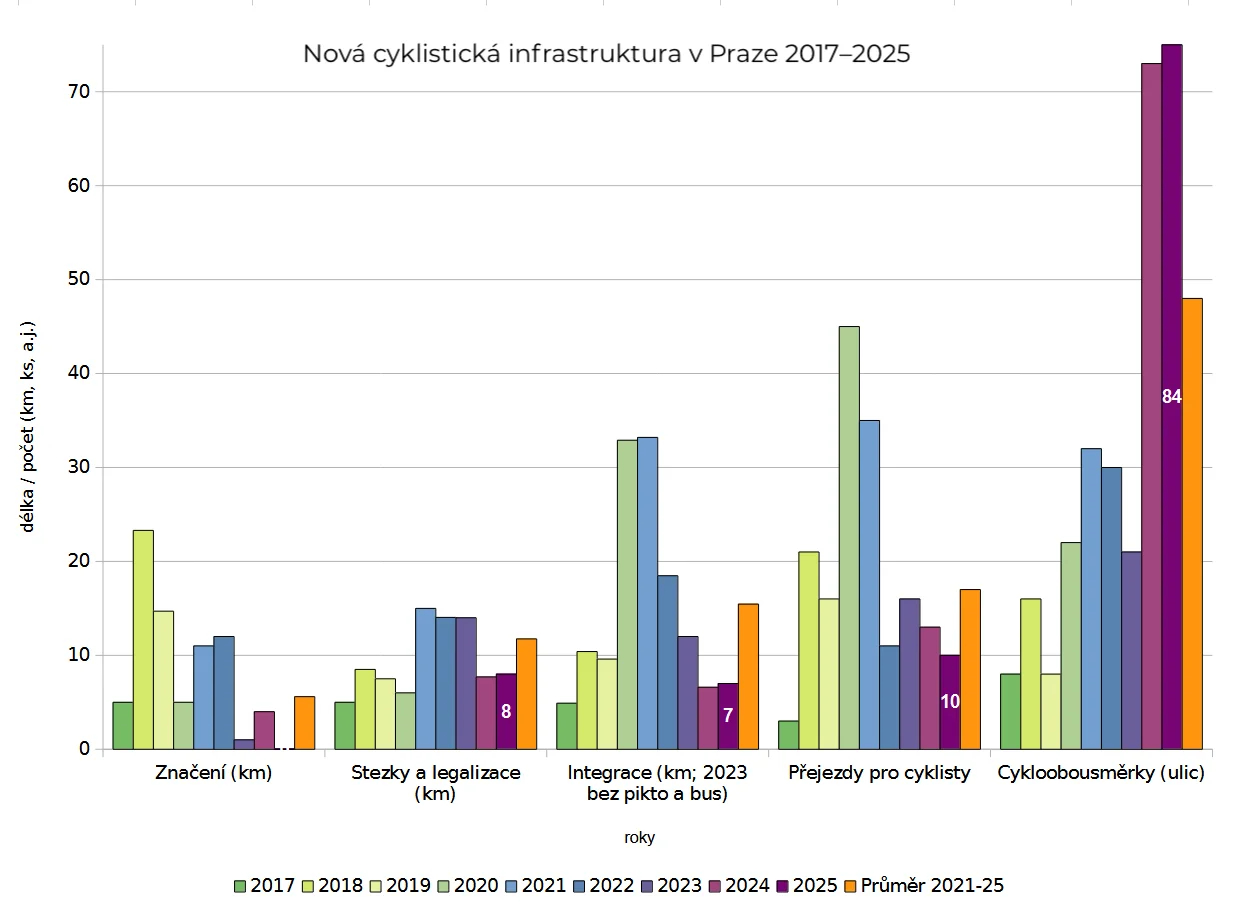
In contrast, the pace of infrastructure development and its quality over the last two years has been very slow. Only 4 kilometers of protected paths were created last year. Moreover, these were only mixed paths with pedestrians and not in the wider center, but on Prague’s outskirts. 2025 thus smoothly continued the significant slowdown in the pace of cycling infrastructure development from the previous year, when, for example, not a single dedicated cycle lane was created. That year not even 3 kilometers of mixed paths were added. While the significant increase in the number of contraflow cycling streets is commendable, it is not decisive for safety in terms of the accident rate.
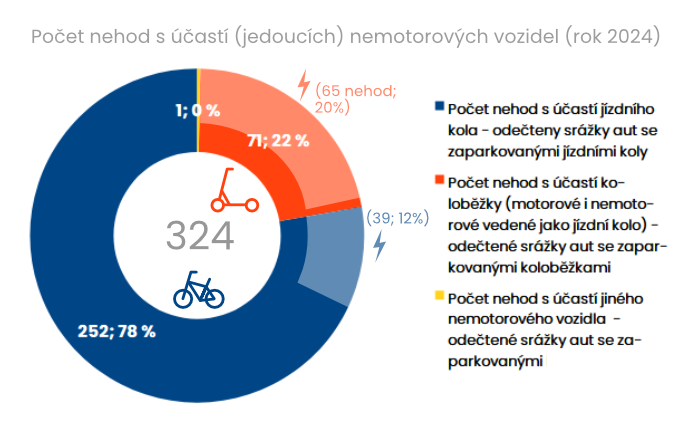
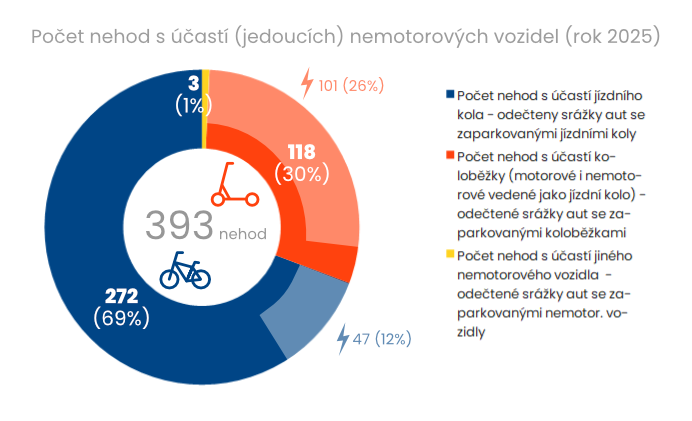
Unsurprisingly, the number of accidents with e-scooters in absolute numbers has been growing since 2023 (38 – 67 – 106), but in terms of the share of the total number of accidents, the difference is no longer so striking (12.5% – 20.7% – 27%). The number of accidents with so-called „shared service“ scooters is growing at a similar pace. On the contrary, the number of bicycles identified in accident statistics as owned by a private organization has decreased. In total, the number of shared vehicles involved in recorded accidents has stagnated since last year.
Is the number of trips taken on private bikes and scooters therefore growing? From such a small number of accidents, and considering a certain error rate in recording vehicle ownership, this cannot be unequivocally judged. It seems, however, that we cannot blame the discouraging accident figures of last year solely on the existence of shared services.
The number of collisions between e-scooters and pedestrians in 2025 is almost triple that of 2024. There are „only“ 11 actually recorded accidents (one of which involved a serious injury to a pedestrian), but it is easy to imagine that in reality, there are certainly many more mishaps, as with all accidents involving non-motorized transport. We are curious to see how the ban on shared scooters, which has been in effect since the beginning of this year, will move the accident rate. For comparison, collisions with a pedestrian in the case of e-bikes, which companies have now deployed instead of scooters, were recorded only twice last year. So, we might be in for major changes here as well.
Articles appear in the media referring to nationwide statistics showing a rising accident rate for people who use e-bikes. In the Prague environment, the number of accidents involving electric-powered bikes and scooters is also increasing, but again only in absolute numbers. As you can see in the charts below, in terms of the overall share, there is no change specifically for e-bikes, which is actually good news given their growing popularity.
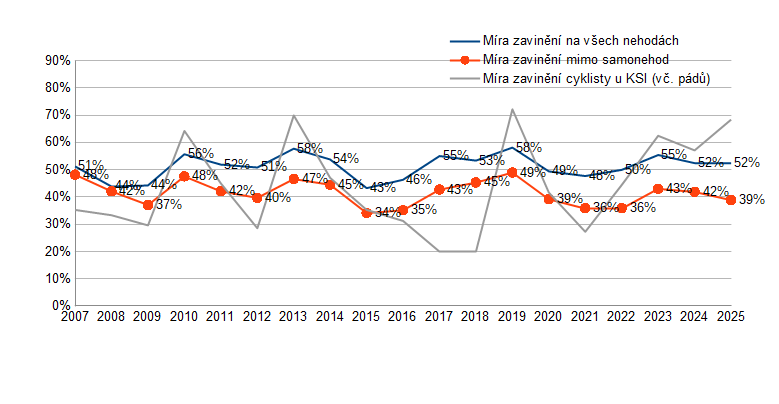
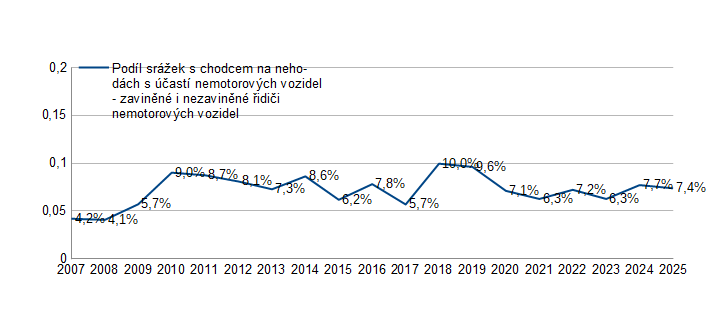
The overall fault rate on the part of those riding a bike or scooter has been slightly decreasing since 2023; in mutual collisions with other traffic participants, it even dropped below 40%. What does this figure and trend tell us? That those who ride bikes may not make mistakes as often as it might seem. Also, that the situation is not worsening even when more people ride bikes than the previous year. Incidentally, regardless of who is ultimately assigned blame, it is they, along with pedestrians, who bear disproportionately more serious consequences than people traveling in cars or trams.
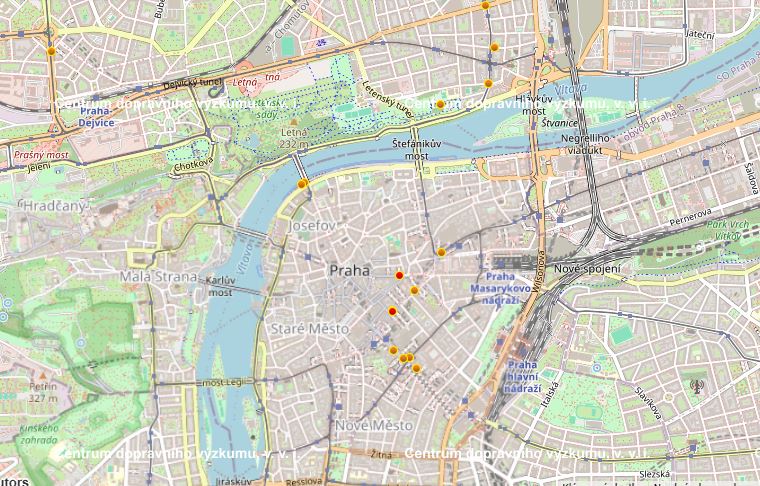
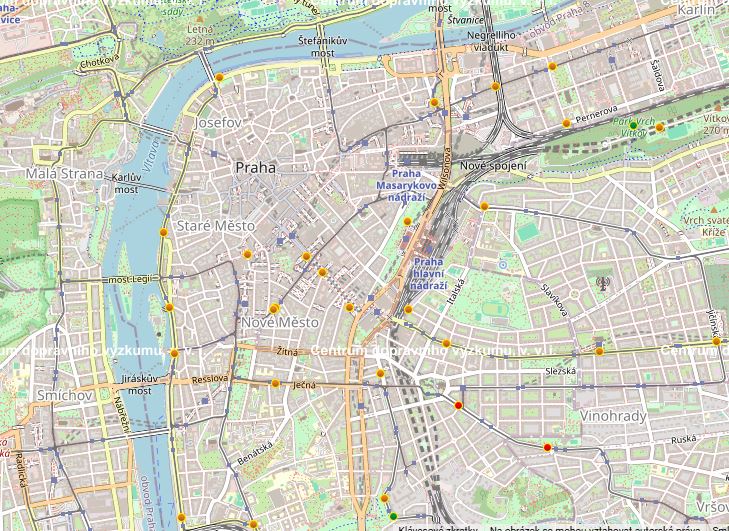
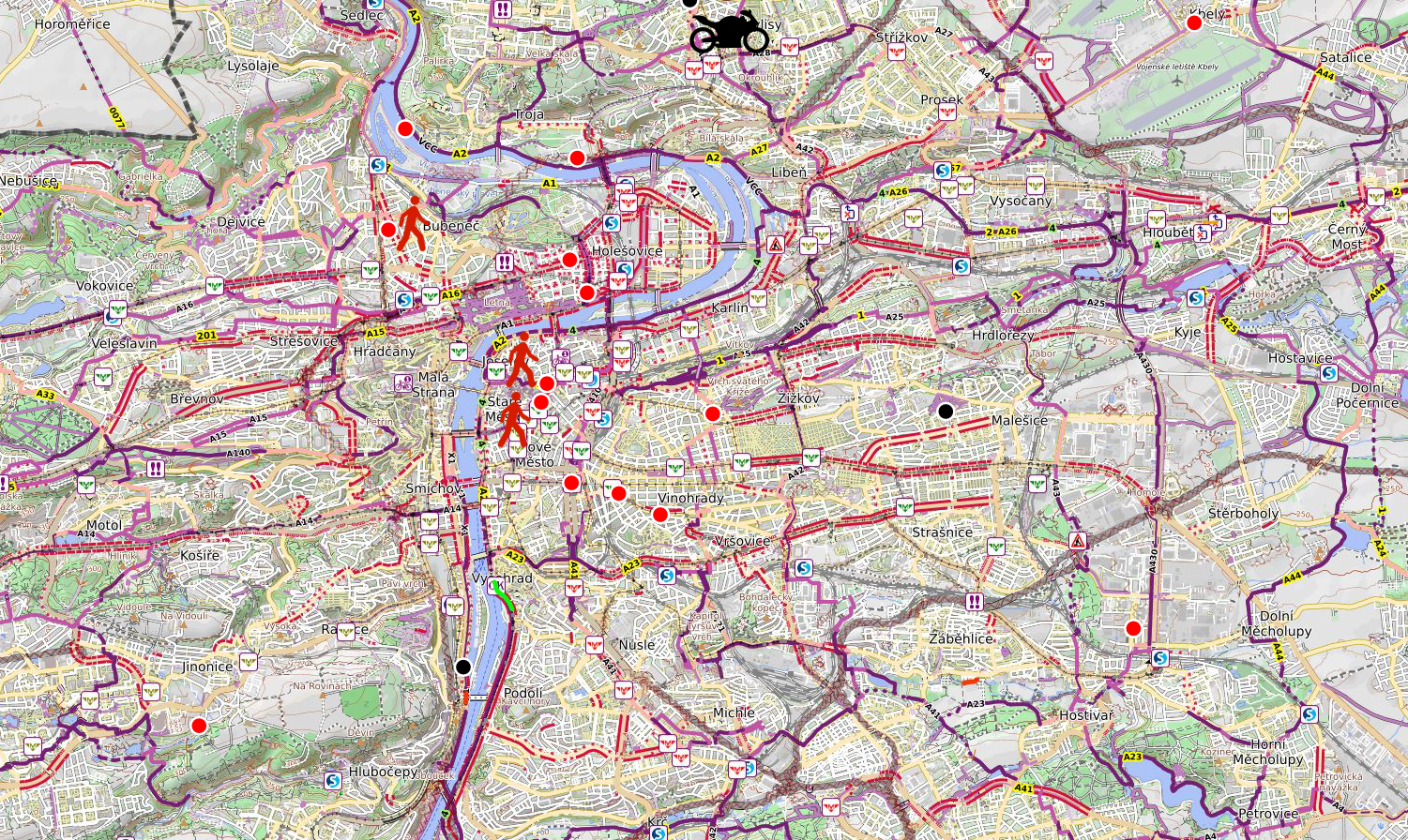
Yes, even those walking through the city are not among protected traffic participants. They are therefore vulnerable, similar to those riding a bike or scooter. That is why we also monitor their mutual interactions and recorded accidents—their number has stabilized in recent years. Of the 29 recorded collisions, 10 unfortunately took place on the sidewalk; 21 pedestrians were injured in accidents, 4 of them seriously. Officially, pets are responsible for two accidents. You can see the distribution of collisions with pedestrians in the center of Prague below. Traditionally, we can see a concentration of accidents in the pedestrian zones of Wenceslas Square and Na Příkopě street. Unfortunately, these still have no safe alternative for transit by bike.
The right-bank cycle route along the Vltava (A1) is, according to the Golemio server, one of the most frequented routes, which corresponds to the concentration of accidents. Smetanovo nábřeží remains critical, for which the passage through the historic center via the so-called „moat corridor“ (which includes the pedestrian zone with permitted cycling Na Příkopě) is a very inadequate alternative.
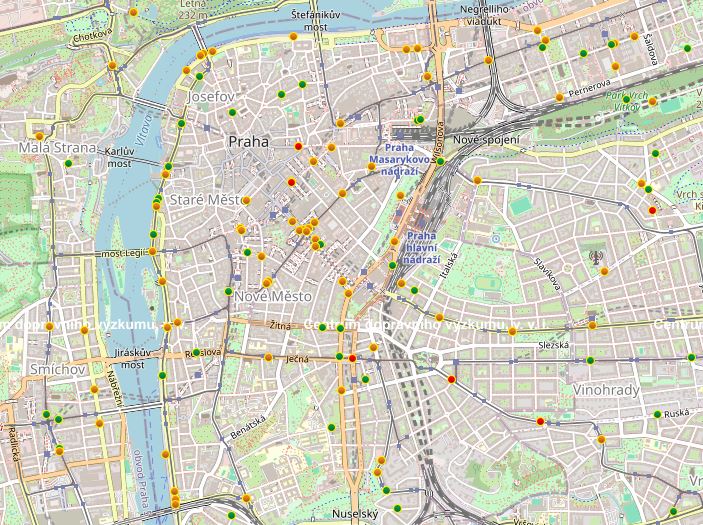
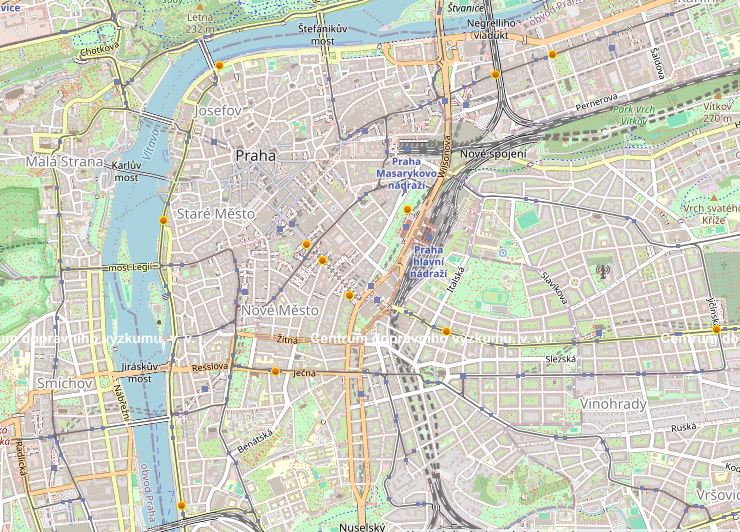
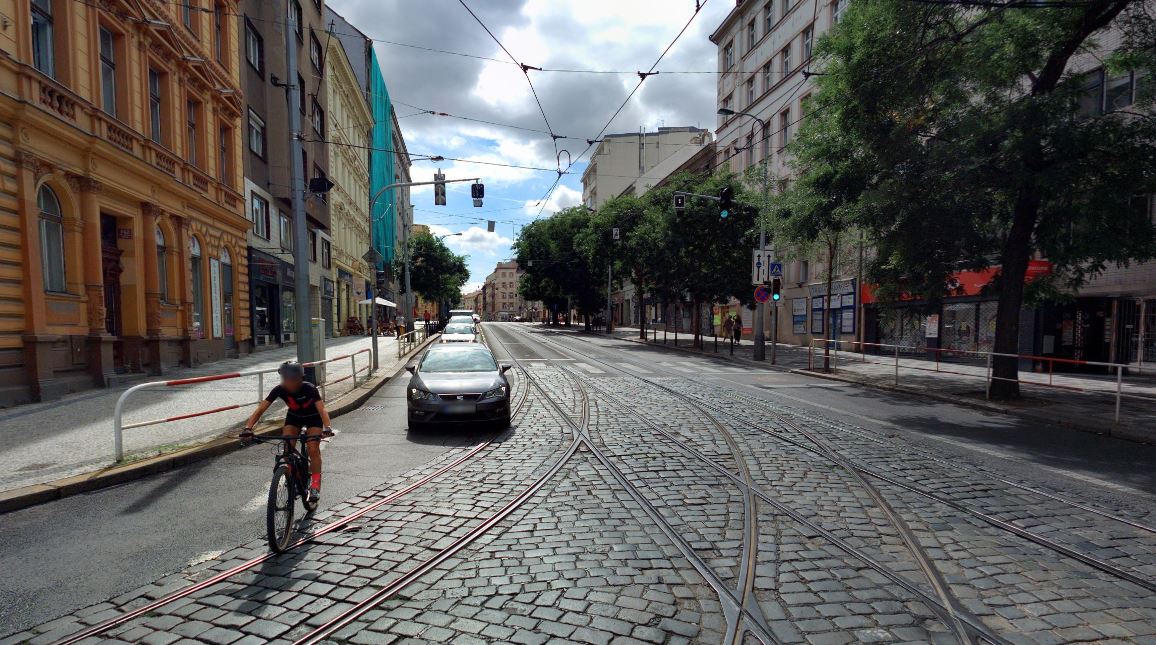
Last year, cyclists collided with a tram a total of seven times; fortunately, there were only minor injuries in all cases. However, the conflict potential of tram tracks is a traditional accident „evergreen“ even without the direct involvement of a tram—especially among accidents marked as crashes (see image below).
Incidentally, addictive substances do not exactly help in situations where you have to struggle with tram tracks. We illustrate this with a map of crashes involving people on bikes or scooters under the influence of alcohol.
Last year, a total of 4 people died in accidents involving bicycle or scooter drivers. One of them, who is missing from the graph at the beginning of the article, is a young motorcycle driver to whom, according to statistics, a female cyclist failed to give way. Unfortunately, we do not have more information about the accident, but in Prague statistics, this is the first such case in data published since 2007.
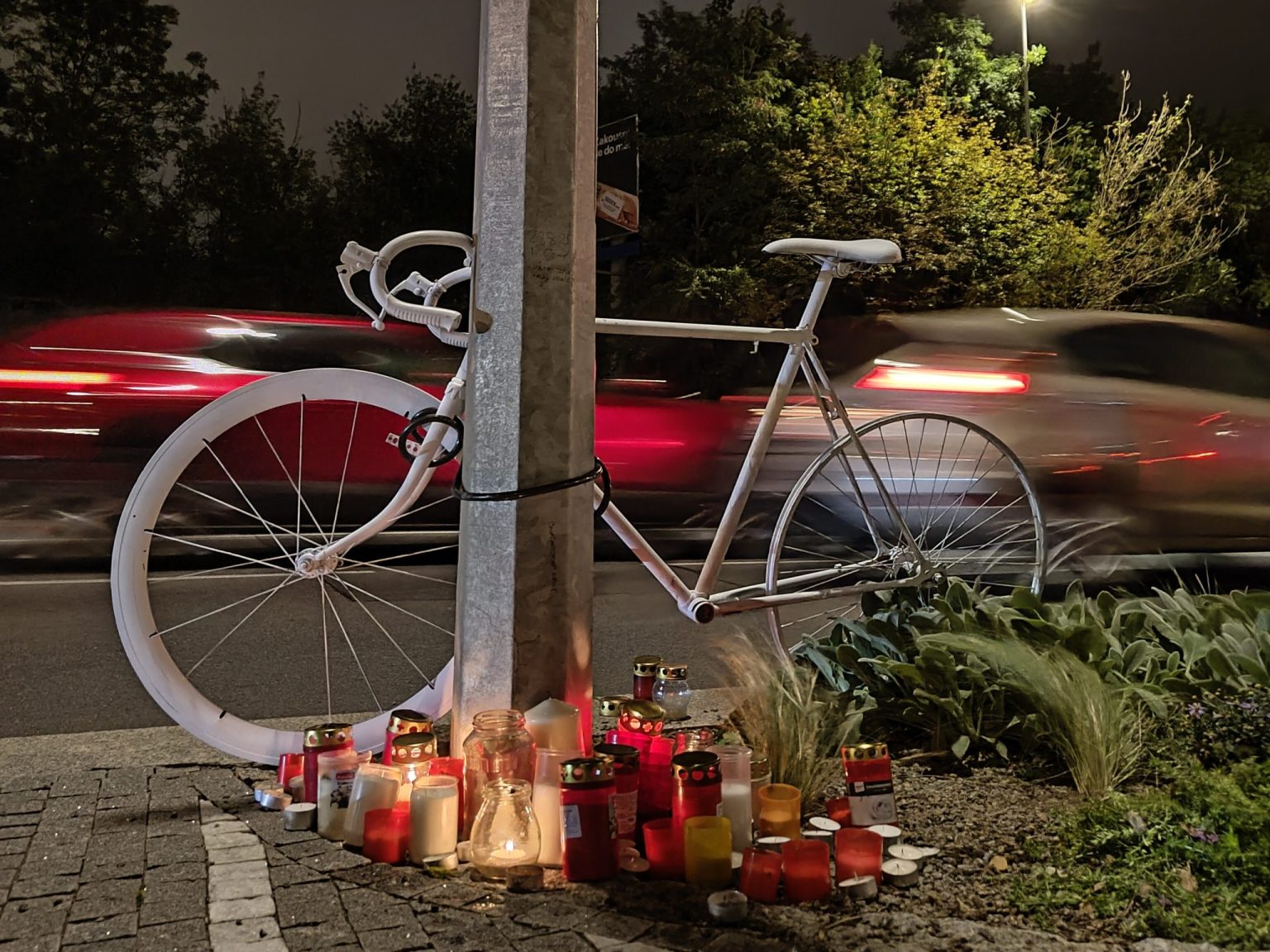
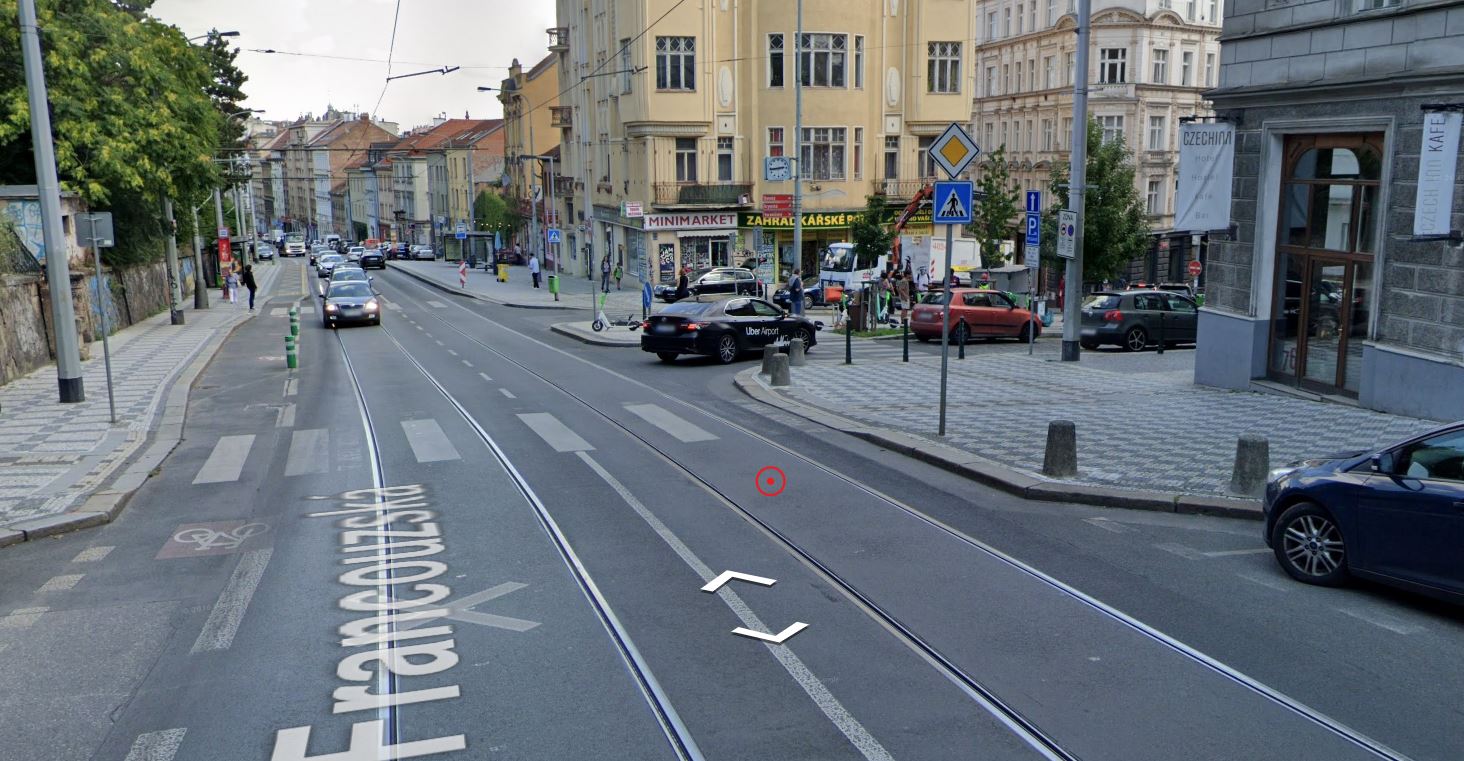
Another young life was extinguished during a collision between a man on a bike and an oncoming driver in a passenger vehicle on Strakonická Street. Statistics officially identify the deceased as the one at fault, as he was turning from Strakonická across oncoming traffic into a side street when the head-on collision of both vehicles occurred. In response to the accident, another Prague „ghost bike“ was placed here shortly thereafter.
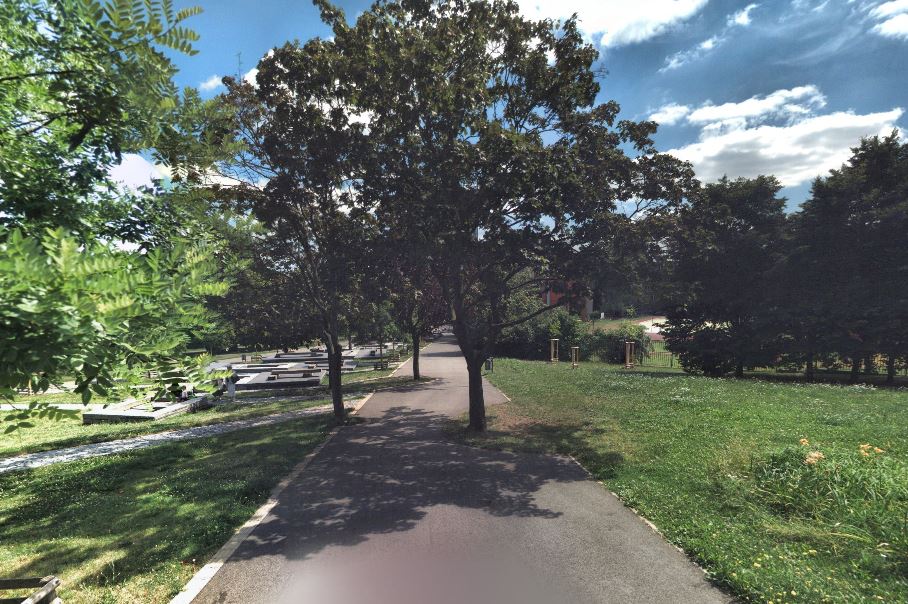
This year, we also reminded ourselves that it is necessary to monitor the column for the „number of days the person died after the accident“ in the statistics. Accidents where a person dies later from the consequences are usually still listed in the statistics as accidents with serious injury. Thus, one young victim is ultimately the result of an evening crash into a tree in the middle of a path in Malešický park south.
Shortly after a collision with a vehicle to which, according to statistics, he did not give way from the right, a 56-year-old cyclist also died in Klánovice at the exit from a cycle path on route A500. Unfortunately, we do not know how fast both vehicles were traveling, as in the case of the accident on Strakonická. Both collisions took place in areas with a maximum permitted speed of 50 km/h.
Among serious accidents (20 accidents with serious injury or death), faults by the non-motorized vehicle driver dominates. In mutual collisions with other traffic participants, it accounts for 12 out of 15 cases. However, more important than fault is considering whether such accidents or their serious consequences could be prevented. And for many of them, definitely yes—by creating a clear and safe environment where the existence of the bicycle and its specifics are not forgotten and where, if possible, traffic participants with different speeds of movement are not mixed. Therefore, we look closer at these accidents also in terms of conditions for cycling.
Only one serious accident was recorded on a cycle path (a collision of two cyclists). On mixed paths or in a pedestrian zone with permitted cycling, four collisions with pedestrians occurred with serious injury (to the pedestrians).
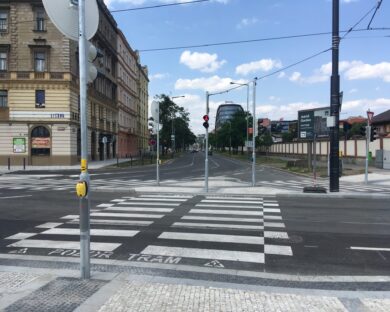
Twice, a person on a bike was seriously injured when crossing tracks; one of the cases was the location before the so-called „island“ tram stop Krymská, where the infrastructure forces you to ride between the tracks when going downhill.
In the statistics for the location of serious accidents, the traffic lane dominates (11 times) and intersections (twice). In most cases, these accidents occurred outside of any cycling measures. Maneuvers at intersections (without cycle crossings) or when entering the road were the cause of 9 accidents. In several cases, a person on a bike was overlooked, something we also have experience with at AutoMat. In this context, our colleague remembered the „Hele, motorka“ (Hey, a motorcycle) campaign, which could work for Prague drivers in the case of bikes as well. So, when you see a person on a bike in traffic while driving a motor vehicle, just say to yourself „Hey, a bike“—you will surely then be more aware of the presence of people on bikes in the city.
Cycle lanes, in addition to creating space for cycling and overtaking queues, generally help draw attention to the possible presence of cyclists. However, the „protective“ ones, which are not colored, can still be easily overlooked, just like people on bikes. A single case of a serious accident in a cycle lane happened last year in a protective cycle lane in Veletržní street and leads us to one recommendation:
Be careful when turning left through a queue of oncoming cars; a person on a bike may be traveling quite fast in the cycle lane parallel to it, and you simply won’t see them through the large cars. The warning, of course, also applies to those who feel invincible when riding in cycle lanes. In the Prague environment, it is still necessary to proactively account for the possible negligence of other participants with whom you share the space at that time.
Please, let’s (want to) create an environment and infrastructure that will help prevent serious accidents. This includes safe connections and continuity. Otherwise, we risk writing the same thing every year, only there might be a few more accidents to analyze again.
The analysis was created only thanks to the supporters of the AutoMat association. If you also want to financially support their independent and systematic work, do not hesitate. Thank you very much.
This is an adjusted machine translation using Gemini of this article: https://mestemnakole.cz/2026/04/pocet-nehod-s-jizdnimi-koly-v-praze-roste-v-roce-2025-dosahl-historickeho-maxima/
Líbil se Vám článek? Chcete v Česku lepší podmínky pro cyklodopravu?
Podpořte nás, stačí i 100 korun. 💙🚲
Vyberte prosím částku, poté budete přesmerováni na darujme.cz



komentář