One of the most common arguments against cyclists on the roads is that they don’t follow traffic rules. But is that really true? And why do cyclists sometimes break the rules? Let’s take a calm look at the issue, using data—without the emotion.
In Denmark, researchers decided to conduct a study that would bring hard data to the discussion about traffic violations. Though the study was carried out six years ago, in 2019, the topic comes up so frequently that it’s worth revisiting.
The researchers monitored various locations in Denmark to track how many traffic offenses cyclists committed, and what kinds of offenses they were. The result? Only 4.9% of cyclists committed any kind of traffic violation when riding on bike paths or designated cycling infrastructure. When riding outside of this infrastructure, the figure was 14%. An earlier Danish study produced almost identical results: out of a sample of 80,000 cyclists, only 5% broke the rules.
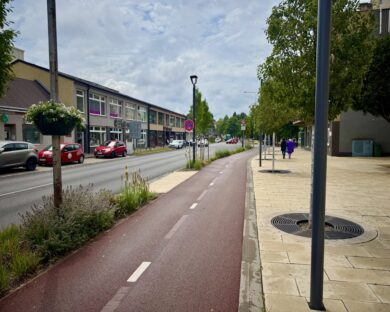
So is that a lot or a little? For comparison: 66% of car drivers committed traffic offenses. Among motorists, the most common offense was speeding—a frequent cause of accidents. For cyclists, the most common violation was riding on the sidewalk, which typically signals inadequate cycling infrastructure or a cyclist’s fear for their own safety.

When discussing traffic violations, it’s important to consider how dangerous those violations are—and what impact they may have on people’s lives and health. Even if cyclists and motorists committed the same number of offenses (which they don’t—cyclists commit significantly fewer), the level of danger they pose is on a completely different scale. There’s hardly any need to explain the difference between being hit by a person on a 12 kg bicycle and by a 1.5-ton car. Despite all the modern safety features in today’s cars—like crumple zones and advanced materials—cars remain exponentially more dangerous than bicycles.
Beyond the ever-increasing size and weight of vehicles, speed is also a major factor. Speeding is among the most common traffic offenses recorded. Anyone who’s ridden a bike in the city knows that the 50 km/h speed limit hardly applies—unless you’re training for the Tour de France. It’s also worth noting that cyclists pose virtually zero threat to motorists. If a cyclist crashes into your car, there’s virtually no chance you’ll be seriously injured—or injured at all. The same absolutely cannot be said in reverse. Interestingly, around 40% of cycling accidents are so-called solo crashes—meaning the only person injured is the cyclist themselves, due to a fall, obstacle, or loss of control.
Another interesting question is: why do cyclists sometimes break the rules? One frequently mentioned topic in public debates is cyclists riding through red lights. While running a red light is indeed dangerous for cars, is it the same for bikes?
Many countries now use tiered rules for red lights—one set for cars, and another for cyclists. In the U.S., this is known as the Idaho Stop—a law first passed in Idaho in 1982, which allows cyclists to treat a red light as a stop sign, and a stop sign as a yield.
Why? Because bicycles and cars are fundamentally different, and so is how they operate. Bikes move more slowly, are more maneuverable, provide better visibility, and take up far less space. That’s why lawmakers in various states and countries have chosen to adjust legislation accordingly. Similar rules exist in Europe: France and Belgium have special traffic signs that allow cyclists to treat a red light as a yield.
Finally, it’s also important to note that not every apparent traffic violation is actually a violation. Not everyone is thoroughly familiar with traffic laws, which can lead to the mistaken belief that cyclists are breaking the rules—even when they aren’t. Here are three commonly mentioned “offenses” that I hear about most often: riding on the sidewalk, undertaking (passing on the right side), and riding without a helmet.
This is an adjusted machine translation using ChatGPT of this article: https://mestemnakole.cz/2025/07/cykliste-a-dopravni-prestupky-jak-je-to-doopravdy/
Líbil se Vám článek? Chcete v Česku lepší podmínky pro cyklodopravu?
Podpořte nás, stačí i 100 korun. 💙🚲
Vyberte prosím částku, poté budete přesmerováni na darujme.cz