

I have been interested in the development of cycling infrastructure in Prague since around 2007. It has proven to be a laborious process, accompanied by stories full of countless twists and turns. In the following accounts, I would like to bring you closer to what I remember from nearly twenty years—before I forget it completely.
Most of what I will write about is something I experienced in one way or another, whether from the position of an observer or, since 2010, as a member of Prague’s Cycling Commission, and ultimately also as the author of analyses and studies for City Hall, including cooperating on updates to the citywide system of cycle routes over roughly the past eight years.
Supporting my memories are the Městem na kole website and my private archive, containing a number of studies, projects, and maps—especially the Prague cycling atlases that I prepared in 2007 and 2008.
Let us bear in mind, however, that memory is a treacherous thing. Although I have tried to verify key facts, what cannot be verified, or what I was unable to find, I may have written differently from how things actually happened. I ask you therefore to take the following anecdotes from the creation of Prague’s cycle routes with an appropriate degree of caution.
I also ask that if there are things I truly do not remember correctly, you help set them right—but please support this, if possible, with contemporary references. Major errors I will correct directly in the articles.
I am also a biased observer — biased in favor of cycling transport. I am an actor who measures the benefits of transport solutions also by their positive impact on cycling and by the absence of solutions that endanger cyclists. I call for conditions for cyclists that are safe, comfortable, and dignified.
I identify with a vision of developing cycling transport that would, in the long term, give Prague a chance to reach a 5–10% cycling modal share, thereby significantly relieving the expensive modes of car and public transport. I estimate that to achieve a functional network of protected cycle routes, Prague should be building approximately 20 kilometers of routes separated from cars each year. Prague came close to this level of development only in 2013, 2021, and 2022, when nearly 15 kilometers of protected infrastructure were built annually.
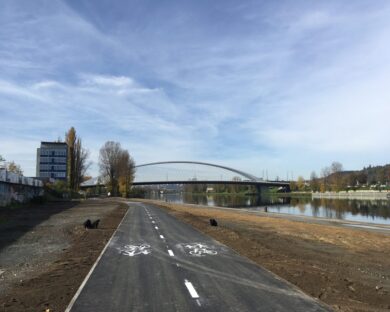
Although the citywide system begins with route A0, everyone knows that the most important cycle route is the riverside A2 along the Vltava—the best known and most heavily used cycle route in Prague. It has already been declared “completed” several times by various politicians, probably for the first time by councillor for the environment, Petr Štěpánek, sometime around 2010. And, in essence, it is complete: it is without heavy traffic, and you can ride it end to end, except for the cursed gap at Smetana Embankment. That gap divided Prague’s cycling areas into north and south twenty years ago just as it does today.
Many of its sections, however, are not wide enough, or were built temporarily on historic sidewalks, and so they are repaired or widened here and there. By the scale of its repairs, cycle route A2 is becoming not unlike the D1 motorway.
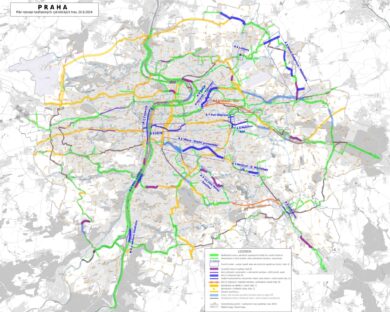
The citywide cycle-route system was created in 2006, and route A2 was one of those that entered it already at least partially in existence. Today, few people remember routes MO-BR (Modřany–Braník), RO (Rohanský Island), TR–PT (Troja–Pelc-Tyrolka), or the long-distance routes 2 and 3 of the Czech Tourist Club that passed through the center of Prague. I wrote about cycle route A2 in detail sixteen years ago; its earlier history is described there.
From the very first study by Štěpán Boháč in 2006, the route was planned as a cycle path. After the first improvements in 2007, its reasonably usable form in the south of Prague ended in Komořany, with the section to Zbraslav under construction. To reach Modřany, however, cyclists still used Vltavanů Street.
From Braník to Výtoň, the path ran along the same sidewalk of Podolí Embankment as it does today, only without a single pedestrian-cyclist crossing, because a shared crossing and a crossing for cyclists was not yet defined by traffic signage under the regulations at the time, and no one dared to create sidewalk crossings over a driveway—even though the frequency of cars heading to the gas station was significantly lower than the number of cyclists. The first sidewalk crossings at the entrances to side streets appeared only around 2011, in Polaneckého Street in Kbely.
The Vyšehrad Tunnel existed with bicycle guidance, and the river embankments were still far from having the continuous smooth strip that first became a symbol of cyclists penetrating inner Prague, and later its curse. We will keep silent about the passage through the city center. The gravel path across Rohanský Island was only just being built, as was Rohanské Embankment, where cycling was partly on concrete panel roads. Freshly, however, it became possible to pass under Libeň Bridge through a recently cleared underpass, and across the Rokytka gates, where—compared to the original version of the project—it was possible to create a non-motorized footbridge.
Cycling on U Českých loděnic Street had only been permitted for a few years at that time, and the hellish sidewalk of Povltavská was not yet legal. From the ZOO further north, cycling went along streets and not always paved paths; in particular, the section to Klecany remained notorious for a long time for offering a choice between bouncing over large stones on an old towpath or riding a smooth, worn singletrack right at the water’s edge.
So when, fifteen years later, it became possible to declare cycle path A2 practically complete from Vrané to Klecany, it was quite an advance. Not that there was one hundred percent satisfaction with the form of the route. The unfinished sections in the city center and on Povltavská were obvious, as was the need to upgrade a number of segments.
In 2021, a fairly detailed study was produced on this at TSK (also for route A1). The first stages of modernization between Podolí and Braník are underway, with others in preparation, as well as the replacement of the narrow sidewalk along Povltavská. As before, the pace can be considered slow: projects are being postponed and delayed, and the very execution of the route faces obstacles in many places in the form of unsympathetic stakeholders. Nevertheless, cycle route A2 is functional, and the discussion has shifted more toward how to make it work better.
Next time, we will take a proper look at some of its locations in the southern part, recall selected sections and the obstacles to their realization, as well as amusing moments that demonstrate that in the complicated system of Prague’s transport decision-making, even something as modest as “the A2” is, in fact, a success.
–– To be continued ––
This is an adjusted machine translation using ChatGPT of this article: https://mestemnakole.cz/2026/01/vzpominani-na-prazske-cyklotrasy-1-uvod/
Líbil se Vám článek? Chcete v Česku lepší podmínky pro cyklodopravu?
Podpořte nás, stačí i 100 korun. 💙🚲
Vyberte prosím částku, poté budete přesmerováni na darujme.cz



komentář