The latest MultiSport Index 2024 survey delivered a warning: more than half of Czech children do not engage in any sports, and a quarter of adults exercise less than once a month. Healthcare costs are rising, productivity is falling. And politicians? Instead of promoting daily physical activity in a smart way, they keep planning billion-crown investments in sports facilities. Yet in many cases, just one thing would be enough — a safe route to school by foot or bike.
According to the Czech National Institute of Public Health, over 60% of Czech adults are overweight or obese — 70% of men and nearly half of women. Obesity contributes to a wide range of serious diseases: cardiovascular issues, diabetes, high blood pressure, and cancer. The state already spends tens of billions of crowns each year treating obesity-related illnesses.
According to a model by Professor Hindls, these costs could reach CZK 313 billion annually by 2035 — more than what the country spent managing the COVID-19 pandemic. A mere 10-percentage-point reduction in the share of overweight people could save up to CZK 60 billion per year.
Over 80% of Czechs cite lack of time as the main obstacle to exercising. Another major barrier is cost. That’s exactly where active mobility has huge potential — it doesn’t require expensive gear, memberships, or special facilities. It enables natural movement as part of daily life — on the way to school, work, or the store.
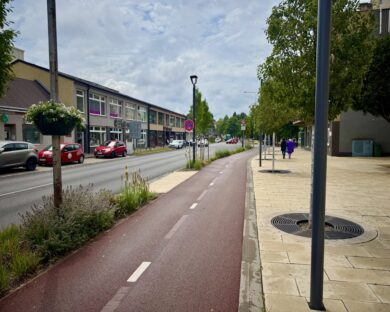
But pedestrians and cyclists still face an environment that makes getting around difficult: narrow sidewalks, missing crosswalks, damaged paths, or disconnected, illogical, and unsafe bike lanes. Daily movement is more an act of courage than a normal routine.
In the capital, sustainable transport is often discussed, but reality paints a different picture. A symbolic case is the recently opened Elektra Elementary School in Vysočany. Despite being a modern educational building, its access for pedestrians and cycling children is unsafe and inadequate — just a narrow sidewalk leads to the school, where kids squeeze alongside passing cars. Meanwhile, those arriving by car can drive right to the entrance. The rest are left with smog and stress.
This kind of approach — which contradicts all national and city strategic documents — is no exception. Instead of promoting active travel, Prague and many other Czech cities build cycling infrastructure slowly, and often poorly and inconsistently.
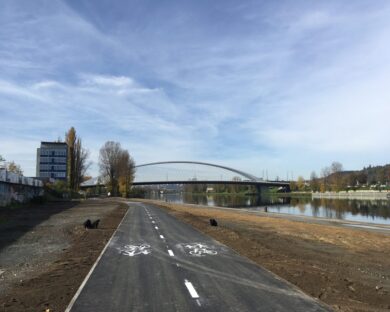
Politicians frequently compete over plans for new stadiums or how much funding to send to the National Sports Agency. But real-world evidence shows that the health of children and adults can’t be secured by one hour of sports per week. Daily movement is more effective and sustainable — whether it’s walking to school, a meeting, or the shop. Instead of investing billions in stadiums, we should focus on building networks of safe bike lanes, school streets, and calm zones — the kind that both 8-year-olds and 80-year-olds can use. And for free.
This isn’t just about health — it’s also about the economy. Danish research shows that every kilometer cycled generates a net gain of about CZK 10 for society, while every kilometer driven by car costs about CZK 6. Active mobility lowers healthcare costs, improves air quality, and boosts productivity.
When public space isn’t safe, parents teach their children — unintentionally — that independent movement is abnormal. This creates the “mom and dad taxi” phenomenon: many children spend most of their day shuttled between home and school by car. They lose touch with public space, with navigation skills, social interaction, and natural daily exercise.
This isn’t parental failure — it’s the result of an environment that systematically prioritizes cars. Children grow up in a world where walking or cycling is either dangerous or impossible. And then, a few years later, the state wonders why it’s spending hundreds of billions on treating diseases caused by inactivity.
Positive steps — like introducing school streets in Prague — show that change is possible. But if we’re serious about public health, individual projects aren’t enough. Political parties and government offices need to realize that improving the physical condition of Czechs isn’t just about pumping money into sports clubs — it’s about how we move in public space every day. That space should welcome active transport, not push it away. It’s where everyday health begins.
This is an adjusted machine translation using Automat’s CycleLingo Translator (ChatGPT) of this article: https://mestemnakole.cz/2025/06/komentar-politici-si-stezuji-na-obezni-cechy-aktivni-mobilitu-pritom-dal-utlacuji/
Líbil se Vám článek? Chcete v Česku lepší podmínky pro cyklodopravu?
Podpořte nás, stačí i 100 korun. 💙🚲
Vyberte prosím částku, poté budete přesmerováni na darujme.cz