There’s been long-standing talk that cycling infrastructure should be integrated into other reconstruction projects in the city. But how is Prague doing in this regard? Sometimes well, sometimes partially, and sometimes not at all. A good case study is the intersection of Patočkova and Střešovická streets.
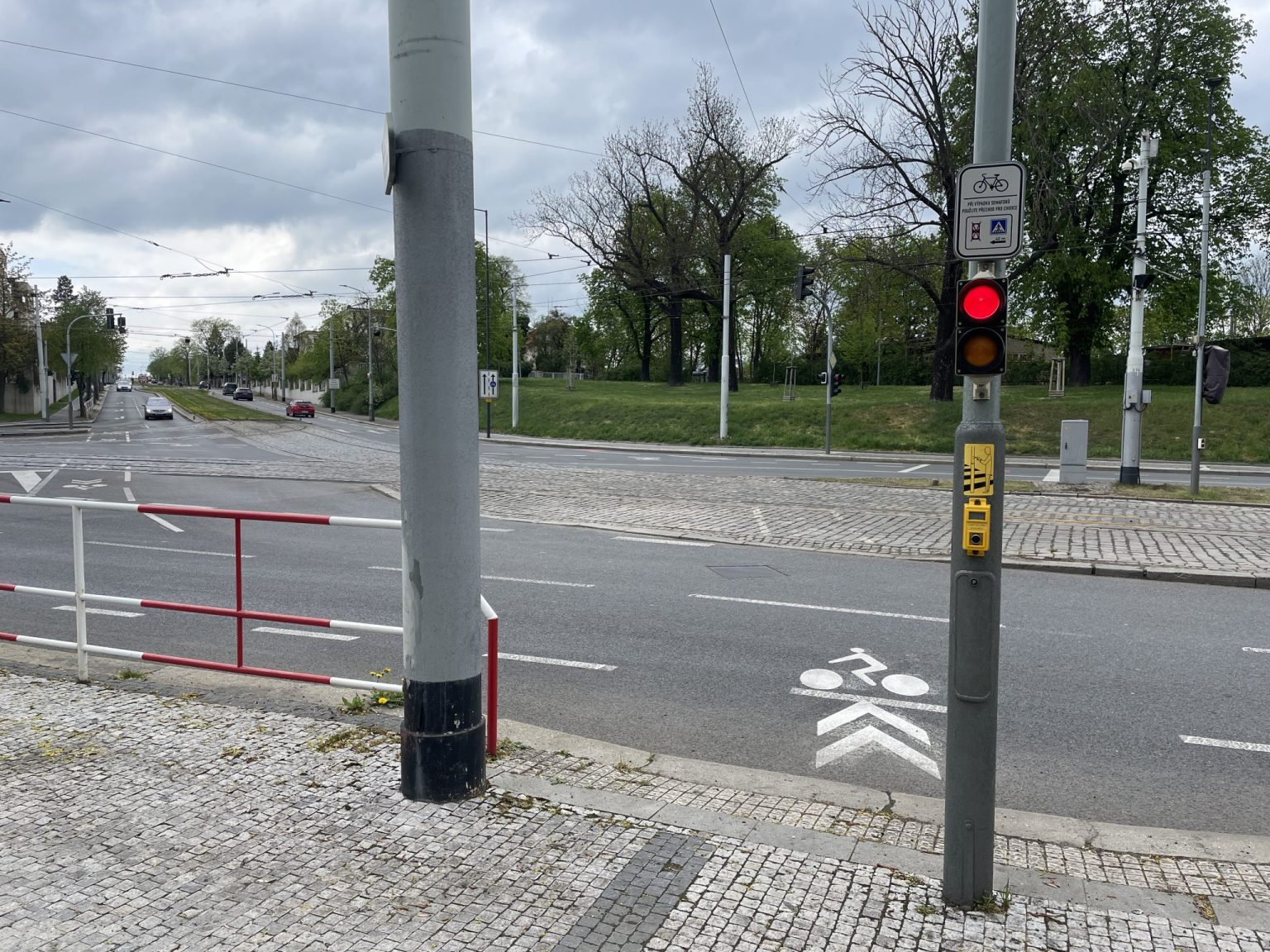
This intersection includes a low-cost bike crossing that allows cyclists to exit the long-standing bike path in Max van der Stoel Park and merge into traffic on Střešovická. The crossing certainly has its flaws: it relies on a dedicated traffic light, the surface quality is subpar, and the wait time for a green signal is long due to the nature of the intersection and its light cycles. What’s more, if next you’re heading left from Střešovická into Sibeliova along bike route A150, you’d have to be a rather masochistic stickler for the rules not to just use the pedestrian crossing a bit further west instead.
As a result, the reverse direction—entering the park from Střešovická—is actually used more often. That “infrastructure” is just a gap in the railing with a lowered curb, rather than the official crossing into Střešovická.
Still, it’s a good thing that both connections exist. They’re simple, cause minimal delays, and allow for direct cycling access between Jelení and Střešovická streets. Without them, the local cycling network would be significantly worse. It’s worth noting that these links were added in connection with the construction of the Blanka Tunnel. In that sense, this could be considered a fairly good example of integrating cycling into a major construction project.
But it wasn’t a given. Next month marks 13 years since the then-spokesperson for Metrostav responded to my inquiry about whether such a cycling connection was being planned at the Střešovická intersection during the Blanka construction. He said: “The issue is being addressed. The project designer has been instructed to include cycling in the intersection design. However, it’s important to note that the original plan was ‘only’ to install new traffic signal poles in existing positions. Moreover, changes weren’t expected in all branches of the intersection. That, of course, impacts the project’s cost and the procedures in place in case of a budget increase. The final decision must be made by the investor.”
The final design therefore reflects the situation at the time—the bike crossing was added later and was not part of the original construction plan. In essence, it’s just a gap in a railing with a dedicated signal. The surface itself was never improved; they simply painted over the tram tracks.
The positive aspect—that the investor eventually decided to fund the dedicated signal and removal of the railing—is somewhat overshadowed by what happened in the following 13 years. Anyone who expected this hastily assembled solution to be upgraded during a nearby reconstruction has been left disappointed.
Workers have intervened in the area of the crossing multiple times since, but each time, everything was restored to its original “temporary” state. Not even a slightly smoother pavement was added—let alone the removal of unnecessary raised curbs where bicycles cross.
A recent example is the replacement of the tram tracks. Tram service was suspended throughout April, the tracks were replaced — yet the original paving was carefully restored exactly as it was before.
Why? The DPP (Prague Public Transit Company) spokesperson explains: “At the Patočkova x Střešovická intersection, the tram tracks will only be replaced. The tram line itself will not be reconstructed, so the work carried out must comply with the original construction approval from the past.”
This raises the question: is a new building permit required to replace paving stones or lower a curb, but not for replacing tracks? In the end, it always comes down to whether someone takes the time to consider this in advance and decides to act — especially when the workers replacing the paving and tracks are already there. If no one thinks ahead, or is unwilling to act or fund the work, nothing will change. Because no matter what, some extra preparation will always be needed — whether it’s applying for a new building permit or simply purchasing better paving in advance.
And you know what? We asked the building authority what kind of administrative process such changes would actually require.
Replacing the pavement with a smoother surface? “If the project involves replacing the surface layer of the road, it would not require a permit from the building authority. However, it would need to be discussed with the road administrator (TSK of the City of Prague). Since the location lies within a heritage-protected area, it would also require approval from the Department of Monument Care at Prague City Hall and potentially other bodies identified during the consultation process. The construction work would not be subject to occupancy approval,” wrote the Prague 6 Building Authority.
And what about fixing the bothersome curbs as well? “If the work involved altering curb heights, then under the new Building Act No. 283/2021 Coll., according to Annex 1, it would be considered a minor construction. According to item (g) of the same annex, it would qualify as maintenance or minor alterations of roadways, and therefore the building authority would neither issue a building permit nor an occupancy permit. However, unlike simply replacing the surface, this would also require consultation with the Czech Police — specifically, the Prague Metropolitan Police Department. In any case, it depends on the judgment of the building authority and the extent of the intended modifications,” the office added. “In this specific case, the project would be assessed by the Department of Roads and Railways at Prague City Hall, since the location involves a first-class local road,” the authority concluded.
So, DPP certainly can’t just show up with smoother paving stones and simply swap them out. There would be work involved — including administrative work. In the end, the question is whether it might have been worth the effort, given that construction was already going to happen and trams wouldn’t run there for a whole month? After all, someone must have planned and prepared the track replacement too.
But those are now questions of the past. Everything is back the way it was. So once again, people will be riding over uncomfortable paving and a few extra curbs. It’s not exactly dangerous — just mildly inconvenient — and after 12 years, everyone’s used to it. Sure, it’s nice that the crossing exists at all. Sadly, even that still isn’t standard in Prague.
And so, despite yet another opportunity, no improvement was made. Why bother, after all? The only result would’ve been a smoother ride.
This is an adjusted machine translation using ChatGPT of this article: https://mestemnakole.cz/2025/06/komentar-jeden-maly-priklad-stagnace-infrastruktury/
Líbil se Vám článek? Chcete v Česku lepší podmínky pro cyklodopravu?
Podpořte nás, stačí i 100 korun. 💙🚲
Vyberte prosím částku, poté budete přesmerováni na darujme.cz