It has been a year since the municipal elections, and we are asking the councillors for transportation in Prague 1 to Prague 22 about their plans for cycling transportation. We continue with the Prague 5 district, which has nearly 90,000 residents and includes the areas of Smíchov, Radlice, Motol, Košíře, and Hlubočepy. Milan Kryl, the councillor for transportation representing the Pirate Party, answers our questions.
After the elections, the leadership of Prague 5 changed completely. Does this political shift also mean a new transportation concept? What is your concept regarding active transportation in Prague 5?
In the field of transportation, there has indeed been a political shift of 180 degrees. How does this manifest itself? Perhaps a greater emphasis on non-motorized transportation. Or greater support for alternative modes of transportation rather than just building more parking lots and expanding roads for cars. However, in the previous electoral term, a transport plan was developed, and we are still working based on that plan. So, we are not starting from scratch, but rather coming up with new ideas and drawing from the transport plan, as well as local experiences related to supporting cycling.
In the previous election term, for example, there was the problematic combination of new parking and bike lanes on Plzeňská Street near Motol Hospital. It became a bit of an issue, with some repainting taking place [parking was removed, bike lanes were kept – editor’s note]. This case completely halted further activities, and now we are revisiting the proposal, which aimed to modify Plzeňská Street towards the city center. Two lanes were narrowed to one multiple times, causing traffic complications. We want to simplify this by creating a bike lane and parking spaces.
Special Newsletter for Regular Donors
Regular donors of „Městem na kole“ (City by Bike) have the opportunity to suggest topics to question the Prague 5 council members. If you want to receive our special newsletters and be informed in advance about similar interviews, become a regular donor on this page.
Similarly, we have commissioned a project for the modification of Strakonická Street, where the A1 main bike route is supposed to lead. It is the most frequented cycling route in Prague 5. On the left bank of the Vltava River, from the distillery towards the city center, it is not ideal at the moment.
Ideally, we would direct cyclists through Císařská Louka and return them to the riverside after crossing a footbridge. However, this vision is not feasible because Císařská Louka is a private island, and we do not have the owner’s consent. Therefore, we need to explore alternative routes to guide cyclists to the city center, especially in relation to successful constructions around Klárov.
What will the cyclist infrastructure look like on Strakonická Street and further into the city?
We have initiated a project for the modification of Strakonická Street, starting from the distillery and extending to the railway bridge. Coincidentally, we had a meeting yesterday about the River Terrace project, which is adjacent to this street, as well as the Šemíkův břeh project. We are very focused on ensuring that the waterfront is not private and closed but rather that there remains ample public space along the river, allowing for pedestrian and cycling access to connect with the riverbanks located to the north. The outcome of the future railway bridge and its modifications is still uncertain, but these projects are generally designed to create new ramps and connections for non-motorized transportation on the bridge.
In the perpendicular direction towards the river, we aim to connect routes and are working on connecting bike paths at the railway bridge. The bike path from the bridge will extend through Strakonická and Nádražní Street, all the way to the new Smíchov City neighborhood.
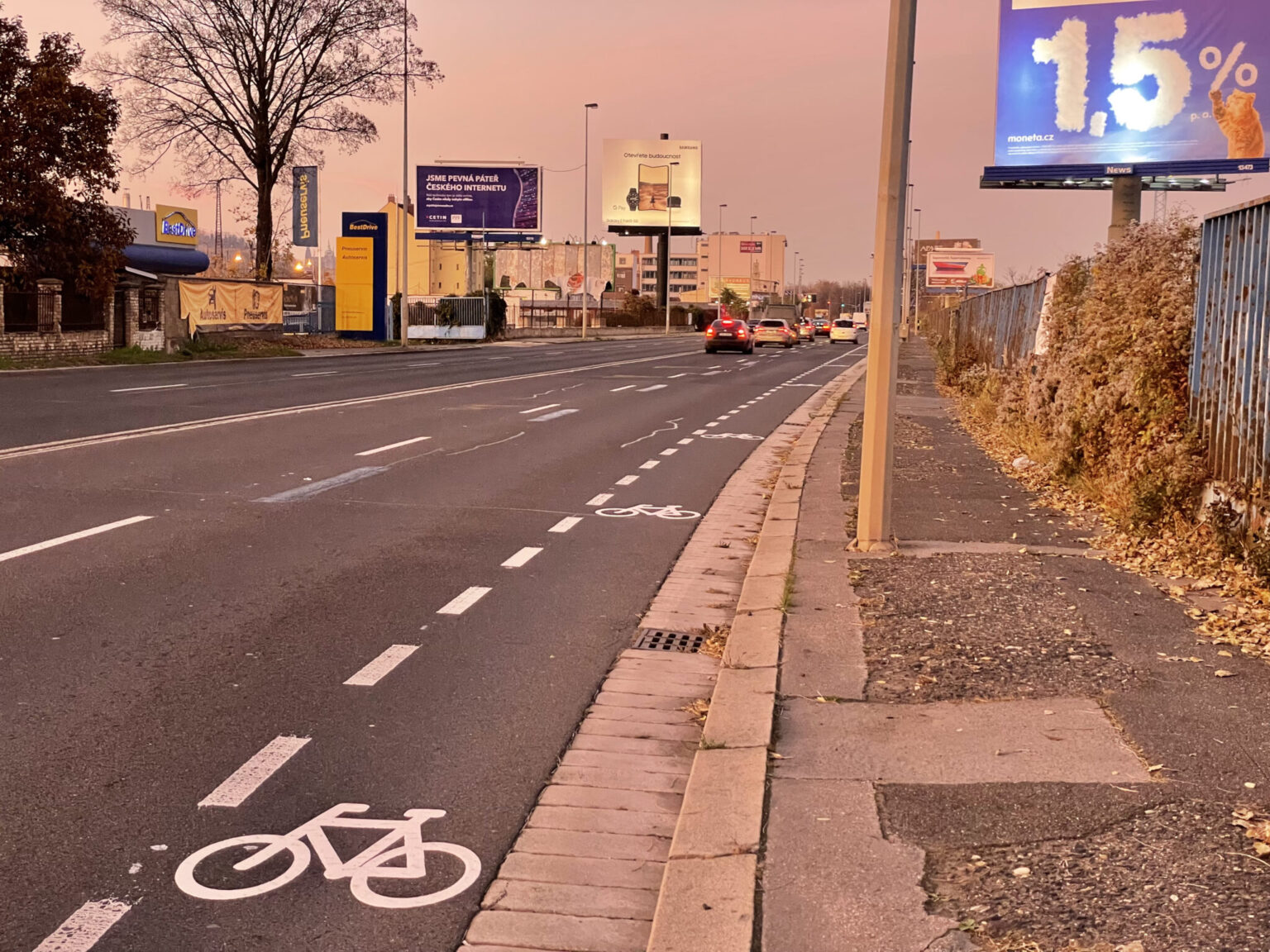
We are also addressing Strakonická Street itself, for which there is a study going on if it could be a possible cycling corridor. Here, we want to physically separate cyclists from cars, or at least make non-structural improvements using measures like „klemfixes“ or similar approaches. I wouldn’t take my children to ride a bike in the kind of traffic you find on streets like Plzeňská or Strakonická.
We discussed these modifications with the Institute of Planning and Development (IPR) and the city. It’s not yet at a stage where we can present it, but we want to have a fully separated lane for cyclists.
Separated from pedestrians as well?
Yes, separated from pedestrians as well. Completely.
And what about heading further into the city? The current bike lane ends under Palacký Bridge.
That hasn’t been addressed yet. On the other bank, there is a smooth path for cyclists along the waterfront. If it is viable for preservationists, then it could be possible to set it up on our side as well.
The waterfront ends before Jirásek Bridge. How to proceed further? Would it be possible to remove the parking lane and replace it with a two-way bike lane?
We haven’t discussed that yet. There are always challenges, and there may be objections to this solution.
So, you’ve focused on the A1 bike route section on Strakonická for now, and other sections are yet to be addressed?
Yes, we started in the south and are progressing northward.
When we move away from the A1 cycle route along the river, passing through valleys in Prague 5 can be problematic…
We already talked about Plzeňská Street. There will be a more continuous bike lane heading towards the city center, and there is some solution in the works for the route out of the center. We also have a study for the Motol Valley, which has some challenging areas. In the part closer to the Vltava River, on the southern slope of Plzeňská Street, we face issues with military-owned land. Otherwise, we would have connected the bike path over those slopes. This requires quite complex solutions but it is a priority. The backbone cycle route project is also in the city’s policy statement.
If someone is currently cycling through the Motol Valley from the city center, there’s no avoiding Plzeňská Street, which can be very unpleasant. I heard that the city administration, in conjunction with Prague 5, is planning to legalize cycling on shared sidewalks. Is that correct?
There was a discussion about it at the last transportation committee meeting. The sidewalk is relatively wide and has low pedestrian traffic, so it will be possible for cyclists to use the sidewalk there. Unfortunately, it won’t be possible for Plzeňská Street to have this regime throughout its entire length.
What about Radlická Valley, where the planned major A8 cycle route passes through?
For the Radlická Valley, we have a separate study. There is also a study for extending the tram line along the upper section of the street. To really be satisfied, we want to transform Radlická into an urban boulevard, which is linked to the construction of the Radlická Radial. With the volume of cars that currently pass through there, it’s impossible to make any significant changes. We first need to get the cars into a tunnel.
Then it will be possible to turn Radlická into a quieter street with wide sidewalks, shops, additional development with active ground floors, and a comfortable space for cyclists.
That will take a long time…
Yes, that’s right.
Ten years or more?
Possibly even longer. For instance, our transport plan is conceived up to 2030, and it doesn’t account for the Radlická Radial. Before the Environmental Impact Assessment (EIA) is initiated, before it is discussed with relevant authorities, before documentation is prepared… In short, it will likely happen in the next decade.
But changes on Radlická are already happening today. ČSOB headquarters was established above the tram terminal, and a continuous residential neighborhood is being built all the way to Jinonice metro station. A project by Penta promised a safe bike path within the new development, but nothing has been constructed. Only a parking lane for cars has been added along Radlická. Are there any plans for changes there?
On the street parallel to Radlická, there should be space for cycling.
However, according to the current regulations, cycling is not allowed there.
It should be marked as a shared space. It is not stated anywhere that cycling is prohibited. On the other hand, it’s not a major cycling route; that would truly be implemented with the future boulevard. The neighborhood is designed in a way that even children commuting to school should be able to ride scooters or bikes and such.
But those who follow the rules legally cannot cycle to school along this route.
A new law should be approved soon to enable the creation of „shared“ zones. So this space in the new development will be shared, but in the current project, it is not. Similar spaces lacked legislative support before and were marked as pedestrian zones with various exceptions. This is now changing.


Let’s move to the tramway viaduct at Barrandov. There has been a long-standing plan to allow cycling along it. Is there any progress on this front?
This initiative is maybe six years old, and at that time, I didn’t even know that I would enter local politics. The initiative encountered copyright issues with the architect of the viaduct. To enable safe cycling, the railing would need to be raised, but the architect disagreed, and the whole idea was shelved. An alternative is Barrandovská Street, which has since become a two-way street for cyclists.
And now, let’s talk about bikesharing. Many other city districts are moving towards „solutions“ for shared bicycles and scooters. Designated areas are being created in front of crosswalks and other locations on the roadway. Prague 1, 2, 3, 6, and 8 are proceeding in this manner. How are you doing on this matter? Many such areas have not yet been established in Prague 5…
Last week was the deadline for submitting comments on the memorandum between the city and the bikesharing companies. Our city district made a comment indicating that the document lacks a definition of parking spaces. The document currently defines „no-go“ red zones where parking is prohibited. So does this mean that parking is allowed everywhere else? That’s exactly what people don’t like. This morning, I walked through Anděl, and bikes and scooters were randomly placed alongside buildings without any rules. There are no rules for this; everyone leaves them wherever they want. That bothers us.
Since the beginning of the electoral period, we have been negotiating with the operators about designated parking locations. We have fairly dense maps of bike and scooter parking locations and the conditions for their use.
How many of these locations will there be in total?
It mainly concerns the city center. We have to consider whether we’re counting the total number of bikes or the number of „nests.“ On many intersections, we have bike parking on each of the four arms. We have thirty such locations in Smíchov, from Lidická to Vítězná. If I multiply that, it’s 30 x 4, so 120 locations. Each of these places can accommodate 4 or 5 bikes, so it adds up to spaces for 600 bikes or scooters in total. We place them in parking bays, and in some locations, they are also planned on the sidewalk.
However, I must say that Smíchov’s streets are narrower than in other city districts. If I consider Žižkov or Vinohrady, then we are at a disadvantage.
When will these new parking locations start appearing on the streets?
This is also a legislative matter. There are currently no rules for bikesharing, which is why the memorandum is being created. We would like it to be enforceable, either through a regulation or another measure. This will compel operators to adhere to the measures.


On the other hand, other city districts aren’t waiting, and they’re marking locations. The situation with scooters is already improving there.
We have preliminary agreements with operators that they will allow parking only in places designated for bikes and scooters. We have obtained a list of locations that are most frequently used by their customers. We have initiated project preparation for these locations, and negotiations with the Czech Police will come next. Once we receive approval from the police, we can hand over the locations for marking by the city’s technical services. So, we are not at the beginning, but we haven’t completed it yet.
You mentioned Lidická Street. I read that Prague 5 wants to extend the pedestrian zone from Anděl towards Palacký Bridge. Do you have a vision for this?
We have consulted the Institute for Planning and Development about this matter. We would like the modifications in Lidická Street to take place together with the reconstruction of the bridge. Currently, there are options that the tram tracks will either be shifted or remain in their current position. If there is no relocation, one side of Palacký Bridge will have a narrow sidewalk. If the tracks are moved, the sidewalk will be expanded where technically possible to accommodate a pedestrian zone. However, the project is still at an early stage.
What is the transport vision for Lidická Street?
We would like a shared space there, similar to Štefánikova Street, where we want to extend the shared pedestrian zone to V Botanice Street. Two new construction projects are being prepared for this. At the intersection of Štefánikova and V Botanice Streets, Pražská developers will build a large residential building, which will also be in connection to this.
Can you provide a preliminary year for implementation?
To have a date for implementation, the project needs to have building permits. We are currently in consultations with the Institute for Planning and Development and the city. Together, we are finding a consensus on what the space should look like. After that, we would try to plan some dates. In a way, the reconstruction of Palacký Bridge will push us. Bridges always drive actions forward because they won’t wait for their own repairs.
How else do you plan to improve conditions for cycling in Prague 5?
Where possible, we would like to create separate infrastructure for cyclists to make cycling safe, ultimately increasing the number of cyclists. Besides the north-south corridor [cycle route A1], we also have other routes, such as from Chuchelský háj across the entire city district to Ladronka, completely away from road traffic.
Are you planning any contraflow bike lanes?
Yes, we are planning contraflow bike lanes in the lower Smíchov area, on streets where the original two-way traffic was changed to one-way to allow more space for parking. If cyclists are required to obey the rules of road traffic, they must detour entire blocks, which unfortunately often leads to them taking shorter routes on the sidewalk.
What change in this electoral period will have the most positive impact on pedestrian and cycling transportation in Prague 5?
In this electoral period, Dvorecký Bridge will be completed, and hopefully, the area around Smíchov Station as well. Then there are new large developments from the distillery to the north and Smíchov City. We want new districts to be permeable „inside.“ Where cars cannot access, there will be maximum permeability for pedestrians and other non-motorized transportation. And beyond Smíchov Station as part of the new development, a cycle path will be created that connects Meet Factory, Sportovná, and the railway bridge.
At Smíchov Station, covered parking for hundreds of bikes is planned. However, according to visualizations, it won’t be easy to access. Before reaching the station, a person will have to navigate through cars, buses, and trams in a discontinuous bike lane. Why won’t a separate bike lane be created here? We did not receive a clear answer from the municipality.
Because there was a demand to establish a pedestrian zone in front of the station, meaning trams would have to move almost at a walking pace, which would extend the journey for many people. So all proposals have their pros and cons. It might be easier to define this once shared zones are in place.
In addition, the pedestrian footbridge above Smíchov Station is soon to be dismantled. How long will we have to wait before a new one is built?
This is a nightmare for me. We only started dealing with it now, after the elections. It turns out the replacement of the footbridge should have been planned much earlier, at the time when the building permit was issued. After the permit was granted, developers designed construction plans – where cranes would be placed – and because of that, even a temporary passage or replacing the footbridge elsewhere is impossible. We won’t be allowed into the Smíchov City construction area at all. For the next several years, this vast area will be completely impassable for pedestrians. It shouldn’t have happened. Now, I am already only negotiating the possibility of alternative bus transport or reinforcing a specific bus line.
So, how long will Radlická be without a pedestrian and cycling connection to Smíchov Station?
The scheduled dismantling of the footbridge is in October this year, and the new footbridge will open in 2025 or 2026. So it will be a crazy two or three years.
Which foreign city is an inspiration for you in terms of transportation?
I’ve traveled to many cities. However, most of them cannot be compared to Prague. Your readers will certainly mention Copenhagen or Amsterdam. Opponents will say that Prague is hilly. I cycled with my family very often when I lived in Karlín, along the Vltava River to places like Troja or Stromovka. Now I live on Barrandovská skála, and it’s all ups and downs, which is a different experience. So, comparing with other cities is difficult.
You don’t need to compare; you can just say which one you like.
Taking the opposite perspective, in many cities that I considered to be rich with high-quality infrastructure, I was disappointed by the negative impact of traffic and the urban planning driven by it. For example, in Los Angeles or American cities which were built specifically for motorists. The city’s surface is often used for wide highways and huge parking lots on every corner. Asphalt everywhere, you can hardly walk anywhere on foot. For a while, I lived in Beverly Hills, and nobody walks there. Everyone drives out of their gates and then drives into them. This is not something we should take as an example. Where do I like it? I can say Paris, Berlin, Munich, or Vienna. I have various sources of inspiration.
Do you ever travel around the city by bike yourself? You mentioned commuting in Karlín.
Now that I’m almost of retirement age and living on a hill, cycling is not a solution for me.
And do you follow our magazine?
After you contacted me, I read it for the first time. Before, I only saw links on Twitter or Facebook, where I follow other transport channels as well.
Thank you.
This is an adjusted ChatGPT translation of this article: https://mestemnakole.cz/2023/10/co-chystaji-mestske-casti-praha-5-2/
Líbil se Vám článek? Chcete v Česku lepší podmínky pro cyklodopravu?
Podpořte nás, stačí i 100 korun. 💙🚲
Vyberte prosím částku, poté budete přesmerováni na darujme.cz