

Cleaning the cycle path on U Českých loděnic Street in 2014 with the aim of creating effective spatial separation between pedestrians and cyclists.
I have been following the development of cycling infrastructure in Prague since around 2007. Its progress has been laborious and accompanied by stories full of countless twists and turns. In this series, I would like to share what I remember from those nearly twenty years—before I forget it completely. I welcome corrections in the comments if there are any mistakes or inaccuracies.
We continue the story of cycle route A2, following the previous section in the city center.
The gravel path on Rohanský Island was built gradually between 2006 and 2007, along the crest of the flood protection embankment. While I praised it in a 2009 article as inexpensive and pleasant, ten years later—due to zero maintenance—it had deteriorated to a condition where in rainy weather only lovers of mud wrestling would ride it.
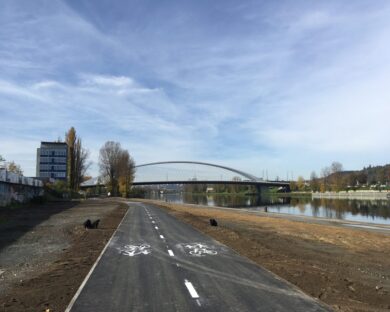
The inadequate gravel path (in terms of both numbers of cyclists and quality of the surface) began to be replaced from 2018 onward with a four-meter-wide asphalt path. Reconstruction of the eastern section near Libeň Bridge was delayed by 2.5 years due to an appeal against the zoning decision, which affected private land. The final, western section was widened together with the opening of the Hol-Ka footbridge in 2023. The path will form the boundary for new development, which today would require a higher standard—especially the construction of a comfortable parallel pedestrian path. However, quality solutions here are emerging rather randomly and certainly will not be continuous.
Under Libeň Bridge, at the intersection with Štorchova Street, we are not on city-owned land. The long-standing request to reverse priority at this unclear and unsafe location has been dismissed due to opposition from the owner of the adjacent land, the company České přístavy (Czech Ports). Even simple resurfacing to prevent large puddles from forming after every rainfall caused problems here.
This company not only opposes efforts to improve cycling safety but also objects to cyclists passing through these areas at all. It does not want a footbridge from Císařská louka and was far from accommodating during preparations to legalize the sidewalk along Strakonická Street north of Lihovar. This is unlikely to be a coincidence; it is an open secret that the matter is personal.
Because of this company’s stance, the very crossing of route A2 with Libeň Bridge was at risk of losing its logical, direct alignment, separated from the bridge by an underpass. Illustrations of the absurd solution that was being prepared—because České přístavy did not want cyclists crossing Štorchova at street level at all—can be found in the Libeň Bridge study on the IPR website, specifically on page 15 of the drawing section. Cyclists would have passed under the bridge only to make an S-shaped detour beyond Menclova Street, return to the bridge, and continue along a new footbridge at a level above the existing path. Alternatively, instead of crossing Štorchova—with only a few hundred cars per day—they would have crossed the bridge itself via pedestrian crossings, where trams run and ten thousand cars pass daily!
Fortunately, this nonsense was eliminated in a later version of the study (which is not public) and in the prepared project, and the A2 path will continue to level-cross Štorchova. As it should—since the effect of such an alteration would have been nothing but wasted money.
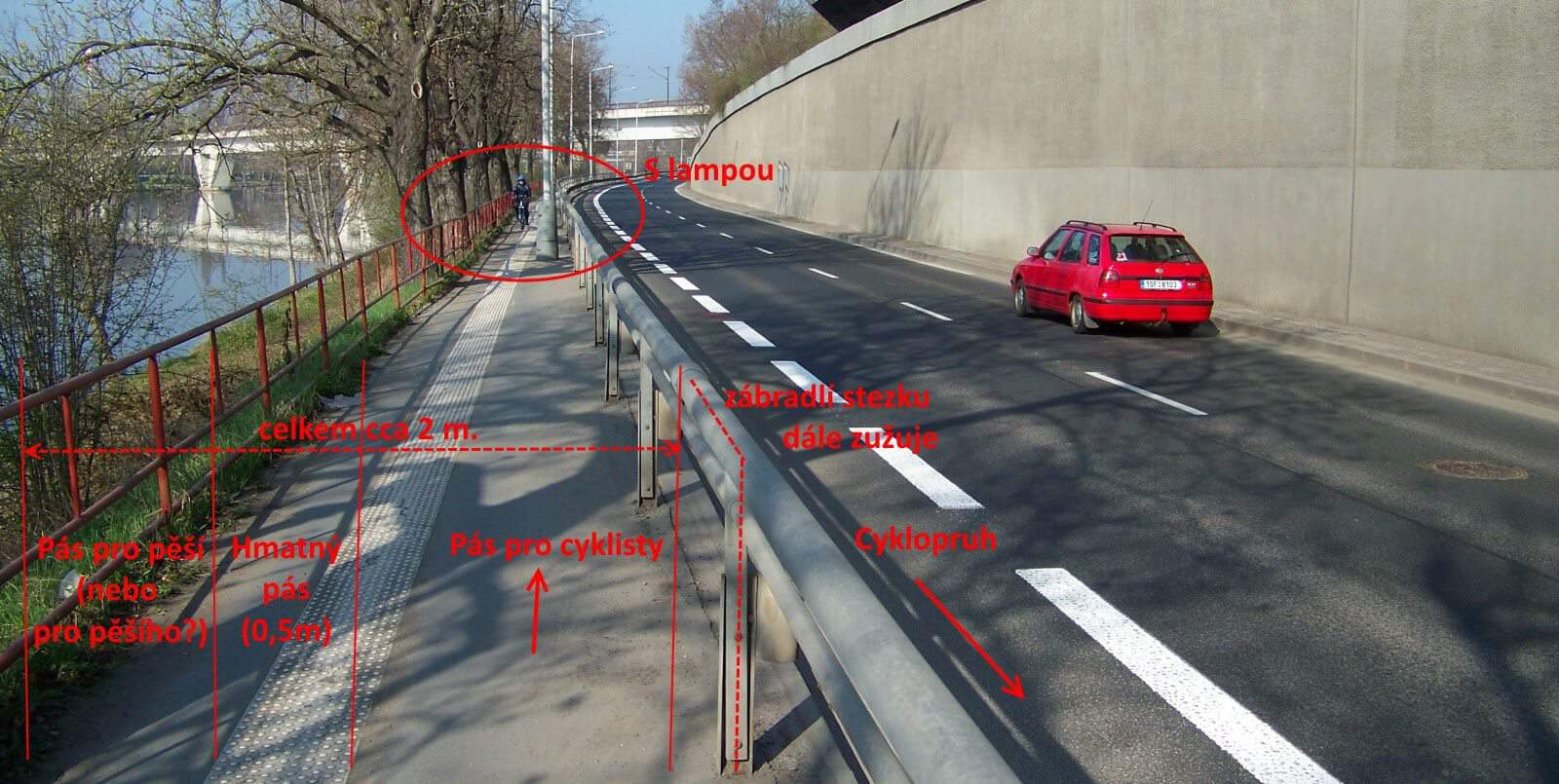
The car-free street at České loděnice (Czech Shipyards) was legalized for cycling around 2005. A few years earlier, I used to ride there to university despite the ban and wrote emails to the Prague 8 district office saying that I would continue cycling there whether they allowed it or not. The narrow sidewalk along Povltavská Street was legalized in 2008, but this change made things significantly worse.
Railings tilted over the “passing bays” between guardrail posts narrowed the already tight sidewalk into something resembling a half-kilometer-long Vyšehrad Tunnel. The optimal riding line was then taken up by a slippery tactile paving strip. Functionality was further reduced by the fact that the solution was one-way only. In the direction toward Libeň, cyclists were forced—if they wanted to ride legally—to use a bike lane in the carriageway of Povltavská, where the speed limit was 70 km/h at the time, but in practice cars often drove closer to 90.
U Českých loděnic Street itself was divided into pedestrian and cycling halves, but very clumsily—by inserting a tactile strip down the middle of broken asphalt whose effective width in places was under four meters. As a result, separating cyclists and pedestrians essentially did not work in either section, and in 2009 the entire “cycle path” between Libeň and Pelc-Tyrolka earned second place in a Prahou na kole website poll for Prague’s worst cycling blunder.
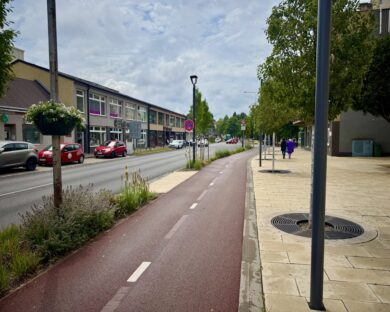
At the time, the Prague 8 district authority insisted so stubbornly on separating cyclists and pedestrians—even in situations where it was unsuitable—that it significantly strengthened the resistance of Prague cycling experts to segregated paths. Paradoxically, fifteen years later this attitude has come back to haunt us: today in Prague we do not have segregated paths even where traffic volumes and spatial conditions would easily justify them. People are simply not used to separating pedestrians and cyclists at all, and designing dedicated cycling space on a sidewalk (or heaven forbid, a corridor route across a square) is nearly impossible.
The idea of “shared space” is still unhealthily idolized by many transport and public-space experts—even in places where functional separation would make sense. The result is an environment where, as a pedestrian, you do not feel safe because cyclists are everywhere (including through-riders who really do not want to slow down), while as a cyclist you cannot ride at an efficient speed because you would be seen as inconsiderate.
Today, a reconstruction of the narrow Povltavská sidewalk is being prepared. The sidewalk is to be widened into a two-way cycle path, while pedestrians will likely prefer the parallel riverside promenade. The upgrade has been discussed since 2023, and the construction should already be prepared in terms of project documentation, but it did not fit into Kovářík’s emaciated cycling budget in either 2025 or 2026.
With the completion of the City Ring Road, Povltavská Street is then expected to be entirely freed from car traffic, and in its place a ten-meter-wide car-free promenade will be created from Pelc-Tyrolka all the way to Košinka.
Individual sections of cycle route A2 from Barikádníků Bridge to the Prague city limits—and further on to Klecany—were built gradually, roughly until 2022.
We were able to fully appreciate this excellent asphalt cycle path from Troja all the way to Klecany this spring, when it was closed for a quarter of a year due to the threat of a rockslide above it. Initial criticism focused on the lack of timely information about the closure, the absence of a protected detour, and also the length of the closure, which gave the impression that repairs were not being rushed.
This closure showed us how fragile Prague’s cycling infrastructure system is and how underestimated the need to maintain it in functional condition is on the part of the authorities. In the future, redundancy here may be provided by a planned footbridge at the ferry crossing between Klecany and Roztoky u Prahy.
— To be continued —
This is an adjusted machine translation using ChatGPT of this article: https://mestemnakole.cz/2026/02/vzpominani-na-prazske-cyklotrasy-4-cyklostezka-a-2-na-severu-prahy/
Líbil se Vám článek? Chcete v Česku lepší podmínky pro cyklodopravu?
Podpořte nás, stačí i 100 korun. 💙🚲
Vyberte prosím částku, poté budete přesmerováni na darujme.cz



komentář