

Prague lacks dedicated cycling infrastructure. While the cycling community demands separated paths, far fewer are built than should—and could—be. In my opinion, we are missing two things: on one hand, recognition from experts and political representatives of the public interest in separated infrastructure; on the other hand, an understanding among the public regarding the limitations of segregated infrastructure.
Therefore, I will address the issue of separating pedestrians and cyclists in a series of essays aimed at clarifying the realistic possibilities for creating segregated infrastructure, as well as its technical and practical limits.
This article follows up on a previous essay that examined the methods of separating pedestrians and cyclists, and the spatial requirements for segregated infrastructure in a standard profile away from intersections.
If we want to have good segregated paths, we must know how to design good separate cycle paths in general. Let us look at five types of problem areas that we need to resolve satisfactorily in order to provide solid segregated solutions. These are:
Please note in advance that this article aims to introduce the topic to the general public. Compared to current technical specifications and Czech National Standards (ČSN), things here are often simplified. For specific conditions and situations, always consult ČSN 73-6110 (Design of Local Urban Roads), TP 179 (Design of Cycling Infrastructure), Prague’s Active Mobility Standards, and other methodological guidelines.
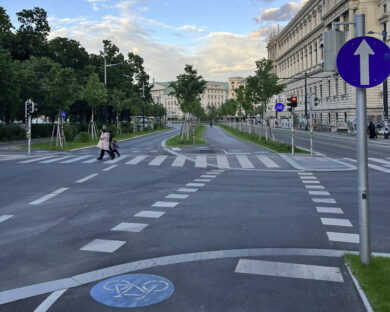
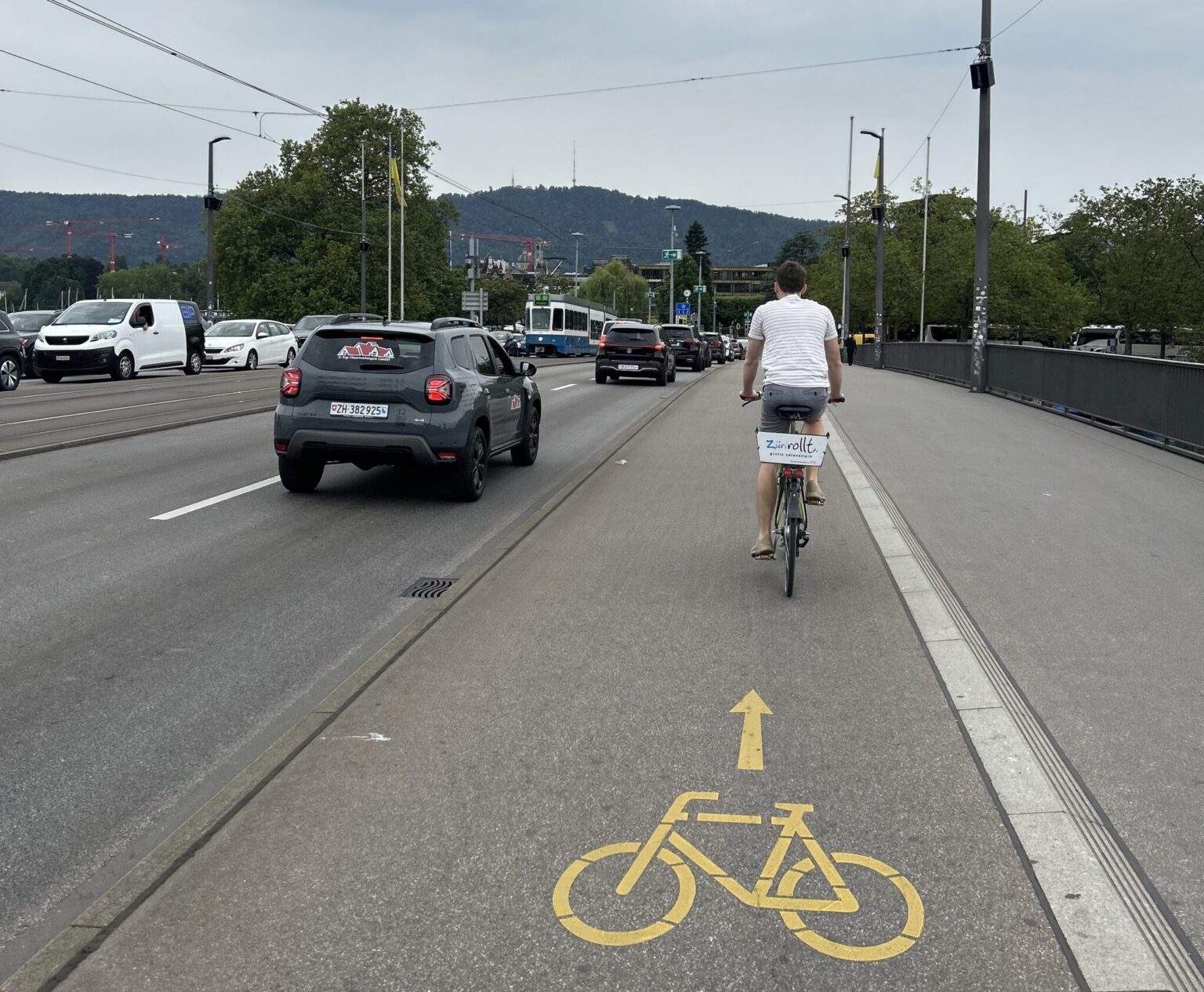
Shared and segregated paths usually cross side streets via cycle crossings. This means cyclists always lose the right of way compared to turning vehicles—a contrast to many Western European countries where maintaining priority is the standard. One-way „Danish-style“ cycle tracks offer the possibility of maintaining priority by crossing in the form of a dedicated lane, but they cannot be two-way and take up significantly more space.
At intersections with side streets, riding in the roadside space presents dangers arising from poor sightlines (usually caused by cars parked right up to the intersection) as well as the inefficiency of having to yield „at every corner.“
Cycle crossings essentially require either excellent sightlines (at least 20 meters free of obstacles), a significant reduction in the speed of turning vehicles (for example, via speed bumps or a raised curb ramp), or the necessity for the cyclist to slow down before every turn to a speed at which they can stop within a few meters—i.e., around 10 km/h.
This is precisely why so many solutions are handled as a „compromise“ dual system: it at least preserves sightlines if you choose priority and fast riding on the roadway, while assuming low-speed movement on the legalized sidewalk, which reduces the risk caused by poor visibility.
One-way cycle tracks solve this problem at the cost of removing parking spaces 20 meters before the intersection.
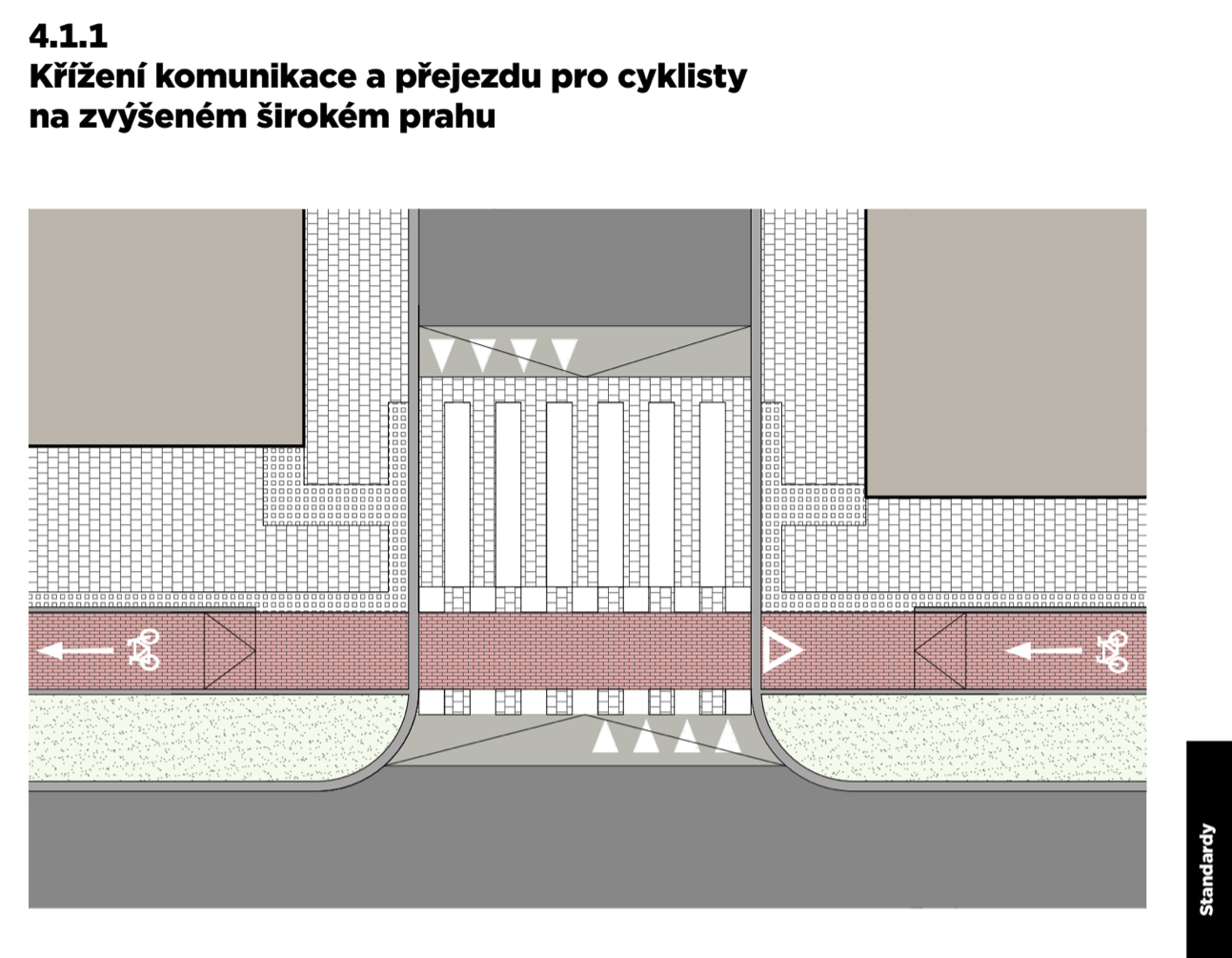
In theory, two-way paths can have priority over turning vehicles if continuous sidewalk crossings are constructed. In this setup, the sidewalk and cycle path remain continuously raised, and turning into the side street functions practically like entering a driveway. Although such a solution can theoretically be implemented even in a Zone 30, in practice, it is almost never seen, except for entrances to courtyards and low-traffic residential zones.
All in all, on a segregated path, it is necessary to sacrifice the right of way at certain intervals and force cyclists to slow down to a near-walking pace. The question then becomes: what is still an acceptable frequency for yielding like this?
On the Podolská path (A2) between the Vyšehrad Tunnel and the gas station on Modřanská, there are four such (unsignalized) spots over a distance of 2.5 kilometers, which is undoubtedly acceptable even for fast-moving cyclists. On a hypothetical path on Korunní Street between Náměstí Míru and Orionka, there would be a cycle crossing requiring cyclists to yield to turning vehicles every 120 meters. While that might be acceptable for those riding at a „Copenhagen-style“ 17 km/h, a commuter zooming at 30 km/h will not prefer such a path, if only because they wouldn’t even be able to reach their cruising speed given the extreme density of side streets.
Key takeaway: Frequent intersections with a loss of priority are thus more limiting for fast-moving cyclists.
When it comes to shared versus segregated designs, segregated paths require a greater width for the pedestrian and cycle crossing area (5.5 meters total—3 meters for the pedestrian crossing and 2.5 meters for the adjacent cycle crossing) compared to shared paths (4 meters total for a combined pedestrian and cycle crossing). This pushes the crossing further back from the intersection, which can create a detour for pedestrians in tight spatial conditions.
For the sake of completeness, a one-way adjacent cycle crossing adds 1.5 meters to the pedestrian crossing.
Frequent intersections with a loss of priority are thus more limiting for fast-moving cyclists.
Signalized intersections present several complications for protected cycling infrastructure.
The first issue involves corners acting as bottlenecks. Multiple lanes for vehicle queuing at intersections, sometimes combined with public transport stops (which, of course, need to be close to intersections for transfers), can narrow otherwise wide sidewalks at corners beyond an acceptable limit.
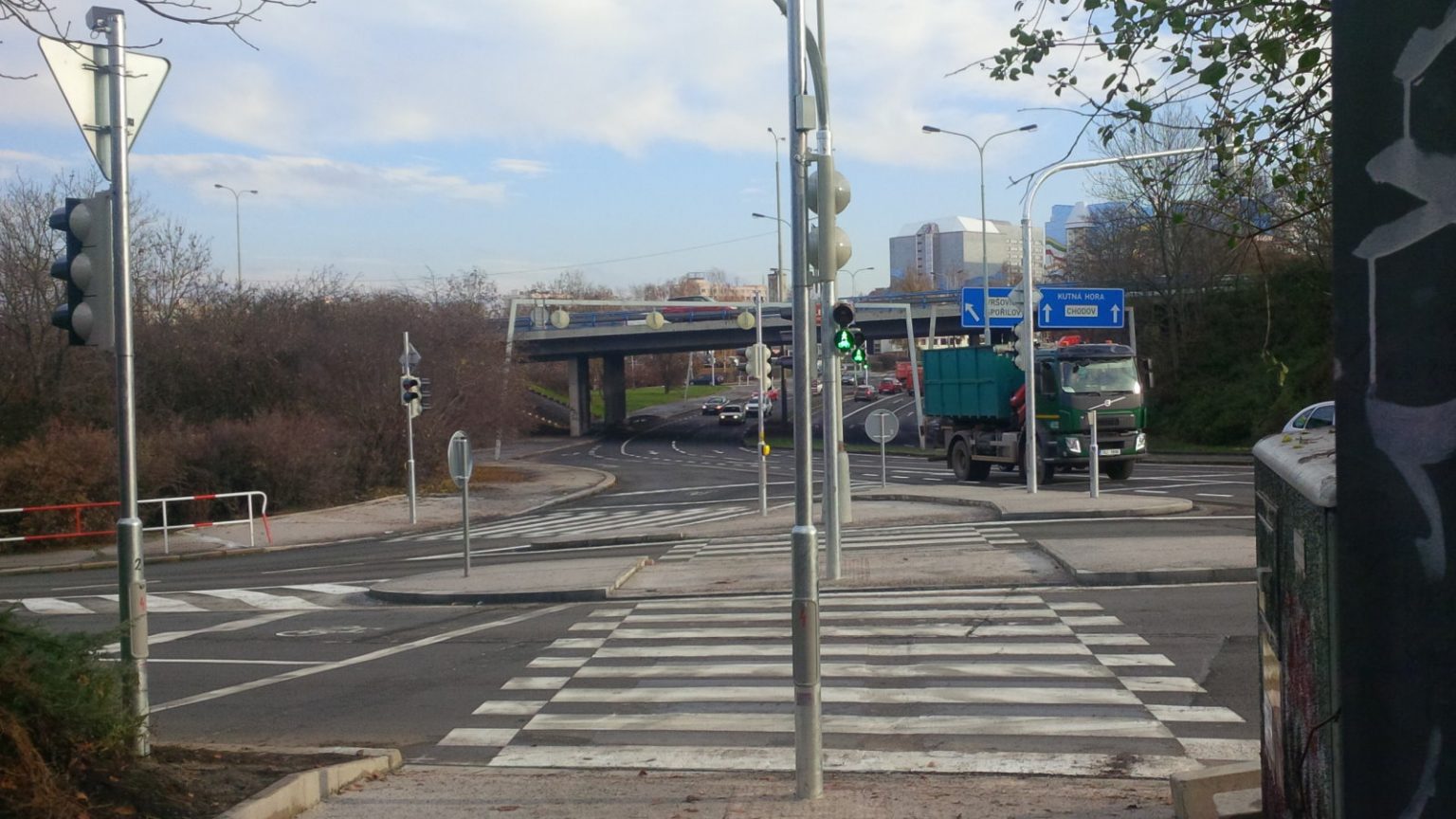
We also face limits regarding crossing lengths. A signalized crossing for cars cannot connect directly to an unsignalized crossing over a dedicated cycle lane or cycle path. A pedestrian island of at least two meters must be inserted between them, which further increases spatial requirements. Additionally, corners may be partially under private ownership—sometimes right up to the edge of the roadway—which can completely prevent the construction of a cycle path.
In practice, a legal passage can be achieved at the cost of a sub-optimal solution: downgrading the segregated paths to shared paths or sidewalks with cycling permitted right before the corner. However, by doing this, we lose the benefit of separating pedestrians and cyclists precisely where it would be needed most due to more complex traffic movements.
Signalized crossings and cycle crossings also demand significantly more space than a segregated path on its own. A combined signalized pedestrian and cycle crossing must be at least 5 meters wide. Furthermore, to ensure turning drivers have a safe sightline of the path, it needs to be offset from the parallel roadway by approximately 5 meters—which also requires turning vehicles to approach at a right angle.
Where there are high volumes of pedestrians in front of segregated crossings, it must be expected that pedestrians will wait across the entire width—including in front of the cycle crossing—and will also cross via the cycle crossing unless there is also heavy bicycle traffic.
Finally, according to current technical conditions (TP), a combined pedestrian and cycle crossing should not feature a pedestrian island at all. This is because a cycle crossing over an island must be designed to run on a single signal phase along its entire length.
Waiting times are often underestimated when evaluating the suitability of protected cycling measures. However, if cyclists operate on a different signal phase than cars, it often has a significant negative impact on the speed and competitiveness of cycling.
A cyclist is not a pedestrian; they move roughly five times faster between intersections. Consequently, waiting at a signal for the same amount of time has roughly five times the relative impact on a cyclist as it does on a pedestrian.
Clearance times at combined signalized pedestrian and cycle crossings are timed for pedestrians, not cyclists. Meanwhile, in a parallel on-road cycle lane, the green light often stays on for almost the entire duration of the vehicle phase, whereas the green on the combined crossing turned off long ago. For cyclists, this can mean a loss of more than 10 seconds per crossing.
Because cyclists ride across a crossing several times faster than a pedestrian walks, they routinely face forced waiting times on pedestrian islands. This is a particular problem at turning lanes with an intermediate island, which mean you have absolutely no chance of riding through the intersection on a bike without stopping; you will always have to wait at least a quarter of a minute inside the intersection. Meanwhile, cars and any cyclists on the roadway will pass through all at once without issue.
Another way cyclists are delayed at traffic lights is through push-button activation (the so-called „beggar’s button“). Cyclists are fundamentally not detected in advance (unlike cars, which are detected at least a short distance away). A cyclist riding alone will never catch a green light unless someone ahead of them has triggered it. When bicycle traffic is low, this adds another penalty of roughly ten seconds if a cyclist arrives just before the end of what would have been an active green phase, as a push-button green light might not trigger until the following cycle.
In general, the green light should trigger automatically for pedestrians as well, just as it would be desirable to introduce a flashing green light to clearly signal the time remaining to cross, and to ease—by at least a fraction—the ruthless assumption that a pedestrian „clears“ a crossing at a speed of 4.5 kilometers per hour.
Public transport priority also plays a role, as it can prolong waiting times or cancel a signal phase. While public transport priority naturally takes higher precedence, it is necessary to minimize its negative impacts on pedestrians and cyclists and to eliminate the shortcomings that priority intersections present to non-motorized transport.
Inserted and especially prolonged phases for trams rarely activate or extend parallel green lights for pedestrians and cyclists. This is particularly frustrating for cyclists, who do not require as long a clearance time as pedestrians and could therefore pass through safely.
It is also unacceptable for a tram’s registration into the signal system to completely cancel a cyclist’s registration into the intersection. This happens at Mánes, where every morning it teaches hundreds of cyclists on the busiest route into the city center that traffic lights are merely an annoying absurdity when riding a bike.
Although all these time losses might amount to somewhere between a quarter and a half a minute per intersection compared to driving with cars, within this seemingly short time, many a cyclist is already a block away. Again, just stand by Mánes in the morning and you will see it with your own eyes.
The final common issue involves cross-connections and transitions back to the roadway. It is not exactly fair to complain that integrated lanes and Danish-style tracks cannot feature indirect left turns, when at half of the intersections on two-way paths (such as the A2), there is no cross-connection to the street on the other side at all. This must be taken into account when designing intersections, but it may not always be successfully achieved.
To see how a public transport stop can turn an easily segregatable street section into a nightmare with no good solution, look no further than the Dvorecký Bridge. The requirements for decent public transport stops are substantial; we really aren’t Amsterdam, where passengers can be disgorged from a tram onto a one-meter strip of pavement right next to a busy two-way cycle path.
Tram islands have a dignified width of roughly three meters. Bus bays are 2.5 to 3 meters deep. In a street, this space is often carved out by interrupting otherwise continuous parking alongside the stops. However, you cannot simply interrupt a cycle path this way.
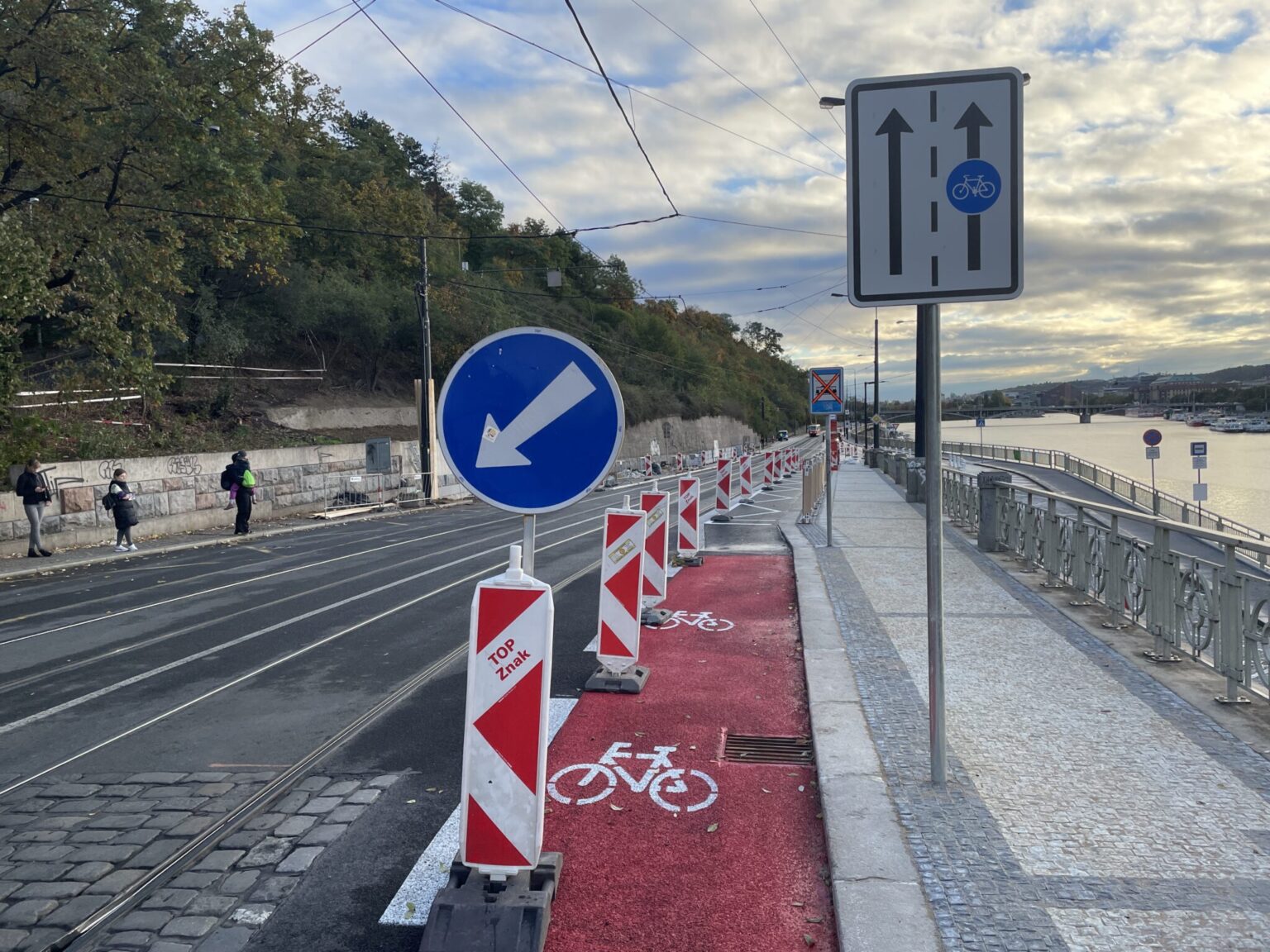
Paradoxically, it is the otherwise more demanding one-way solution that can handle stops better. A two-lane cycle track can be narrowed from its usual width to a single lane (down to 1.75 meters along the island), or even into a 1.5-meter bollard-protected cycle lane, which reduces the spatial requirement of the island to less than 2 meters.
You can also use a „Vienna-style“ cycle track passing over a bus bulb (boarding peninsula), which is theoretically possible even at a bus stop. This is the most space-efficient solution (approx. 1.75 meters), meaning it requires no extra space.
Finally, a one-way cycle path can, in the worst-case scenario, be interrupted by a bus bay, with buses entering the bay having the right of way—also without increasing spatial requirements. This is particularly suitable when bus traffic is low.
Two-way routing is more difficult. You can have an island bypassed on both sides and minimize the width of the cycle path (down to 2.25 meters), or even to 1.75 meters with passing places before and after the stop. Sometimes, it might be possible to shift cars into the tram tracks at the stop and dedicate the existing lane along the island to bikes. If there are no buildings along the street (or if they have no entrances), the path and sidewalk can be swapped, tucking the path against the building so that the sidewalk runs along the edge of the stop.
When nothing else is possible, you can create a full-width bus bulb that cyclists ride over; in the worst-case scenario, you can just delineate the space for bikes with lines further from the edge of the stop. This only makes sense for low-frequency stops (e.g., Plynárna Michle). Cyclists can also be required to stop in front of the transit stop area while a public transport vehicle is boarding and alighting passengers. Finally, each direction can be handled differently, utilizing one-way solutions in the direction of public transport travel.
Separating the transit island from the cycle path also needs to be done properly. Good sightlines are crucial. At shelters, it is necessary to ensure that no one steps out into the path from behind the shelter or an advertising panel. Railings between the island and the path are also useful because waiting passengers like to lean against them. It is desirable to have a vertical separation of the island and the path using curbs on both sides—except at designated barrier-free access points—even if the path and sidewalk are flush elsewhere.
As for bus bulbs, it should be unacceptable to route cyclists from a sidewalk-level path onto a boarding peninsula. This is especially true if the volume of car traffic on the road is anything more than negligible. And if there is absolutely no other way in some places, the entry of cyclists into the tracks will always need to be managed by reducing the speed of all vehicles to 30 km/h.
Even in blocks where regular parking spaces do not exist—perhaps precisely because they were removed to establish a path or cycle lane—it is often still necessary to reserve parking spaces for deliveries.
In the case of wide paths, delivery vehicles may be permitted to stop within the cycle tracks during off-peak hours, provided it remains technically possible to bypass them safely on a bike. However, it is crucial that such bays are not abused for long-term parking, which is quite difficult to enforce in Prague.
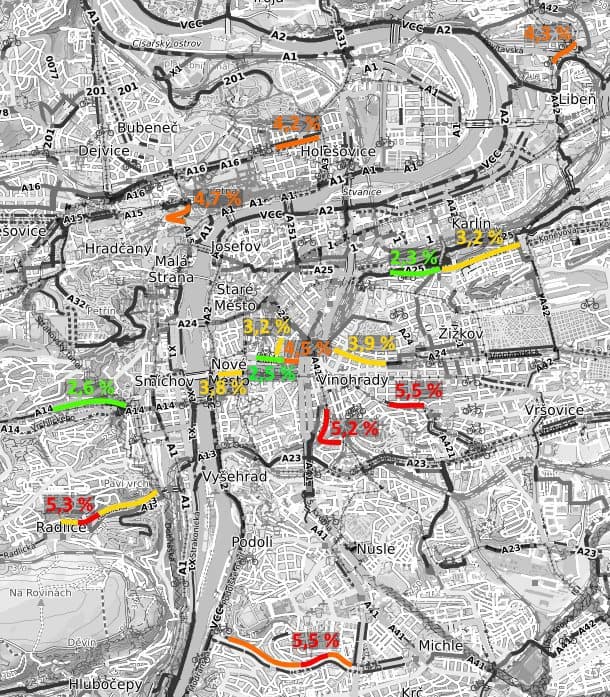
Due to lower cyclist speeds, uphill climbs increase the need for separation from cars, while conversely reducing the need to separate cyclists from pedestrians. Major distributor roads with inclines exceeding 3–4% should always offer an option for riding off-road.
However, inclines create a wider gap between slower and faster cyclists, including e-bike riders. There will be more overtaking uphill than on flat terrain. Therefore, a completely segregated solution on inclines over 2% should not be reduced to a single lane.
On significant inclines, a shared solution can be considered where a segregated one would otherwise be appropriate. This can reduce spatial requirements, which can instead be allocated to the downhill direction.
Finally, on uphill sections, it is not as critical to prioritize the right of way over turning vehicles; uphill directions can therefore be managed via cycle crossings rather than relying as heavily on dedicated on-road cycle lanes.
Downhill sections are the exact opposite of uphill sections, as they increase the need to separate cyclists from pedestrians and decrease the need to separate cyclists from motorized traffic. Higher speeds also mean greater width requirements, but wider paths can simultaneously tempt cyclists into dangerous riding. This can be addressed by keeping the „psychological“ width of the path unchanged while increasing safety clearances—for instance, by doubling the curbs or adding a narrow median island in a different color or paving material.
Longer sightlines are necessary. Where 20 meters is standard, at least 30 meters should be provided. It is advisable to install optical speed-reduction markings before cycle crossings and points where pedestrian paths intersect (such as transit stop entrances).
For pedestrians, it is preferable if the segregated path is routed on the side of the street where cars are driving uphill; this places pedestrians closer to the slower, uphill-moving cyclists. Conversely, downhill cyclists will be further from pedestrians and closer to cars, which helps improve mutual visibility.
Yielding at cycle crossings must not be too frequent.
While it cannot be calculated with absolute precision, it can generally be assumed that a crossing interval of less than 100 meters results in an unusable path, whereas an interval of over 200–300 meters is acceptable.
And when a crossing over a turning road is constructed and the cyclist loses priority, they must at least be provided with good sightlines. Having 20 meters free of visual barriers is an absolute necessity even at crossings: not so that the driver sees the cyclist in time (for that, 30 meters or more would be needed), but so that the cyclist can see whether anyone is turning into their path.
Signalized intersections must cover logical connections.
It must be possible to reach all directions and connections legally and clearly, just as would be possible on the roadway. This applies even in places where the segregated infrastructure does not continue, especially if continuing on the roadway is a direct extension of that segregated infrastructure.
Signalized intersections must not kill the efficiency of cycling compared to parallel riding on the roadway.
In particular, green lights at crossings must be set to trigger automatically (without push-button activation) concurrently with the entire parallel phase for automobiles.
It is necessary to limit signalized turning lanes that operate in anti-phase, which interrupt the ability to ride through a traffic light system in a single go.
When public transport priority is implemented, parallel cycling signals must be taken into account, and physically possible passages must not be blocked—especially during the extension of a green phase or the insertion of a phase for public transport.
We must think about cyclists traveling at (different) speeds.
Hilly terrain and e-bikes create massive differences in cruising speeds. Cyclists must have the opportunity to overtake one another even off-road—even if, in the worst-case scenario, this is only handled implicitly by not making overtaking maneuvers impossible.
The answer to the question of whether we should build shared or segregated paths is definitive, at least from the cycling community and the public: we need to separate more.
At the same time, however, it is up to the experts to find the boundary where it still makes sense—or at least where it doesn’t become nonsensical. Part of finding this boundary involves reflecting on what happens if a preference for segregated paths leads to integrated on-road measures being sidelined, under the argument that since cyclists now have such great off-road infrastructure, what do they need cycle lanes for anymore?
The final commentary of this series will address this issue.
This is an adjusted machine translation using Gemini of this article: https://mestemnakole.cz/2026/05/trable-spolecnych-i-delenych-stezek-v-ulicni-siti/
Líbil se Vám článek? Chcete v Česku lepší podmínky pro cyklodopravu?
Podpořte nás, stačí i 100 korun. 💙🚲
Vyberte prosím částku, poté budete přesmerováni na darujme.cz








komentář