Rekola, the company operating bike-sharing systems in the Czech Republic and Slovakia, is celebrating its 10th anniversary since its first rental. To mark this significant milestone, we bring you a comprehensive interview with the founder of Rekola, Vítek Ježek. In the first week of September, Jiří Motýl from Městem na kole interviewed him about the beginnings and the future of Rekola.
You are preparing to celebrate ten years of Rekola, which is quite a significant milestone. How do you evaluate the journey you have undertaken in these 10 years?
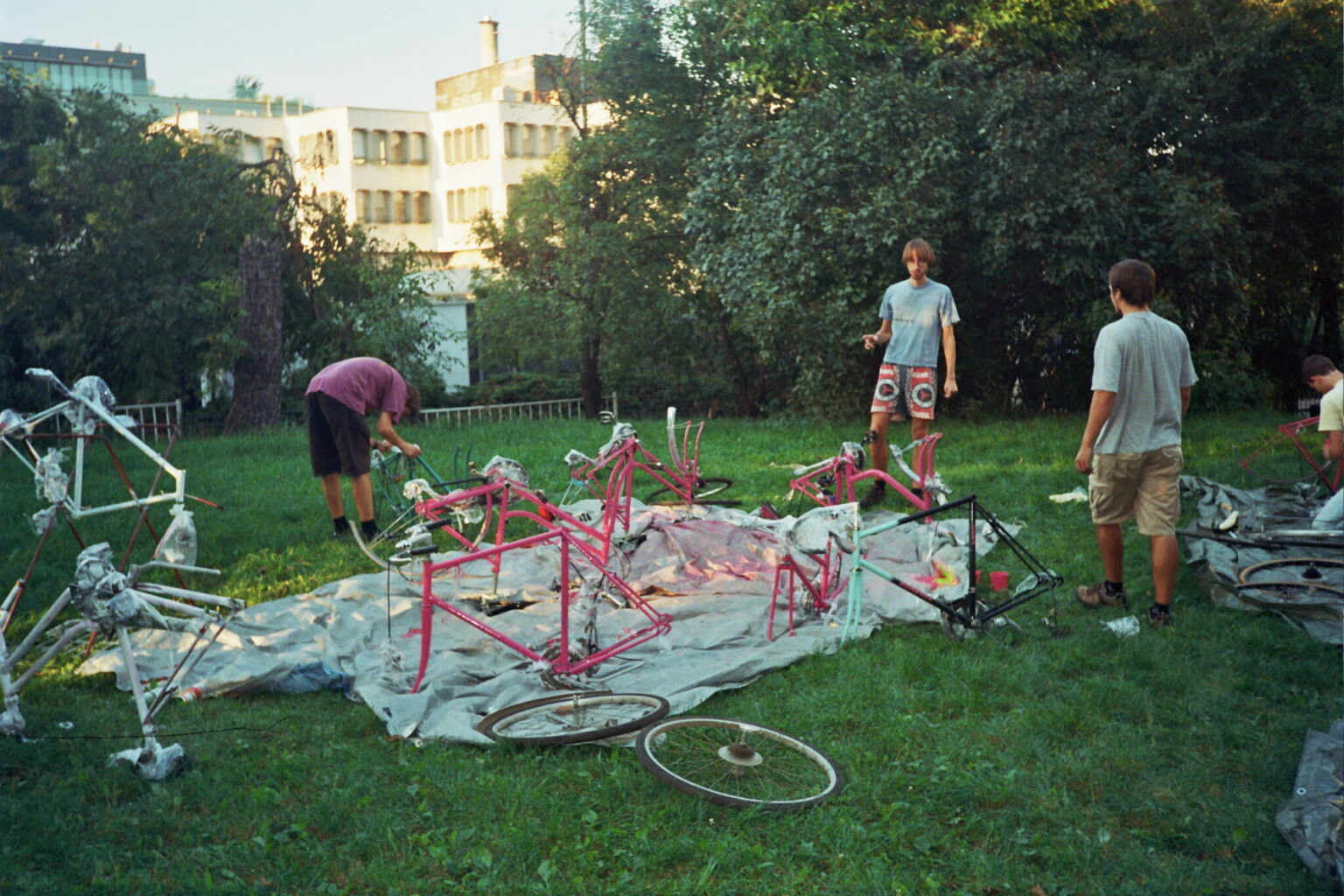
Wow. I would start by summarizing the journey of our company. The reason we were founded was that Prague lacked bike-sharing. It was missing for me, and in fact, it was missing for many people. However, the beginnings were in Suchdol. There, the guys within the Žijeme tady association took old bicycles, painted them pink, and left them in Suchdol without an app, without any security.
Yes, I interviewed them back then.
And then someone threw those bikes into the woods. They realized that they needed to secure them. They started assigning numbers with locks and gave users codes for the locks on mini cards.
Around that time, I met them at TEDx, and I thought it was incredibly brilliant. Because I was working in IT at that time, I thought I could help them with IT. It would remain their project, and I would just provide some support and scale it for Prague. The guys said it sounded great, but it was too big for them. They planned to continue only in Suchdol. However, they would be happy if I wanted to do it for the whole of Prague.
I actually felt it would be a shame not to do it, so I got involved. However, it all started from my personal need because Prague was one of the few capital cities in Europe that did not have its own bike-sharing system.
In the beginning, we wanted to test if it was bothering only me. We went through Hithit crowdfunding, to find out if there was indeed a larger community of people interested in this. We managed to raise 150,000 crowns. This also confirmed that there was an interested community of people. At the beginning, it wasn’t even about business; I was a bit naive, thinking that users would not only report problems but also repair the bikes.
So, in the app, I had the option to report a problem and solve a problem. After the first week, when the bikes were starting to fall apart, and no one was repairing them, it became clear to me that it wouldn’t be that simple. We started talking to a community of people who would volunteer with us and have responsibility for certain areas.
By the way, at the beginning, users were members of our association, so we didn’t even have individual rentals. A person could become, for example, an annual affiliated member and could use the bikes. As time went on, and we saw that interest was growing, we transitioned to a company. We secured investments, and the quality of the bikes improved. We will soon have half a million users.
You have also experimented over the years – you were in Finland for example.
Back then we talked to a city there about initiating a bike-sharing program because they expressed interest in it. We offered to provide them with usage data, which they received from us, but in the end, they didn’t launch the program. It was something of an experiment, and we eventually withdrew. However, in Bratislava, for example, we started from the beginning without expecting financial support from the city. On the contrary, we counted on investing our efforts and being there at our own expense. And we succeeded.
And now you manage to finance it without city subsidies?
Yes, Bratislava can still be financed without the city’s subsidies. Of course, the smaller the city, the more challenging it becomes. There is a certain threshold where it really becomes impossible. However, Bratislava can still be financed without city subsidies.
Vítek Ježek
Founder of Czech bike-sharing system Rekola. Since 2013, it has been operating in Prague and later also in other Czech and foreign cities. In 2016, the company received an investment from Reflex Capital, founded by Ondřej Fryc, the founder of Mall.cz.
Apart from Rekola, Vítek Ježek is also part of the company manGoweb, which specializes in the development of comprehensive websites and applications. He often travels and works abroad. At least once a year, he embarks on a major cycling expedition. He has cycled to Paris, Copenhagen, Istanbul, and Venice.
You mentioned the company, but how has the environment changed?
The approach to bikes and bikes as a transportation alternative has changed a lot here. Historically, a bike was purely seen as cycling, meaning the image of a cyclist as an athlete in a jersey, sweating.
We try to show that it doesn’t have to be just this sporting type, that a bike can also be an interesting, fast mode of transportation, that doesn’t have to be sweaty, and a person doesn’t have to break records. For example, in Prague now, through cooperation with Lítačka, a person can take the metro to get somewhere and then ride a bike for the last kilometer. I think this concept is evolving in people’s minds. Here it’s not like in the Netherlands, where there are even different names for someone in a jersey and someone using a bike for transportation. But I believe that people are starting to think more about it, and cycling is becoming more integrated into everyday life.
The second part of it is separate infrastructure, which unfortunately hasn’t progressed much yet. Specifically, in Prague, where maybe the most was done during the time of the ODS Mayor Bém – the separate routes along the Vltava. But since then, the construction of separate infrastructure in central city districts hasn’t progressed much. So, I just hope and keep my fingers crossed that it will succeed.
When we were writing and doing various interviews and articles before the start of bike-sharing in Prague, there was always the question of whether to first build infrastructure and then introduce bike-sharing, or attract people through bike-sharing and then build infrastructure. It’s interesting now that we have a lot of people riding shared bikes, but the infrastructure is still lacking.
It’s important to mention that it needs to be uninterrupted. Some sections exist, but the number one reason why people don’t ride is their concern for their physical safety. At least that’s what comes out of a survey conducted by Prague. It’s quite clear; it’s as if the D1 highway were interrupted in the Vysočina region, and it was up to people to dismantle their cars and carry them to the other side of Vysočina. Which is absurd. Then there would be almost no one on the entire D1. And I see it the same way in terms of cycling infrastructure.
You cooperated with the IPR and Prague on sharing data about bike usage and where users want bike racks. Do you have any feedback? Has anything moved forward based on that?
It did move forward, but our expectations were somewhat higher. I don’t think it’s the fault of the specific institutions. I perceive it as being more about the process that is set up this way. Maybe that’s our biggest limitation, both at the local and national levels in the Czech Republic.
But we set up these processes ourselves. We set them up at the level of the city council or even at the level of parliament. Now it’s like the eleventh commandment, that it has to be done in this specific way.
We see it in other cities, and we don’t just have to look at cities like Paris, which now has an amazing acceleration. Or Oslo, which may be hillier than Prague, but the number of people on bikes is growing, and the infrastructure there is much more advanced and comprehensive. And recently, we can also observe it in Bratislava, where Mayor Matúš Vallo, an architect, is in charge. They recently took two lanes from a four-lane road on the waterfront and created separate cycling infrastructure there. That’s something we can only dream about here.
But I think it’s an interesting city to watch. And I somewhat believe that Bratislava could surpass Prague during this electoral term.
Returning to your question, for example, we handed over the „Kolostav“ project, where users marked places where they wanted to park. Some places were built, others were not, and some are still in the process. However, it is often decided that it cannot be done exactly in that place or that physical stands cannot be placed there.
That actually brings me to the point that you’ve been here for 10 years, and the environment has changed a lot. You started as a completely stationless bike-sharing system. Now you have a new feature, after an agreement with city districts and the city itself, where you have fixed stations. It’s like a full circle, starting with classic station-based bike-sharing abroad, then moving to stationless systems, and now slowly returning to at least virtual stations. How do you assess these changes?
From the beginning, I wasn’t against stations per se; it just didn’t make sense to me to build stations dedicated solely to bike-sharing. It seemed more meaningful to build bike racks that anyone could use. Another keyword for me is accessibility. Recently, I was in Malmö and Helsinki, and there, the stations are quite far apart, which is a problem for many station-based systems. Stations are sometimes 300, 400, 500 meters apart, and as a result, the usefulness of bike-sharing decreases. The user then doesn’t have a station near the start or end of their journey, and it ceases to be a quick transportation alternative.
In Rekola, we are currently trying to have a station every 150 meters, which I consider crucial. Furthermore, we will try to densify it further. But I also consider it crucial for stations to be visible on the street. Whether there will be a bike rack, also for private bicycles, or a white rectangle drawn. Clarity of the system is crucial for bike-sharing in my opinion.
In Karlín, there is one at every intersection, plus a few extra places. This means I don’t have to open the app and search for where to park. I just know that I will always find a place at the nearest corner; I don’t have to think about it. We would like it to be the same throughout Prague. But it’s a bit of a challenge because each city district, the traffic department, and the local police deal with it in their own way. And often it’s not very clear to users. Somewhere they say, „park in the traffic shadow,“ while elsewhere, they claim that under no circumstances should you park in the traffic shadow. In some places, it’s always marked, while elsewhere, there may only be purely virtual stations. We are now trying to at least take pictures of these stations throughout central Prague so that there is a photo of where the bike should be returned in the app.
You’re saying something similar to what Lucie Krahulcová from Bolt mentioned in a recent interview for Městem na kole. She talked about how it’s challenging to educate users about proper parking because very few users are so geeky about Prague’s municipal politics and city administration that they understand how each city district deals with or wants bike and scooter parking.
Which is completely normal; the average user doesn’t live with all the municipal regulations in mind. They just want to get somewhere conveniently and quickly from point A to point B. They don’t want to think about where they are at the moment and what’s happening there. That’s our role as operators. But I think cities should also play a role. The infrastructure should be prepared because this is truly a transportation alternative that can relieve other modes of transportation.
I often hear the objection that bike-sharing companies should pay for the city allowing them to park on the streets and providing parking spaces. What do you think about this? Did the city ask for something like that?
There are two aspects to this. One aspect is how the city looks at transportation options and parking in general, the physical side of things. If I’m not mistaken, Prague is currently working on reforming its parking system, which could bring some necessary changes to the car parking system, so we’ll see.
However, if the price for one car parking space, which is very cheap compared to the amount of public space it occupies, doesn’t change, and it’s said that more than 20 bikes can fit in one such space, so the annual price for one bike could be CZK 60, it’s conceivable to me.
The second aspect is that in Prague, the city currently orders bike-sharing as a service. It’s an activity supported by the city. The city can easily say in the next tender that it wants companies to somehow contribute to the construction of infrastructure. Or, conversely, it might say that it thinks bike-sharing is such a noble activity and brings so many other benefits that it might forgive certain things but wants operators to do specific things. To provide data or have a procedural API, for example.
When it comes to tender conditions, in the last contract, Prague set a condition that a certain number of metro stations should be covered by bike-sharing. However, this ultimately leads to the bike-sharing zone being only around the metro station and nowhere else nearby. So, the system certainly cannot serve as a means of commuting to or from the metro. What would it take for it to start working in more peripheral parts of the city?
That’s, of course, a more complex question. The first thing is that in some city districts, it’s somewhat challenging to acquire those stations. Even at some metro stations where we have stations, they are not located ideally in terms of functionality. The first thing is to enable the possibility of bike rentals.
The second thing is about concentrations. We try to be reliable. That means there is a certain number of bikes, and we gradually add them while monitoring how they are being used.
Although we thought we would gradually cover more peripheral areas, when we add more bikes to the city, they seem to disappear like steam above a pot. It doesn’t seem like we could expand the operation. It’s also essential to consider the economics of the whole thing. In peripheral areas, it will never be as advantageous as in the central parts of the city.
In the tender, we priced it to reflect what was demanded in the tender. We also inquired about the tender conditions, whether the city was aware that this could happen, that the bikes would be purely at those metro stations. The city said it was aware and wanted to try it this way. So we submitted an offer that took into account these tender conditions that the city wished for.
We might expand further in some places, but it also depends on agreements with individual city districts. So, we might do more where they are open to it. Prague is not a hilly city, rather terraced. And in many of these terraces, the infrastructure is not quite right yet. So, we will probably expand more in areas where a city district says it sees it as a priority and wants to build the infrastructure for it. Even if it’s just temporary measures, it will be a signal for us to prioritize expansion in that direction.
Did you manage to set up any successful motivation system, for example, in the terraced areas, to prevent the bikes from disappearing down into the city center? Can users be motivated, or will it always depend on redistribution?
Currently, we have a motivation system where, if a user returns a bike to a bonus station, they don’t have to pay for the first 30 minutes of the ride. It works well. It results in a significant increase in rides heading back up. However, it’s still a substantial increase from very small numbers, so more bikes are still heading down. Redistribution is definitely needed. Although other options can help, like electric bikes, we’ve also experimented with those.
The last time we met, you were introducing them.
There, it’s again a question of the user’s intentions and how the system is set up economically. Because the price for an electric bike ride will always be significantly different from the price for a non-electric bike ride.
For us, right now, the analog is more interesting because there’s still a significant unfulfilled demand. When we feel that the current service is fully developed and can’t be expanded further, we’ll start building something new.
And then there’s another redistribution solution on the hills, but I’ll keep that one to myself for now. It’s also an invitation for readers to our birthday party, where we’ll discuss how we think the problem can be finally solved for Vinohrady and Žižkov. For now, I’ll remain a bit mysterious.
What can readers look forward to at the celebration?
The celebration will be held on the anniversary of the first bike rental. [This article appeared in Czech before the celebration – red.] The first registered rental in our system was on September 14, 2013. So it will be at Kasárna Karlín exactly ten years from the first registered rental. Team members and staff from both Prague and other cities will be there. People from Rekola’s history will also be there, and I’ll be talking about the history and its beginnings. We’re still finalizing some details, but I think there’s a lot to look forward to. There will also be activities for children.
Celebration of 10 Years of Rekola at Kasárna Karlín
Rekola, the bike-sharing service, is celebrating its 10th anniversary. On this occasion, they are organizing a celebration at Kasárna Karlín on Thursday, September 14th, at 5:00 PM for all their current and future users. Rekola is a purely Czech company that was founded in 2013 with the idea that every city should have its own network of shared bikes. What began as a project where old bikes were repaired and given new life during weekend workshops has now become a company with over 460,000 users and thousands of daily rentals. They currently operate shared bikes in Prague, Brno, České Budějovice, Prostějov, and Bratislava.
Program:
Do you have any future plans that you can share?
I don’t want to reveal some plans openly yet. But I can say that we will definitely increase the number of bikes. The potential in Prague is still there. I have various improvements in the app that we will release later this year. The transition to returning bikes to stations was the most significant change recently. We still plan to improve it to make it as convenient as possible for users. Plus, we’re starting to look at international tenders and tenders in other cities. It depends on specific conditions, but we plan to participate.
The competition is expanding more, for example, Nextbike is in more than 30 cities in the Czech Republic. Why do you think that is?
We also applied for those tenders, but with a price that would make it profitable for us. We’ll see what the future holds because Nextbike historically, so to speak, went more aggressively with lower prices. And then perhaps colleagues at Nextbike realized that the economics still need to work out and had to adjust it in some way.
So, we’ll see what the future holds. For us, it’s always essential to be available and reliable where we operate bikes. It’s not suitable to spread ourselves too thin just to have many flags across the country. We try to have satisfied users where we are.
So, a small number of cities doesn’t mean a decline or stagnation for Rekola?
Not at all.
You recently spoke out quite actively against the proposal for mandatory helmets. Do you engage in such issues more often, or does it mostly happen without your involvement? For example, efforts to change laws to better accommodate the needs of cyclists?
Our current activity is focused on finding a consensus with other operators to present jointly to the city. We, for example, have about 95% of local users, while other operators may have more tourists. But we want to speak with one voice. If we don’t speak together, no one will understand our needs, and nothing will change. It’s a lot about infrastructure. Bikes may not generate as much controversy and negative externalities as scooters do, but I believe that even in the case of scooters, the infrastructure will help. And it’s already changing. Our cooperation is helping to change the approach.
But to answer your question, we’re not for a revolution in regulations. In my opinion, the devil is in the details and the specific wording. So, we try to talk about what each detail might mean for our users. We discussed things like helmets, which, in my view, were nonsense because scientific studies worldwide show that any potential benefits of mandatory helmet use are significantly outweighed by the disadvantages, such as the loss of health benefits from regular cycling.
Do you ride Rekola bikes or your own bike? Do you cycle in Prague at all? How do you manage?
I would say I’m an average, maybe slightly above-average Rekola user. I don’t have my own bike. For me, bike-sharing works best in combination with something else, like the metro. I’m very satisfied with it. I think this is an area where we can still make a lot of progress and show many other people how well this combination works.
When I look at your history, you’ve acquired a lot of experience. For example, the emergence of Asian bike-sharing systems, testing the Chinese ofo bike-sharing in Prague 7, which ultimately ended, also globally, with bikes ending up in scrap yards. Attempts to introduce station-based urban bike-sharing, which didn’t work out after your challenge, and the city didn’t reissue that contract. On the contrary, you later integrated it with Lítačka and a stationless system…
It should be noted that it saved many tens of millions of crowns.
…Then the development of the shared electric scooter system and many other innovations. How do you think the field of bike-sharing will continue to evolve?
I travel a lot around Europe, and I see that in many countries, the role of cycling in the transportation mix and in cities in general is much less of an issue than it is in the Czech Republic. Here, it’s a divisive issue. In other places, they don’t even discuss it.
I compare it to, say, public health insurance in the United States. It divides opinions there, but in the Czech Republic, it wouldn’t be an issue at all. Here, the attitude towards support for cycling is often split along political lines. In other countries, it’s not even a topic, and everyone supports it. Because, thanks to that, every car driver who is not afraid to cycle and can use a bike will help me when I, for example, transport pianos in my van, because I won’t have to wait as long in traffic. I think that’s something that hasn’t fully arrived in the Czech Republic yet. Of course, it’s also fueled by the aggressiveness of some cyclists, not all, and I want to emphasize that. So I understand how we got to this point here, but I find it unfortunate.
As a company, we are trying to do something about it in the future. Also in terms of our communication. We say that different trips require different modes of transportation. It’s not about prohibiting something, but for some trips, it’s best to walk, for others, public transport is suitable, and sometimes a car or a bike. Every mode of transportation is suitable for certain trips, and it’s not a one-size-fits-all solution for all trips.
And as a citizen, I should have the freedom to choose. Until there is safe infrastructure, I simply don’t have that option. The vast majority of people don’t have it. Over the past ten years, there has been a huge shift, where a bike is no longer just sporting equipment. But at the same time, there has been a certain polarization and a certain preconceived notion among all groups. It would be great to gradually change that in the coming years.
When you mention this, is it the same in other cities, or only in Prague? You are also present in other places like Prostějov.
To some extent, I would say it’s much better in other places because they have highly developed separate infrastructure compared to Czech standards, although it’s still not perfect. But I also have experience from other Czech cities, and I would say that, to some extent, it applies everywhere, although more in some places and less in others.
Another problem, for example, is that in the Czech Republic, within the separate traffic lanes, cyclists lose their right of way, even if they are on the lane alongside the main road. Here, when a side street merges, it means the end of the lane, and then it starts again after the intersection. Cyclists lose their right of way, reducing the comfort of cycling. However, when cars approach from a side street, they still have to stop and give way to the main road, so this adjustment wouldn’t create significant new difficulties for anyone. It would only make commuting easier for cyclists.
One last question, the Prague City Hall reported in its data that the number of people cycling in the city has either stagnated or slightly decreased over the past year. How is it with you?
The City Hall didn’t report on the overall situation but rather on data from bike counters. It’s important to mention this because it may not provide a completely representative sample of the situation across the entire city. Some of these counters are located outside the city center, and others might be affected by road closures. So that should be taken into account.
Additionally, from our perspective, bike usage is highly weather-dependent. For example, it seems that September will be quite exceptional in terms of bike usage. I haven’t looked at our numbers in detail, but I would say there will be an increase. So, we don’t perceive any stagnation in our case at all. However, the City Hall has data from its own applications, such as the „Na kole Prahou“ app, which may also provide interesting data that can offer different perspectives.
Thank you for the interview.
This is an adjusted ChatGPT translation of this article: https://mestemnakole.cz/2023/09/zakladatel-rekol-vitek-jezek-mel-jsem-potrebu-aby-praha-mela-bikesharing/
Líbil se Vám článek? Chcete v Česku lepší podmínky pro cyklodopravu?
Podpořte nás, stačí i 100 korun. 💙🚲
Vyberte prosím částku, poté budete přesmerováni na darujme.cz