

Photo above: A cyclist overtaking a queue of cars on Smetana Embankment.
Lead photograph:
I have been interested in the development of cycling infrastructure in Prague since around 2007. Its progress has been arduous and accompanied by stories full of countless twists and turns. In this series, I would like to bring you closer to what I remember from those almost twenty years—before I forget it completely. I would welcome any corrections of possible mistakes or inaccuracies in the comments.
We continue with the story of cycle route A2, following the previous section south of the city centre.
The legalization of cycling through the Vyšehrad Tunnel was the subject of debate for at least twenty years. Paradoxically, requiring cyclists to dismount and walk their bikes made passage more difficult for both pedestrians and cyclists, as it complicated passing each other and was therefore generally ignored.
Since the turn of the century, widening the sidewalk was being discussed. Building a second footbridge around the rock proved unacceptable from a heritage-protection perspective. Extending the riverbank promenade—by the way, there has been a hundred years’ worth of preparatory construction for this in the form of a “tooth” in the embankment railing below the maternity hospital—also did not get approval from heritage authorities and was also ruled out due to extreme financial demands. It was therefore necessary to work with what already existed.
That meant allowing cycling together with pedestrians, while at the same time not actively encouraging cyclists onto the sidewalk. This led to partial adjustments that made riding outside the cycle path easier, while discouraging fast cyclists from using it. Pictograms appeared in the tram tracks and connecting cycle lanes were created, recently improved with a signal bypass. By contrast, the path leading to the tunnel was downgraded by restoring paving stones and by introducing a traffic regime more akin to a pedestrian zone than to a transit, non-motorized route.
However, since 2020 the Vyšehrad Tunnel has permitted cautious cycling at a speed of 5 km/h. Incidentally, this also eliminated one of the favourite spots for police to catch passing foreign cycle tourists.
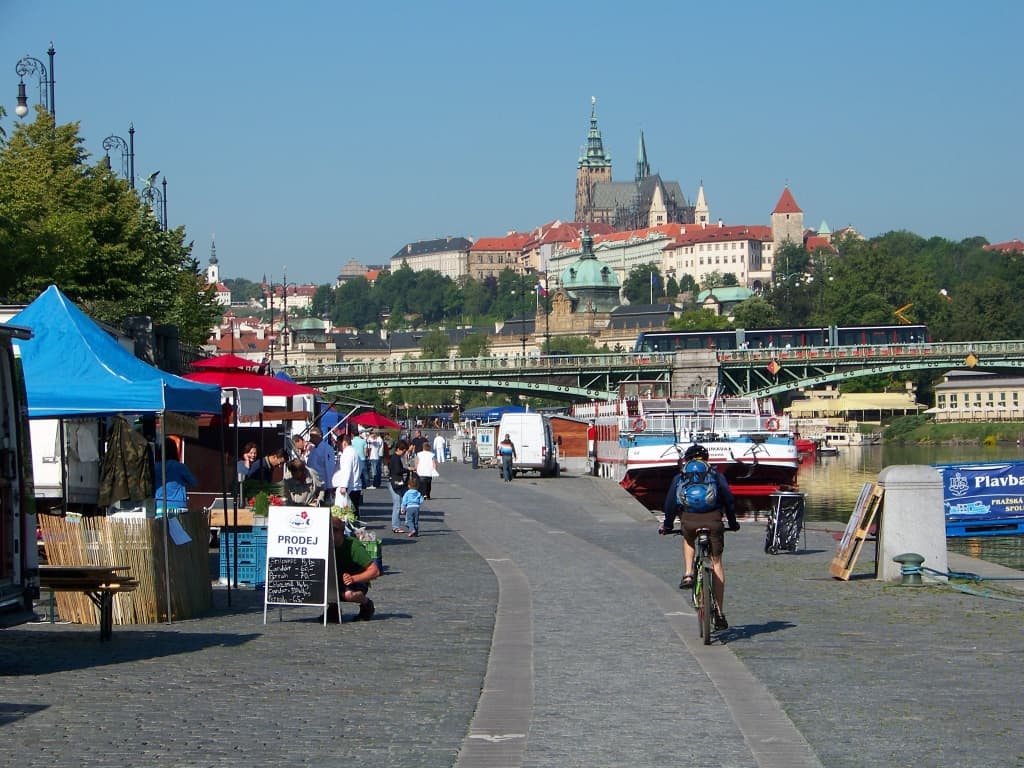
The story of cycling measures on the river embankments could easily fill a separate article. The embankments paved with rough cobblestones used to be the domain of anglers, occasional joggers, and parked cars. Narrow strips of smooth paving began to appear in stages from 2007 onward; for a short time they consisted of almost equally bumpy stones, which was pointless, but eventually it was possible to negotiate genuinely smooth slabs.
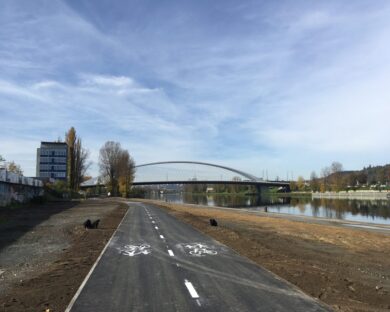
For many years afterward (until around 2020–21, depending on the section), the cycling lanes were still missing hundreds of metres at the entrances to the city centre, because they were not completed before cycling received a political “stop” for several years. Cyclists thus only really got a continuous smooth surface at a time when, at least on the New Town Riverside, the area was already usually impassable on pleasant afternoons and evenings due to crowds of people.
The narrow strips were originally marked with cyclist pictograms. However, because they were the only place where one could walk along the embankment without the risk of twisting an ankle—or, for example, push a pram—pedestrian traffic soon concentrated on those two metres of walkable paving. As the number of people on the embankments increased, movement along the cycle lanes became conflict-prone. Fuel was added to the fire at the time by hate-filled media texts. Although the anti-cycling sentiment of the day was not enough to bring about a ban on cyclists entering the embankment, the bicycle pictograms disappeared so as not to “embolden” cyclists too much. The embankment—partly brought to life precisely by people on bikes (let us recall the original Bajkazyl beneath Jirásek Bridge)—gradually became yet another attraction of the tourist industry rolling over the city centre.
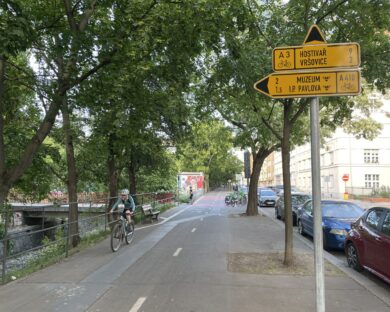
Today, route A2 in Prague 2 is, to be on the safe side, signposted both along the embankment and up above along the quay, which often offers more capable riders a more comfortable passage than weaving between pedestrians. A similar doubling of the route is also being considered on the Old Town Riverside, where it would alternate with cycle lanes on Edvard Beneš Embankment. For the past ten years, the New Town Riverside has effectively been a cycling highway in the morning, and a pedestrian zone in the afternoon and evening—one for which the upper embankment still does not provide a sufficient substitute.
The kilometre and a half between Mánes and the Rudolfinum remains the most shameful gap in Prague’s cycle route system. Hope for change came with the start of embankment modifications in 2020, but these did not continue into the next phase, which would have required limiting through traffic on both riverbanks—and thus a political consensus that the Strahov Tunnel and the Blanka Tunnel also serve to prevent cars from taking a shortcut through the forecourt of Charles Bridge.
Restrictions on through traffic here have been promised and demanded by the public for many years. Let us at least recall that AutoMat repeatedly proposed increasingly bold solutions between 2006 and 2015, and that the City Hall has its own study on restricting passage to local traffic through a measure of a general nature since at least 2020.
The political dance (we need more analyses, we will look into tolling—which won’t work, ha ha, surprise—we have to wait for the Strahov Tunnel, for Blanka, for Metro Line A to Motol, for the City Ring Road, for the outer ring road, for the outer ring road and all the radial roads, for a high-speed rail line around the Moon…) continues to this day.
Over the years, route A2 has at least seen some integrative measures applied here using the “whatever fits” method, as well as a trial one-way cycle lane from 2022, which clearly shows us that while we can sometimes have nice things, if they are not fully carried through, they will not function as consistently as needed.
An unexpected new development (because it had been postponed for several years) was last year’s extension of the island at the Staroměstská stop northwards, the side effect of which is a short cycle lane in the traffic layout, with clear benefits for pedestrians and no major negative impact on the comfort of the cycle route.
The passage beneath the terraces of the Hilton Hotel in Karlín dates back to around 2005, at a time when Pavel Polák was “Bém’s cycling coordinator,” with a mandate for cycling stronger than that of the deputy mayor for transport, Zdeněk Hřib. The Hilton bypass was one of the first larger cycling investments in inner Prague. Without this passage, we would probably not have a route into Karlín at all.
In 2017, the passage was under repair for a long time due to its poor condition. It is relatively narrow and difficult to see through because of two S-bends, so currently there are considerations to supplement it or reroute it into an underpass beneath Rohanské Embankment, where cycle lanes now run.
— To be continued —
This is an adjusted machine translation using ChatGPT of this article: https://mestemnakole.cz/2026/01/vzpominani-na-prazske-cyklotrasy-3-cyklostezka-a-2-v-centru/
Líbil se Vám článek? Chcete v Česku lepší podmínky pro cyklodopravu?
Podpořte nás, stačí i 100 korun. 💙🚲
Vyberte prosím částku, poté budete přesmerováni na darujme.cz




komentář