

The AutoMat association presents its traditional analysis of traffic accidents in Prague involving bicycles and scooters. Unfortunately, the decline in accident severity seen in 2023 did not continue into 2024. While the total number of accidents has essentially stagnated over the past three years, those involving injuries have been continuously increasing since 2019. Moreover, 2024 once again saw a large number of serious accidents.
The more data collected, the more mistakes and inaccuracies can occur during collection. That could be the headline of this year’s analysis of Prague accidents involving „non-motorized“ vehicles. Despite these complications, we believe we’ve succeeded in highlighting the most important points. It’s not an entirely positive read this year, but we hope you’ll find it informative and inspiring.
Acknowledgment: The analysis presented in this article was made possible thanks to the use of accident data from Prague provided by the Czech Police.
Scooters are considered non-motorized vehicles, but their riders are often recorded as drivers of motor vehicles—this is the most common error, and it particularly affects the accuracy of data on responsibility. This mistake has been repeated for a second year, even though we alerted the Czech Police to it last year. Nonetheless, we must thank both the Police and the Transport Research Centre (CDV) for collecting the data and making it publicly accessible.
The number of accidents involving drivers of non-motorized vehicles has again risen to nearly the 2022 level. Particularly alarming is the number of accidents with serious consequences (severe injuries and deaths, i.e., KSI – killed or seriously injured). From the chart below, it’s evident that the number of accidents involving injuries has been steadily increasing since 2017 (with the exception of 2023). The explanation is clear: the number of people cycling in Prague’s streets increases year by year (see AutoMat’s analysis in this 2024 article). The cycling infrastructure is also expanding significantly in length. However, the rising number of accidents—especially serious ones—raises the question of whether infrastructure development is still lagging behind the actual needs of Prague’s traffic and the people moving through it.
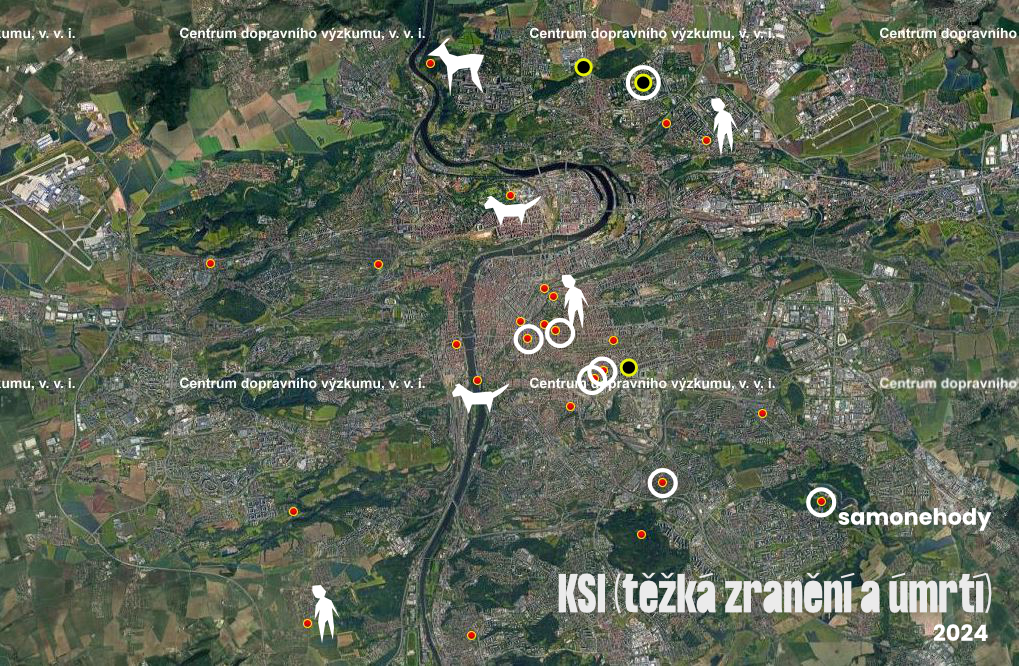
Due to the large number of accidents with serious or fatal injuries, we are not presenting these individual cases with commentary this year.
Compared to last year, the number of reported accidents involving scooters has increased, the vast majority of which involve electric scooters. Scooters now account for nearly a quarter of all recorded accidents involving non-motorized vehicles in Prague. Could the significant restriction or even complete ban of shared scooters substantially increase (at least according to accident statistics) safety in Prague’s streets? Based on official statistics, it’s not that clear-cut—more than half of the accidents (33 out of 65) involved private scooters.
Of the 65 electric scooter accidents last year, 30 were officially attributed to “motor vehicle drivers.” However, 8 of these were misclassified and were actually caused by scooter riders. So in total, scooter riders were responsible for 45 accidents. Of these, 22 were solo accidents, where the rider crashed or hit an obstacle. In 4 cases, the accident occurred near tram tracks (although only one is officially recorded as such).
In 23 cases, alcohol or drugs played a role—most often with blood alcohol levels above 1‰ (18 cases). However, only 12 of these involved riders of shared scooters (owned by private companies, per the statistics). A total of 16 of the intoxicated accidents occurred between 10 PM and 6 AM. Altogether, there were 26 intoxication-related accidents, which is over a third of all scooter accidents. Of these, 15 involved shared scooters. In total, shared scooters were involved in only 24 out of 67 recorded cases.
To draw clear conclusions, scooter-related analyses need more attention. The data is limited, and the error rate remains high—as seen in the misclassification of accident responsibility. However, it’s evident that banning shared scooters won’t eliminate all electric scooter accidents. On the other hand, restricting usage times or introducing drug and alcohol testing—as tested by companies like TIER abroad or currently used by Bolt in some countries—could help prevent the most avoidable incidents, likely including many involving shared scooters.
Interestingly, electric scooters collided with pedestrians only three times last year, according to official statistics. This does not downplay the real safety issues pedestrians face, especially in the city center. One of these incidents resulted in a serious pedestrian injury; two others resulted in minor injuries. None of these accidents occurred in Prague’s historic center—all three were located beyond the New Town ring road (beyond the North-South arterial road [Magistral – eds.]).
Accident statistics certainly suggest so. While in 2023 there were 54 accidents involving non-motorized vehicles with electric drive, this year the number has nearly doubled. A comparison chart clearly shows that solo accidents involving electric vehicles result in more severe outcomes than collisions with motor vehicles.
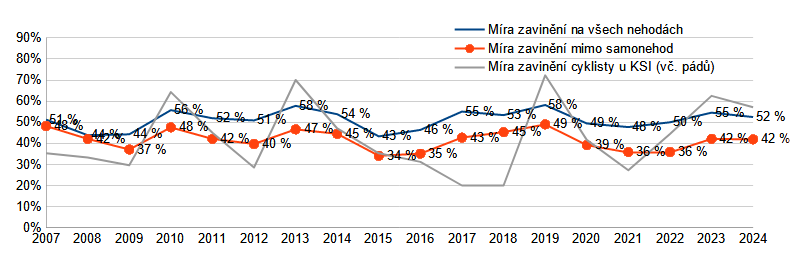
Even with the increasing number of people using bicycles for urban transportation, the fault rate has not increased. In fact, last year there was a very slight decline. In collisions with other road users (cars, trams, or pedestrians), the fault lay with the non-motorized vehicle user in 42% of cases. There was also a decline in accidents with serious consequences or fatalities, even though the total number of such serious incidents recorded by police was at a record high this year. In 30% of accidents caused by drivers of non-motorized vehicles, alcohol played a role—excluding single-vehicle accidents, the figure is 28%. That’s not a negligible number.
Twenty-five accidents involving non-motorized vehicle users resulted in serious injury, and three sadly ended in fatalities. One electric scooter rider died after a fall, likely on a separated path, under unspecified circumstances. Two others died in collisions with a large Tatra truck—both likely due to the drivers not noticing them at intersections. In Dolní Chabry, the accident was a classic „right hook“ (failure to yield when turning right), and in Vršovice, it occurred on a start from a relatively short cycle box.
Serious injuries to other road users
How dangerous a collision with a cyclist can be even for a motorcyclist is shown in one incident where the „more protected“ participant—on paper—ended up seriously injured. The accident occurred at the U Bulhara intersection, likely caused by a cyclist emerging from a tram tunnel. A similar but even worse accident happened this April near Dolní Chabry. A motorcyclist died after colliding with a female cyclist.
Five pedestrians were seriously injured in incidents involving distraction, failure to yield at pedestrian crossings, and two younger individuals riding together on a single electric scooter.
Animals
Four-legged participants also played a notable role in serious accidents last year. There were two cases involving dogs (plus one additional dog-related accident without injuries), and in another incident, a cyclist collided with a deer. Yes, even Prague has forests—such as the Bohnice Valley. But now, back to the city.
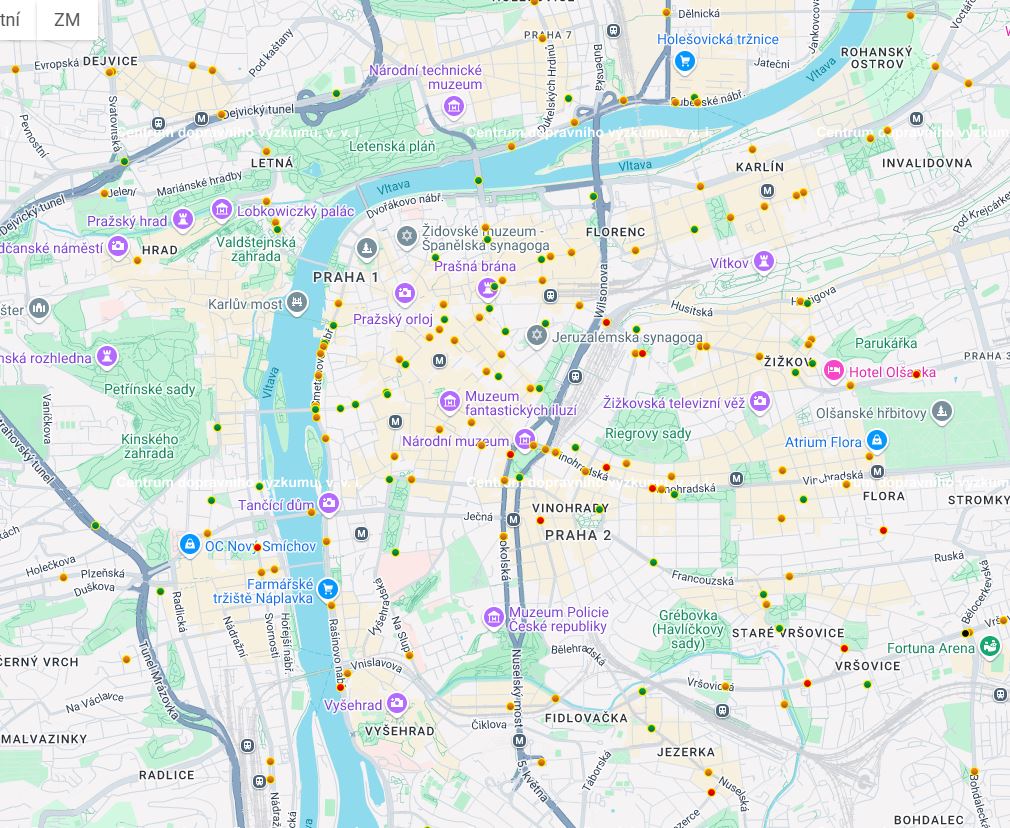
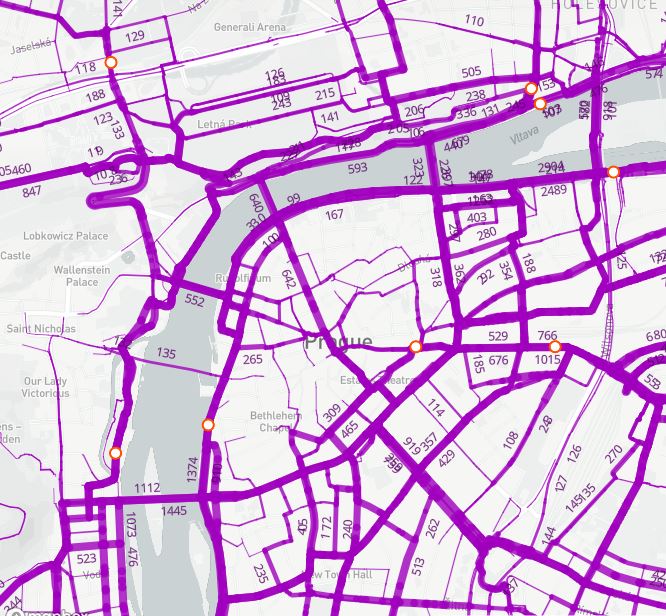
Do you remember when the revitalization of Smetana Embankment started in 2022, introducing the first-ever Danish-style lane that also allows motor vehicle parking? Do you remember how often politicians have promised to give Smetana Embankment back to the people? The accident map is so full of dots that the name is barely readable. A similar pattern appears on the connecting Hradební Corso, which reflects how many people on bikes and scooters pass through daily. However, the level of safety in these areas does not match this usage—a mere 200 meters of a one-way separated bike lane doesn’t make much of a difference.
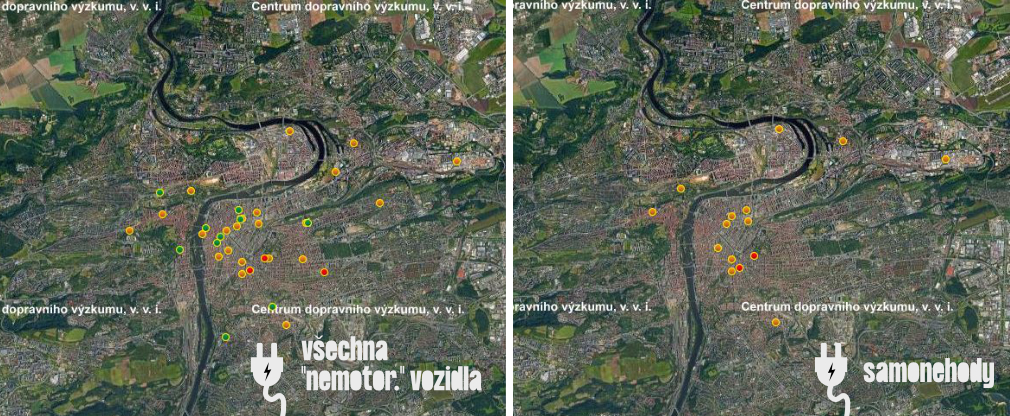
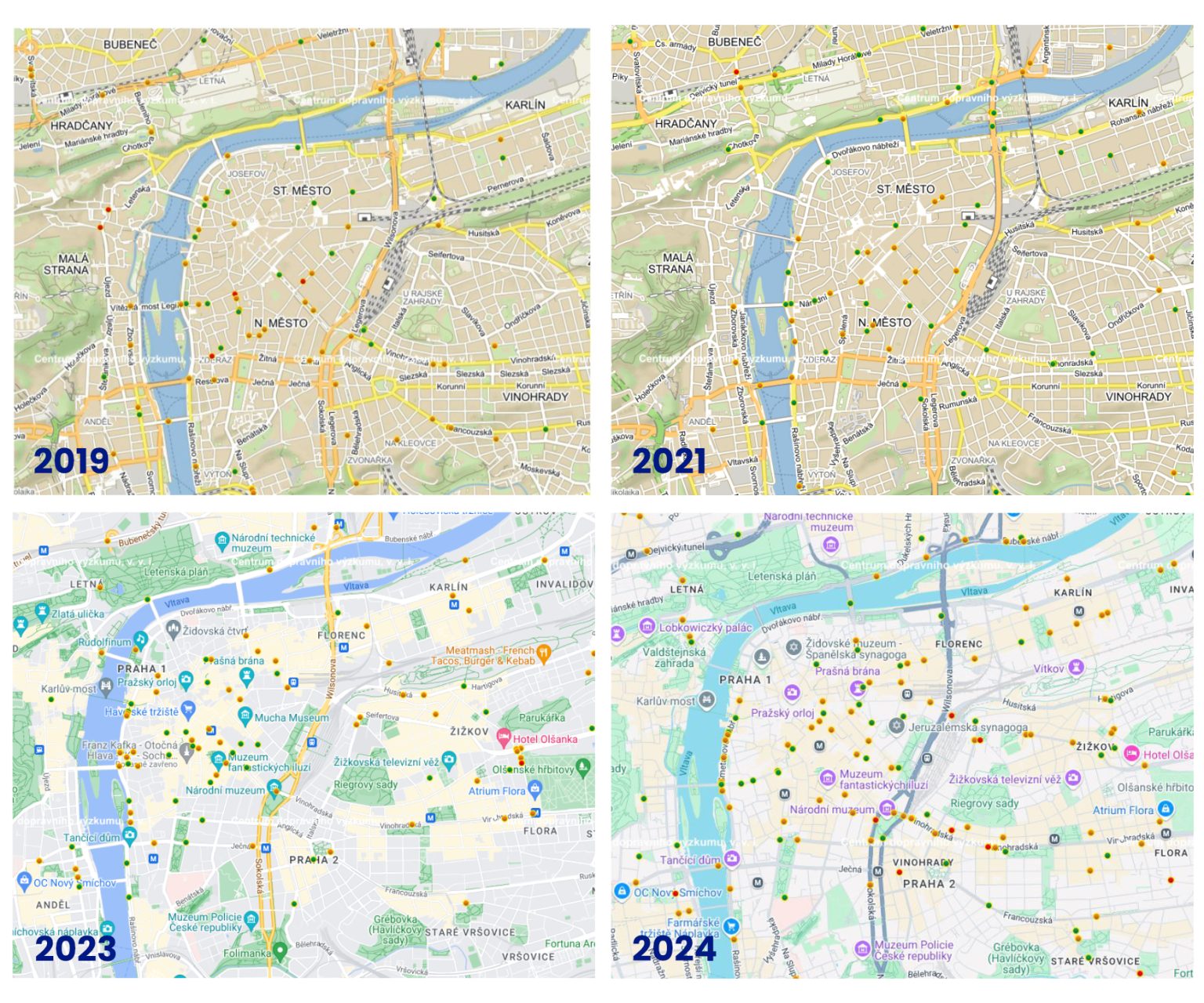
What kind of accidents happen in central Prague? For the second year, we are presenting a map showing the distribution of collisions with pedestrians, single-vehicle crashes, accidents involving alcohol or drugs, and incidents with shared bikes or scooters. This year, scooters (the yellow checkmarks) were added to the map. Judge for yourself.
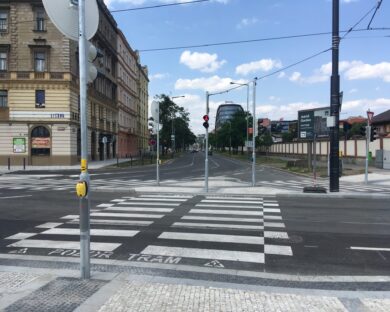
This year’s statistics confirm what our colleague Michal Šindelář noted in a study of self-reported accidents: apart from alcohol, tram tracks and the surfaces around them significantly contribute to crashes involving bikes and scooters. Bicycles crash more frequently than scooters on them (14 vs. 7), although this is a rough estimate from the accident map.
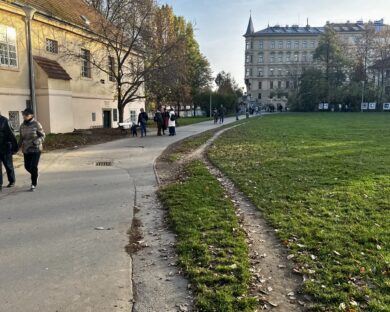
A total of 25 pedestrian collisions were recorded, with 17 caused by cyclists. In 10 cases, the crash occurred on the sidewalk (8 caused by non-motorized vehicle drivers). One resulted in serious injury—a cyclist on an e-bike, reportedly distracted, hit a 15-year-old boy in front of a residential building and fled the scene. This is an isolated case, but it’s important to highlight, especially as riding on the sidewalk is prohibited unless explicitly permitted by signs.
Extra caution is needed on electric bikes, even in shared traffic spaces, since they are usually heavier and therefore more dangerous. Last year, 8 electric vehicles were involved in pedestrian collisions, matching their overall share in non-motorized vehicle accidents.
Watch out for children
Three of the pedestrian victims in sidewalk or shared-path collisions were under 5 years old. This highlights the fragility and unpredictability of young children, who need safe space in the city.
Brief look at pedestrian accidents
For comparison, there were 445 pedestrian collisions in Prague last year. 73 resulted in serious injuries, and 8 pedestrians were killed. In 30 serious cases, the pedestrians were at fault; in another 29, motorists failed to yield at marked crossings. In total, 9 children under 10 were injured at pedestrian crossings due to drivers’ failure to yield.
The analysis was made possible thanks to the supporters of the AutoMat association. If you’d like to support their independent and systematic work, please consider donating. Thank you very much.
This is an adjusted machine translation using Automat’s CycleLingo Translator (ChatGPT) of this article: https://mestemnakole.cz/2025/05/cyklonehody-v-praze-2024-vice-nehod-i-vice-chyb-v-datech/
Líbil se Vám článek? Chcete v Česku lepší podmínky pro cyklodopravu?
Podpořte nás, stačí i 100 korun. 💙🚲
Vyberte prosím částku, poté budete přesmerováni na darujme.cz

![Number of accidents involving bicycles, scooters, and other non-motorized vehicles in Prague [dark blue = deaths; red = serious injury; yellow = light injury; light blue = no injury - eds.] Zdroj: AutoMat, 2025](https://mestemnakole.cz/app/uploads/2025/05/pocty-nehod.png "Number of accidents involving bicycles, scooters, and other non-motorized vehicles in Prague [dark blue = deaths; red = serious injury; yellow = light injury; light blue = no injury - eds.] Zdroj: AutoMat, 2025")
![Number of accidents involving bicycles, scooters, or other non-motorized vehicles in Prague – Trend of accidents with injury [= yellow line - eds.] Zdroj: AutoMat, 2025](https://mestemnakole.cz/app/uploads/2025/05/nehody-se-zranenim-24.png "Number of accidents involving bicycles, scooters, or other non-motorized vehicles in Prague – Trend of accidents with injury [= yellow line - eds.] Zdroj: AutoMat, 2025")





komentář