Since last Autumn there has been a second Viennese tram/bike stop in Czechia. Coincidentally, both are located in Prague, one being the Krymská tram stop and the other Čechův most. But how should one properly behave at these stops? Let’s take a look.
Firstly, it’s important to note that the behavior of cyclists at a Viennese tram/bike stop should not differ from that at a classic Viennese stop. A Viennese stop is colloquially referred to as a stop with an elevated platform, over which a regular roadway passes. When a tram stops at the stop, its vehicles let passengers get off and on. Unlike a classic roadway exit, however, the stop allows barrier-free access to trams or buses, making travel easier for people with large luggage, strollers, or limited mobility. In the cycling variant of the Viennese stop, the platform is only ridden over by bicycles, while for other vehicles, the stop functions like a classic raised platform that cars go around.
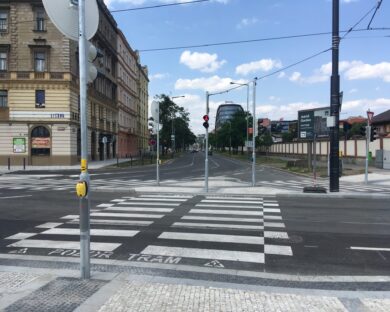
Upon approaching the stop, you will see a vertical traffic sign IJ4(c,d,e) indicating a tram, bus, or trolleybus stop. On the raised roadway, there will be horizontal markings V11a or V11b in yellow or white. That is, a yellow or white zigzag with the word TRAM or BUS at the entrance.
Whether it’s a classic Viennese stop or a Viennese tram/bike stop, the procedure is always the same. You ride through the stop on the roadway, not deviating into the passenger area or onto the sidewalk or anywhere else where cycling is not permitted. If there is no tram or bus at the stop, you can continue as usual. The passage is governed by paragraph number 15 of the Road Traffic Act (No. 361/2000 Coll.).
This states that at a stop without a boarding island, one must stop behind the public transport vehicle that has stopped at the stop. You may continue driving only when you no longer endanger passengers who are boarding or alighting.
In principle, the safest practice is to wait until the tram or bus starts to leave the stop. Some modern public transport vehicles may have, for example, automatic door opening/closing buttons, including the possibility of re-opening if the vehicle is still at the stop. Thus, for instance, it cannot be entirely relied upon that no passengers will suddenly alight after the doors have closed.
„Behind a public transport vehicle that has stopped in a municipality at a stop without a boarding island or without a platform on an elevated tramway strip, the driver of another vehicle must stop; if there are multiple public transport vehicles at the stop, they must stop behind the second one. They may continue driving only when they no longer endanger passengers who are boarding or alighting. This does not apply if a bus or trolleybus stops at the edge of the roadway.“
Source: § 15, Act No. 361/2000 Coll.
Passengers of urban public transport should behave similarly to when they are waiting at a stop on the roadway. That is, wait for the arrival of a bus or tram off the roadway, where vehicles, including bicycles at the Viennese tram/bike stop, pass through. Everything is governed by paragraph number 49 of the Road Traffic Act, which states that passengers may enter the roadway only after the public transport vehicle has stopped at the stop.
„A person waiting at a public transport vehicle stop may enter the roadway at a stop without a boarding island only after the public transport vehicle has stopped at the stop.“
Source: § 49, Act No. 361/2000 Coll.
Especially at Viennese tram/bike stops in Prague, where bicycle traffic rarely reaches very high intensity, passengers might unknowingly wait in the bike lane due to a lack of knowledge. Although the stop should ideally distinguish the roadway from the waiting area not only with horizontal markings but also with different materials (typically paving in the waiting area versus asphalt in the roadway/bike lane), it’s still a novelty and not every passenger may be familiar with it. In such cases, it’s appropriate to alert pedestrians of your approach on a bicycle from a greater distance by ringing a bell. It’s definitely not a solution to ride into waiting passengers or to endanger or be vulgar towards them in any way. Weaving between other passengers is also not appropriate. Mutual consideration and politeness are essential.
In Prague, passengers are now newly alerted to Viennese tram/bike stops (along with all other stops with exits onto the roadway) by an announcement in public transport vehicles upon arrival at the stop stating: „exit onto the roadway“ following the announcement of the stop name. As Aneta Řehková, the spokesperson for the Prague Public Transit Company, adds for the magazine Městem na kole, the addition of this announcement was primarily based on feedback from blind and visually impaired passengers.
„During discussions about adding the announcement, both its ‚intrusiveness‘ and its benefits for various groups of passengers were considered. The announcement is not primarily intended for passengers with limited mobility but for all passengers whose assessment of the current traffic situation after exiting the tram might be somehow limited (for example, due to poor hearing, sight, or in the case of small children who often run out of the vehicle without looking around),“ adds spokesperson Řehková regarding the new feature.
Viennese tram/bike stops address two problematic situations. They are placed in locations where it is not suitable for cyclists to share the road space with motor traffic and also in places where there isn’t enough room, or it’s otherwise inappropriate, for a standard detour around the stop in the form of a cycle path.
The effort to separate cyclists‘ passage from motor traffic mainly occurs in places where there’s a significant difference in speeds between cyclists and other traffic (for example, on uphill stretches), or in areas with high motor traffic frequency. Crossing tram tracks is always a risky maneuver, especially in wet conditions, so there’s an effort to minimize track crossings wherever possible, especially in heavily trafficked areas where it’s difficult for cyclists to slow down significantly.
Instead of a standard detour, the Viennese tram/bike stop is chosen primarily in confined locations, where its spatial requirements are usually somewhat smaller than those of a classic detour behind the stop. It can also be a suitable solution in situations where the corridor for cyclists continues in the form of a bike lane before and after the stop. That is, in places where the Viennese tram/bike stop reduces the number of conflict points between passengers and passing bikes.
There are several reasons why there are currently only two Viennese tram/bike stops in the Czech Republic. First and foremost, there is a lack of experience, so there are still concerns about whether all participants will understand the rules of their operation. Concerns about whether passengers will wait off the roadway, or whether cyclists will indeed stop behind the tram or bus, are often expressed when the possibility of implementing these stops is discussed.
In the case of the criticized Brno tram stops at Zvonařka, Brno spokesperson Anna Dudková told Městem na kole that the implementation of Viennese tram/bike stops did not occur due to concerns about passenger safety: “The transfer of cyclists directly over the boarding edge of the stop (the so-called Vienna type) here was rejected with regard to the safety of alighting and boarding passengers.”
At least in Prague, the unsuitability of these stops from the perspective of people with visual impairments or blindness was most discussed. This was not only a remark against Viennese tram/bike stops, but against Viennese stops in general. In an interview for Městem na kole, František Brašna from the United Organization of the Blind and Partially Sighted of the Czech Republic (SONS) described that for the blind, it is challenging to recognize that they are in the roadway and not on a boarding island after alighting from a tram or bus at Viennese stops.
Part of these difficulties is addressed by the newly introduced announcement in Prague when exiting trams, buses, or trolleybuses. In other cities, such as Olomouc, similar announcements upon exiting onto the roadway have been in place for a longer time. It is therefore a question to what extent similar changes will support the implementation of more Viennese-type bike stops, especially in corridors of main or superior bike routes. In Prague, the possibility of implementing more Viennese tram/bike stops is being discussed, for example, during the planned reconstruction of the uphill section of Vinohradská Street.
This is an adjusted machine translation using Automat’s CycleLingo Translator (ChatGPT) of this article: https://mestemnakole.cz/2024/02/navod-jak-bezpecne-na-videnskou-cyklozastavku/
Líbil se Vám článek? Chcete v Česku lepší podmínky pro cyklodopravu?
Podpořte nás, stačí i 100 korun. 💙🚲
Vyberte prosím částku, poté budete přesmerováni na darujme.cz