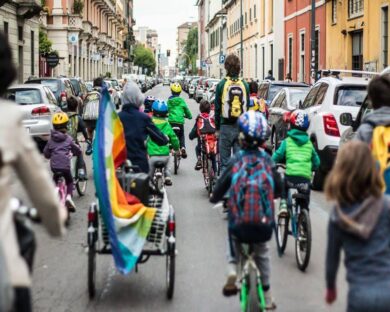
Riding safely in traffic is an essential cycling skill in cities with insufficient infrastructure. The following guide summarizes the most important actions. In addition to safe driving in traffic, considerate driving among pedestrians is also essential.
We always pass pedestrians in such a way as not to endanger them, and if possible with a distance of at least one meter. Pedestrians being approached from behind should be alerted by the bell from a greater distance (20-30 meters) and one should slow down. It goes without saying that you say thank you when you pass. In the pedestrian zone and on the sidewalk where cyclists are allowed, you must pay extra attention to pedestrians and, if necessary, stop.
It is not advisable to stick too close to the curb or parked cars. The key is to keep a margin of at least three quarters of a meter from the kerb – this allows you to avoid ditches and the mess at the edge, while also giving you room to swerve if a careless driver overtakes you too closely.
Add a distance along the parked cars. Continuously parked cars create a so-called „door zone“ into which anyone sitting in the car can suddenly open the door. Very heavy traffic can get you closer to parked cars. Move away from cars when going downhill fast. Do not hide in the gaps between parked cars, you will have to return to the lane very soon anyway.
Lane blocking protects against dangerously close overtaking. It makes sense where drivers are not supposed to overtake anyway, because they would endanger the cyclist. In particular, this applies to roundabouts (except for the largest ones) and one-way lanes narrower than approximately 3.5 meters, for example along tram islands. Lane blocking needs to be done early, clearly (ie with a show of hands), and one should go back to the right as soon as safe overtaking is possible, so you don’t do more harm than good. It is not safe to occupy a lane where cars are traveling more than 50 km/h.
A direct left turn requires the following procedure:
At intersections with multiple lanes, do not hesitate to take the turning lane, it is safer for you.
If the intersection is too big for you, it will be better to turn indirectly. The procedure is as follows:
While waiting at the intersection, you must not obstruct passing cars. Check the unknown intersection in advance and, if necessary, guide the bike through the transitions.
At roundabouts, drive through the center of the lane, which you must join before the intersection. This does not apply to large roundabouts, which are more like expressways. Here, keep to the classic right.
As cyclists, you have nothing to do on the pavement. But if there is no bearable driving in traffic and you do go on the pavement, it is necessary to behave with the utmost consideration and always be ready to jump off the bike and lead it. Riding on the sidewalk is a bad habit that you should get rid of as much as possible over time. By driving on the road you will only gain. You have the right of way on the road, you can pass large intersections there.
Drive on the road in quiet streets. Behave predictably and indicate the direction of the turn. Look back when turning left. Calm or quiet streets are suitable for off-pavement riding, even for riders with absolutely basic skills. There are so few cars that anyone passing you will have a space in the opposite direction. You can drive on the road without any problems in places where there are almost no buses and trucks and where it is clear thanks to the small number of parked cars.
Unless you have sufficient skills, it is not safe to drive on a road where the traffic is too heavy or fast for each car to pass you separately safely. But the sidewalk is only an option if it is wide enough and there are a minimum number of people walking on it. As soon as you drive between the houses, consider walking on the sidewalk. You have to carefully pass pedestrians, cross entrances, driveways, parked cars, gardens, pillars, side streets. So after all, isn’t it worth riding on the road?
If the sidewalk is crowded and you don’t want to run into traffic, don’t be shy to get off your bike and lead it.
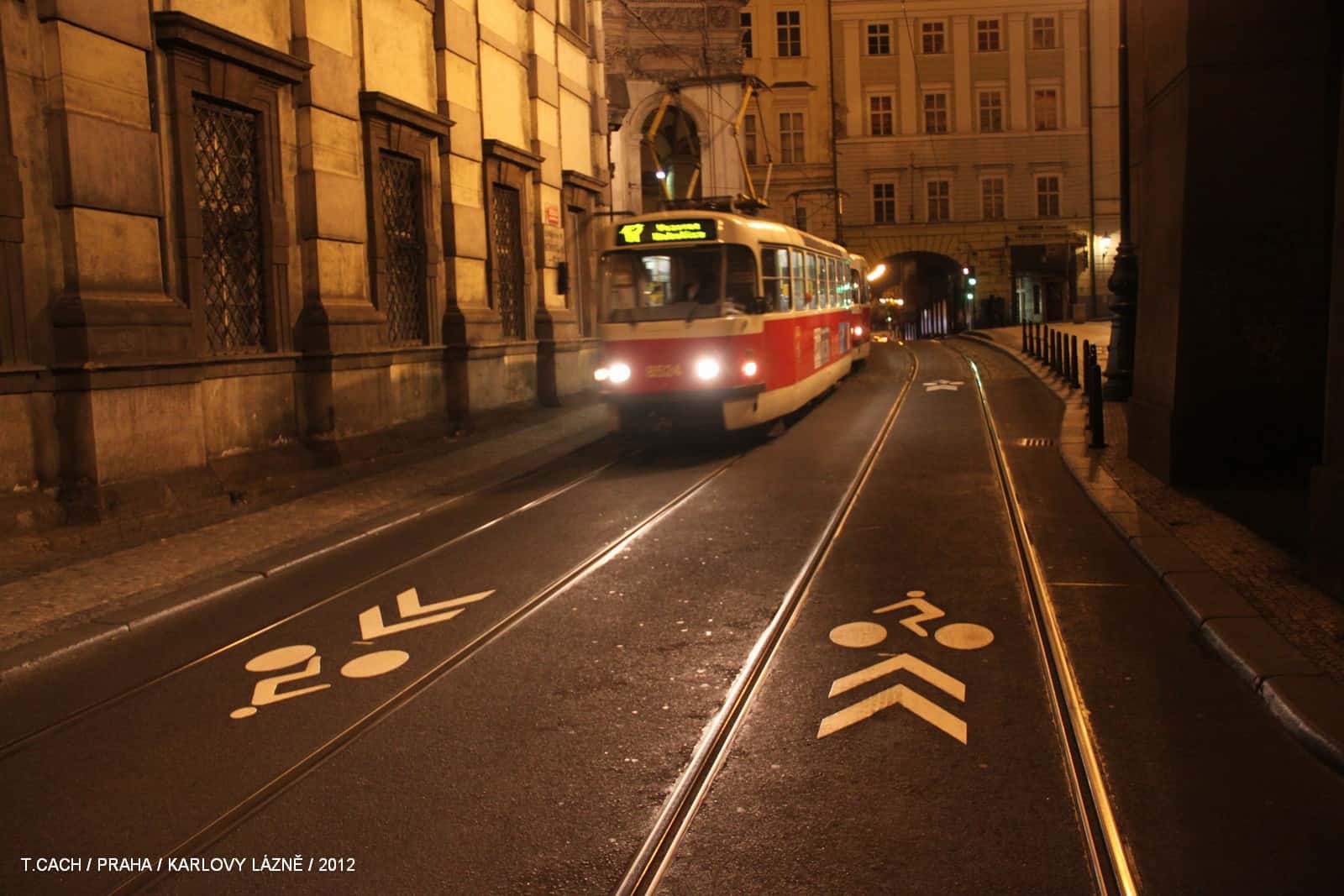
In the cycle lane, ride in its left part, above the center of the cyclist pictograms. Along the parked cars, they are placed further to the left to maintain the distance from the door zone. When the cycle lane ends, you continue riding along with the cars. The driver must not endanger a cyclist exiting the ending of a cycle lane.
Go around cars obstructing the cycle lane well in advance, don’t forget to signal the change of direction with your hand in time. If there is not enough space, take the lane when overtaking. The fact that someone parks in a bike lane is really not your fault.
Approach the waiting area in front of the traffic lights carefully. If you are the first, if possible, line up directly in front of the driver of the vehicle behind you so that he can see you and make room for other cyclists.
Avoid a „right hook“, i.e. a situation where a car first overtakes you and then turns right. When driving faster, increase the lateral distance from the edge. If you have dynamo lights, turn it on during the day. Don’t forget the rear flasher in the dark. If you’re riding on the bike path, watch out for cars that might turn at bicycle crossings. Even parked cars or advertising panels can obstruct mutual visibility here! At regular roundabouts, drive in the center of the lane.
Avoid not giving way from a side street or when turning from the opposite direction. It is good to have the front blinker permanently on, the front reflector is not enough in the dark. If you see a car behaving suspiciously in front of you at the intersection, you can temporarily take over the lane.
Be aware of blind spots where truck or bus drivers can’t see you, even if you have the right of way. Before the intersection, do not try to overtake waiting large vehicles and in no case stop in the same lane next to them.
If you cannot fit to the right of the tram tracks so that you still have at least half to three quarters of a meter reserve for maneuvering, drive in the middle of the lane between the tracks.
Learn emergency maneuvers: effective braking, emergency swerving, jump over a hole.
This is a Google translation of this article: https://mestemnakole.cz/navody/v-provozu/
Líbil se Vám článek? Chcete v Česku lepší podmínky pro cyklodopravu?
Podpořte nás, stačí i 100 korun. 💙🚲
Vyberte prosím částku, poté budete přesmerováni na darujme.cz