
For daily city trips, a carrier and a city bag for work essentials are sufficient. Even on a regular bike, you can transport a decent amount of groceries with the help of bags. If you need to transport larger loads more frequently or combine it with carrying children, you can consider a cargo bike. Their range is wide: from bikes with slightly extended carriers to three- or four-wheeled cargo specials belonging to logistics companies. Let’s start from the beginning, the following guide will help you with the basics.
The carrier is essential. City bags attach to it from the side and can be easily removed and slung over your shoulder like a regular bag. Special padded bags are made to protect your daily transported laptop, but inserting your computer into its own sleeve works just as well. Higher-quality products guarantee water resistance and tear resistance.
If you’re not interested in special bags, you can hang a basket on the side or place it on top of the carrier. And then put your bag in it. If you don’t want a carrier at all, a messenger bag on your back is suitable for short trips with few items. For larger purchases, there are side bags with a volume of over 20 liters.
A front carrier can be used if you need extra space or have a child seat at the back. You can also place a basket on the handlebars. Carriers or baskets hung on the handlebars have a load capacity of about 5 kg. Carriers leaning on the front fork can carry around 20 kg. A front carrier connected to the frame eliminates the disadvantage of poor maneuverability when fully loaded.
For medium-sized loads, you can use a cargo trailer. It attaches either to the seat post or the rear hub. Small two-wheel trailers are light, foldable, and can carry up to 50 kg. The size of the cargo trailer or its width is not limited, so you can practically tow anything behind your bike.
An extended carrier allows transporting loads over the usual 30 kg, larger children or even adult passengers. By moving the rear wheel back, longtails are created, with a loading area of 80 cm to a meter. There are special bags and accessories available for longtails that allow carrying even long boxes, sets of skis or surfboards. Two children can easily sit in seats on the long carrier without any problems. The center of gravity of the load is sometimes lowered by using a smaller rear wheel.
By extending the carrier in the front and reducing the front wheel, a „bakery“ bike is created, generally called the Short John, with a loading area allowing for a regular crate. In the Czech Republic, the common two-wheeled cargo bike Long John is also created by shifting the front wheel forward and placing the crate between you and the front wheel. In its lightweight electrified form, courier services often use it. Due to its small width (less than 60 cm), it is possible to ride them even in heavier traffic without bike lanes, but it requires good mastery of riding technique. Long Johns equipped with a crate and seats are also popular in the USA for transporting children (they can accommodate 2-3 children with shopping).
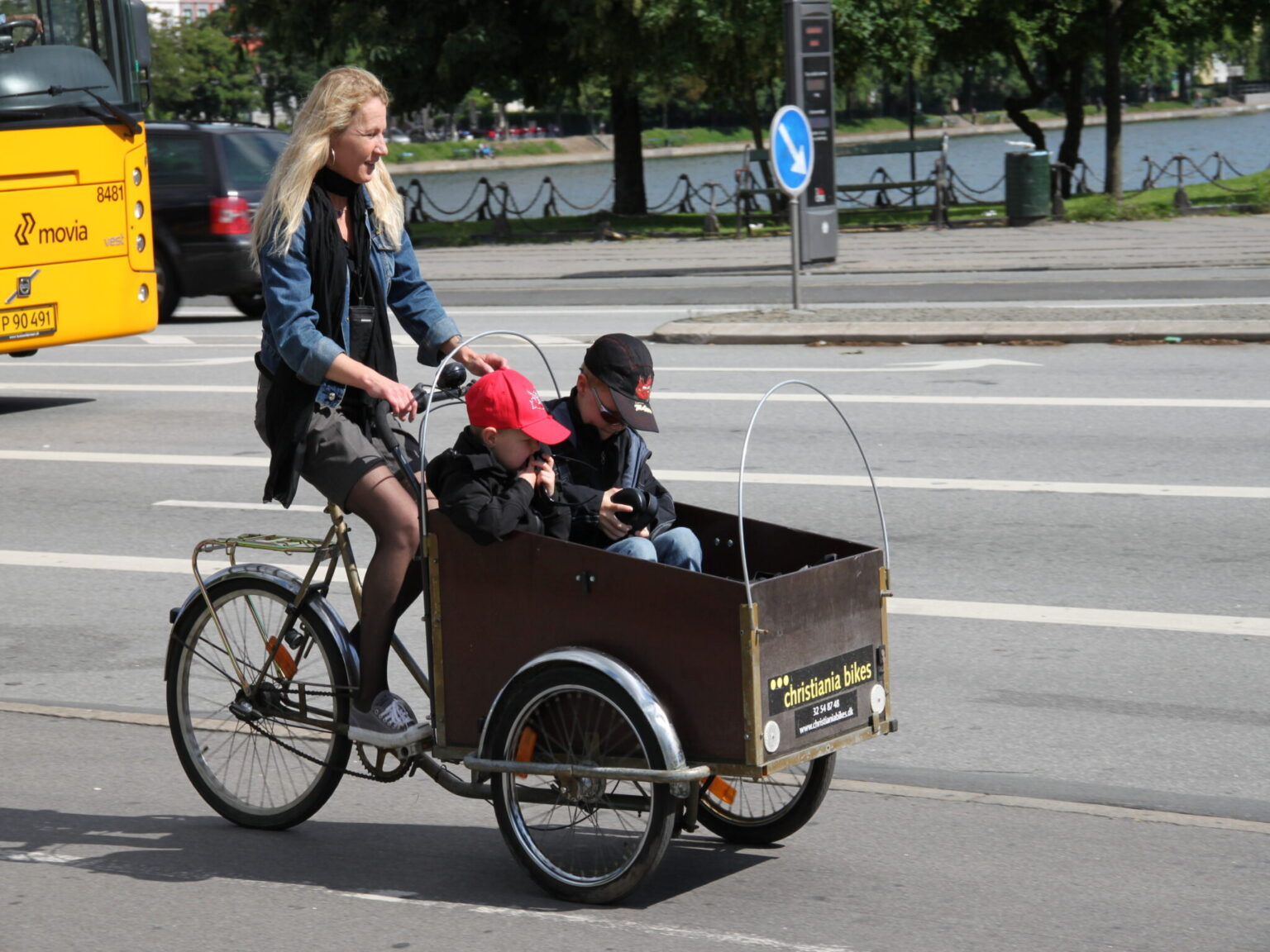
Three-wheelers with a load in the front (sometimes called „Christianias“ after the Danish model) are more stable than two-wheeled cargo bikes, especially at low speeds. However, they are usually wide, between 90 and 120 cm, which complicates driving in heavy traffic. The driver turns the entire box in front of them using a handle. Three-wheelers are popular in Denmark and the Netherlands as family bikes for transporting children. There are also four-wheeled cargo bikes designed for either transporting larger loads or more children.
Cargo bikes are more expensive than ordinary bikes and often have a more robust construction. They have become increasingly electrified in recent years. In recent years, specially designed electric longtails for uncompromising family mobility have appeared. Their purchase price is comparable to that of a used car.
Law no. 361/2000 Coll. on road traffic allows for children under 7 years of age to be transported on a seat with footrests or in a trailer attached to a bicycle (with no age limit). Cargo bikes are not regulated by law.
Child seats are the most accessible means of transporting children between approximately 1.5 and 7 years old. The most common type is a seat on the seatpost. Rear seats on the carrier are not as comfortable, but they lower the center of gravity. Rear seats take up the carrier, so cargo needs to be handled differently. Front seats on the frame are intended for younger children (approximately up to 5 years old). There are also seats on the handlebars, which are suitable roughly up to 4 years old and are supplemented with a windscreen. However, it still applies that in cold weather, the child must be properly dressed and possibly wrapped in a blanket. The disadvantage of child seats is the difficulty of getting on and off.
Child trailers are stable and practical, suitable for 1-2 children from approximately 3 months of age. It is practical to keep the width of the trailer below 80 cm. The advantage of the trailer is comfort even in bad weather. Trailers are very safe, as the frame of the trailer protects children from above. However, the trailer is not suitable for riding in heavy traffic, where children in the trailer are practically at the height of exhaust pipes.
Cargo bikes allow for children to be transported either on the carrier of a longtail or in a box, which is equipped with seats, seatbelts, and can be supplemented with a roof against rain.
The longtail is operationally the closest to a regular bike. With a two-wheeled trailer or cargo bike, you must watch the width of the passage, especially in turns. All two-wheeled cargo bikes must be kept balanced, as you may not be able to handle a larger tilt with a heavier load. On a tricycle, you must lean inward to make turns, but starting and stopping are more comfortable. For an unfamiliar cargo bike, try it out without a load first.
Cargo bikes are difficult to carry and are often parked on the street for extended periods. This certainly means the highest quality lock or a sturdy chain and covering the cargo area with a roof or tarp.
This is a ChatGPT translation of this article: https://mestemnakole.cz/navody/cargo/
Líbil se Vám článek? Chcete v Česku lepší podmínky pro cyklodopravu?
Podpořte nás, stačí i 100 korun. 💙🚲
Vyberte prosím částku, poté budete přesmerováni na darujme.cz




Nightrider 15. 4. 2025, 17:06
Correction: trailer width is limited to 90 cm by law.
Bike width is generally not limited, but there are quite a few zones in Prague with local limit of 1.2 m.